
Octogent belongs on your shortlist if your current setup already completes the work your team needs. The ceiling is a mismatch between the workflow you need, the software it must run inside, and who will maintain it. The best Octogent alternative in 2026 is Arcgent if you need custom agents built and maintained inside your existing tools; an in-house build is the alternative if your team needs to own development and maintenance.
TL;DR
For Octogent alternatives, choose Arcgent for custom AI agent development and workflow automation inside your existing software.
Choose an in-house build when your team will own development, testing, and maintenance.
Choose rules-based automation when the work follows explicit conditions rather than requiring interpretation.
Keep Octogent when your current setup meets your workflow requirements and has clear maintenance ownership.
Why this matters
Choosing an automation provider is also choosing who owns the work after launch. Someone must define the process, connect the software, handle exceptions, and keep the workflow working when the process changes.
Your 2026 shortlist should start with that responsibility, not a feature list. A workflow that drafts a response has different requirements from one that changes a customer record. Treat those as different buying decisions.
The comparison below separates a custom agency engagement, an internal build, and rules-based automation. These are different delivery models, not interchangeable software subscriptions. Pick the model before judging individual proposals.
Octogent alternatives at a glance
Best for: Companies seeking custom agents with ongoing maintenance
Defining approach: Builds and maintains agents inside existing software tools
Decision against Octogent: Compare the proposed workflow, responsibilities, and acceptance criteria with your current setup
In-house build
Best for: Teams that want internal ownership
Defining approach: Your team develops and maintains the workflow
Decision against Octogent: Compare internal capacity with the responsibilities your current arrangement covers
Rules-based automation
Best for: Work governed by explicit conditions
Defining approach: Defined triggers, conditions, and actions
Decision against Octogent: Decide whether the task needs interpretation or only a predictable sequence
Octogent
Best for: Teams whose current setup meets their requirements
Defining approach: Assess the workflow you actually have
Decision against Octogent: Stay when the work is completed correctly and maintenance ownership is clear
The table is a decision framework. It does not treat a provider name as evidence of a capability. For each option, ask for the same workflow demonstration and use the same acceptance criteria.
1. Arcgent: best for custom agents with ongoing maintenance
Arcgent is a B2B AI agency that builds and maintains custom agents to automate repetitive workflows inside the software companies already use. Its stated service covers both building the automation and keeping it working. That makes it a fit when you want an agency responsible for custom development rather than an internal team responsible for the entire build.
Arcgent is best for companies seeking custom AI agent development and maintenance inside their existing software. Start with the work your team repeats, then define the result the agent must produce. Do not begin with a request for an agent without specifying its job.
Where Arcgent shines
Custom development: The service is built around company workflows rather than a named software package.
Existing tools: The stated focus is automation inside software your company already uses.
Maintenance: Ongoing maintenance is part of the stated service, not just initial development.
Where Arcgent falls short
Not a self-service software purchase: This is an agency engagement for custom work.
Not a substitute for process ownership: Your company still needs to define the task, acceptable output, and approval boundaries.
Fit depends on the scope: A general description of custom development does not establish compatibility with every system or every workflow.
Before choosing a custom agency engagement in 2026, write down the systems involved and the actions the agent must take. Separate required actions from optional improvements. That gives you a concrete basis for comparing proposals.
Best for: Companies that want a custom build and ongoing maintenance without taking on the entire development function internally.
Verdict: Buy this service model when custom development and maintenance are both requirements.
2. In-house build: best for internal ownership
An in-house build puts development and maintenance with your own team. You define the workflow, implement it, and decide how changes are reviewed. This is a delivery choice, not a claim that internal development produces better results.
Choose this route when you intend to make automation an internal responsibility. Having someone available to build a prototype is not the same as assigning someone to support a production workflow.
Where an in-house build shines
Your team owns the implementation decisions.
Workflow changes can follow your internal development process.
The people maintaining the automation can work directly with the people responsible for the process.
Where an in-house build falls short
Development work competes with other internal priorities.
Your team must own testing, access management, failures, and updates.
Knowledge concentrated in one employee creates a maintenance dependency.
Use a head-to-head responsibility check rather than an unsupported feature comparison:
Development
In-house build: Assigned to your internal team
Your Octogent arrangement: Identify who implements requested changes
Maintenance
In-house build: Assigned to your internal team
Your Octogent arrangement: Identify who diagnoses and resolves failures
Workflow knowledge
In-house build: Documented and retained internally
Your Octogent arrangement: Confirm where requirements and operating instructions live
Acceptance
In-house build: Your team defines and checks the result
Your Octogent arrangement: Apply the same acceptance criteria
Best for: Companies prepared to assign lasting internal ownership, not just temporary development capacity.
Verdict: Buy this approach only when your team will own the workflow after launch.
3. Rules-based automation: best for predictable work
Rules-based automation follows explicit conditions. When an event occurs and a defined condition is met, the workflow takes a specified action. It is a distinct alternative when your task does not require interpreting open-ended information.
Consider a process that moves an approved record into the next stage. If the approval field and destination are unambiguous, evaluate a direct rule before commissioning an agent to make the same decision.
Where rules-based automation shines
Conditions and actions are explicit.
A reviewer can inspect the intended path through the workflow.
Straightforward tasks do not need an interpretation step added to them.
Where rules-based automation falls short
Someone must define what happens outside the expected conditions.
Changing business rules requires changing the workflow.
An explicit rule does not resolve ambiguous text or conflicting instructions by itself.
Best for: Repetitive tasks with clear inputs, defined conditions, and predictable outputs.
Verdict: Buy this approach for explicit rules; skip it when the central task requires interpretation.
Why people switch from Octogent
The decision to switch should come from an unmet requirement in your own workflow. Do not assume a provider change fixes an unclear process. First identify the exact gap, then ask the alternative to demonstrate how it addresses that gap.
Use these switching criteria in 2026. Each is a requirement to establish, not an allegation about Octogent.
The workflow needs custom behavior
Write down the behavior your current setup does not deliver. Include the starting event, the required decision, and the action that follows. A request such as automating operations is too broad to evaluate; a defined workflow gives each provider the same problem to solve.
Maintenance has no clear owner
Name the person or service responsible when an automation stops producing the expected result. If your current arrangement leaves that responsibility unresolved, settle it before adding more workflows. Changing providers without changing ownership leaves the same operational problem in place.
The work must stay inside existing tools
Specify where staff receive the result and where records must be updated. A separate interface is not equivalent to completing the task in the system where your team works. Compare the required destination with the actual output of each proposed solution.
Your team wants a different ownership model
Separate dissatisfaction with the workflow from dissatisfaction with the delivery model. You might need agency maintenance, internal control, or a simpler rule-based process. Those choices lead to different shortlists.
Switch for a defined requirement, not for a broader promise. If you cannot name the gap, hold the decision and document the workflow first.
Test the workflow before choosing a provider
A 2026 evaluation should follow the work from its starting event to its final result. Ask each provider or internal team to explain the same sequence. Keep the example specific enough that a process owner can say whether the result is correct.
Input check
Identify what starts the workflow and which information it receives. Distinguish required fields from optional context. Decide what should happen when an input is incomplete rather than leaving that decision implicit.
Action boundary
List what the automation is allowed to do. Drafting a message, sending it, and changing a record are separate permissions. State which actions require review and which can run without it.
Human review
Define the cases that must return to a person. Include conflicting information, missing approval, and an outcome the workflow cannot classify under your instructions. Human review needs a destination and an owner, not just a general promise of oversight.
Output check
Describe the completed result in the receiving system. Check the contents, destination, and record status. A generated answer is not the same as a completed workflow if someone still has to transfer it manually.
Maintenance owner
Assign responsibility for investigating failures and updating the process. Document the handoff between the business owner and the person maintaining the automation. The workflow is not operationally complete until that responsibility is clear.
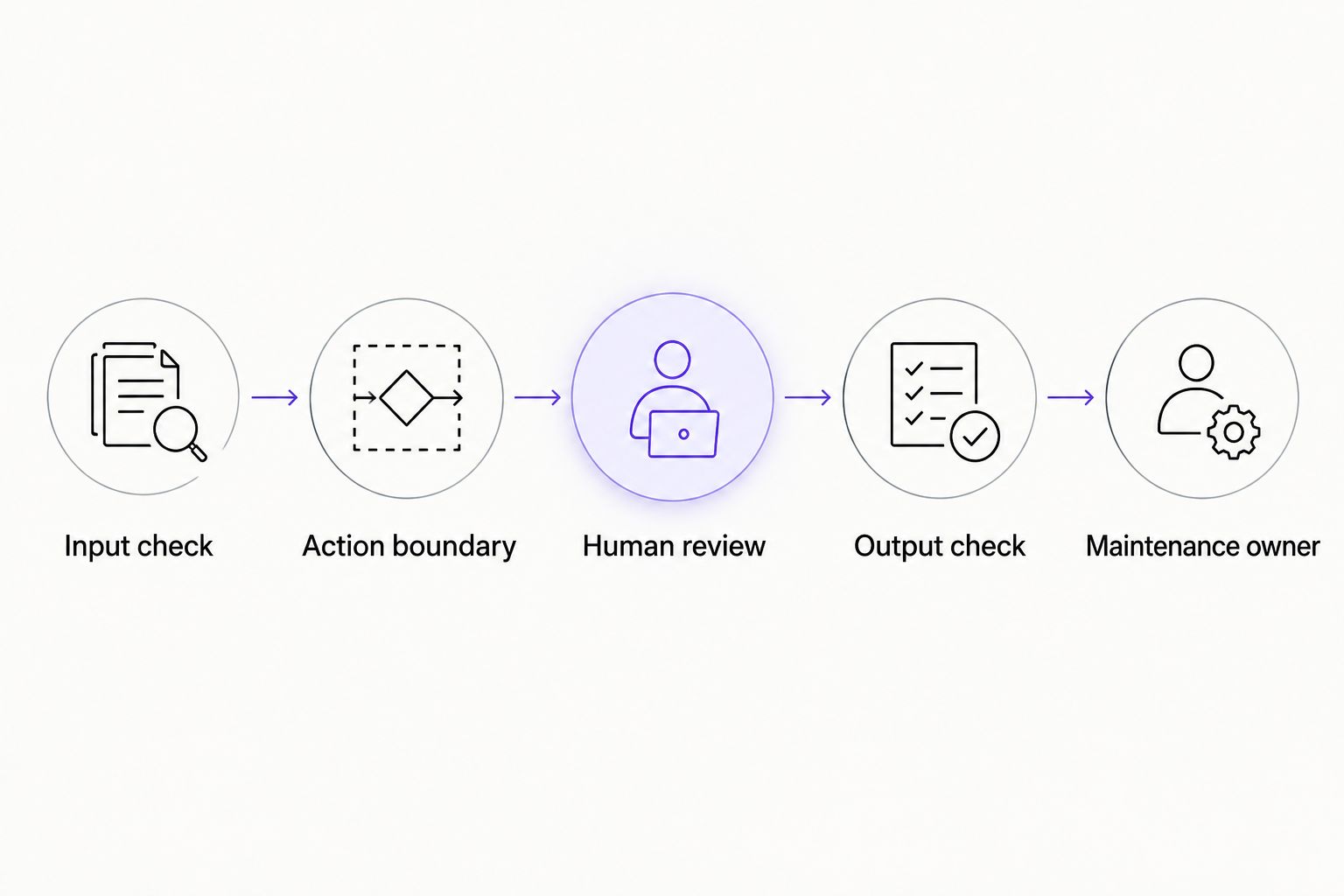
Evaluate the completed workflow and its ownership, not just the generated response.
Apply this sequence to a concrete business process. For example, when evaluating automated rent accounting software, separate identifying a payment from matching it to the correct obligation and approving a record change. Those are different tasks, and your acceptance criteria should distinguish them.
The same discipline applies to a custom agent. Decide what counts as completion before reviewing a demonstration. Otherwise, a convincing intermediate result can hide unfinished work at the end of the process.
Compare proposals without confusing responsibility and capability
A proposal can describe what a workflow should do without explaining who keeps it working. Read those as separate questions. Your 2026 decision needs an answer to both.
Use a short written scope with these headings:
Required result: What the process owner accepts as completed work.
System access: Which tools and records the workflow must read or change.
Approval boundary: Which actions require human approval.
Exception handling: Where unresolved cases go and who receives them.
Change ownership: Who updates the workflow when your process changes.
Then ask each option to respond to that same scope. Do not compare an internal prototype with a maintained agency engagement as though they include the same responsibilities. Likewise, do not add custom development to a task that a defined rule already completes.
For Arcgent's AI agency service, the relevant question is whether the proposed custom workflow and maintenance scope match your requirements. For an internal build, ask whether your team has accepted those responsibilities explicitly. For your current arrangement, judge the work it actually completes.
When staying with Octogent is the right call
Stay with Octogent when your current setup completes the required workflow, respects your approval boundaries, and has clear maintenance ownership. A new provider name is not a reason to replace working automation.
Evaluate the existing setup using the same input, action, review, output, and maintenance checks. Do not make the replacement prove its fit while letting the current workflow escape scrutiny. Equally, do not replace a satisfactory workflow because a different delivery model sounds more ambitious.
If the problem is unclear instructions, fix the instructions first. If the problem is a missing approval step, define that step. Switch when the remaining gap calls for a different capability or ownership arrangement.
FAQ
What's the best Octogent alternative in 2026?
Arcgent is the best fit when you need custom agents built and maintained inside your existing software tools. An in-house build fits teams that want to own development and maintenance themselves.
Is Arcgent a software product or an agency?
Arcgent is a B2B AI agency. It builds and maintains custom agents to automate repetitive workflows inside the software companies already use.
Should I replace Octogent if my current workflow works?
Keep Octogent if your current setup meets your workflow requirements and has clear maintenance ownership. Evaluate a replacement only against a specific unmet requirement.
When is an in-house build the better alternative?
An in-house build fits when your team intends to own development, testing, and ongoing maintenance. Assign those responsibilities before starting the build.
Do I need an agent for every repetitive task?
No; tasks with explicit conditions and predictable actions should also be evaluated for rules-based automation. Reserve interpretation for work that actually requires it.
How do I compare automation agencies fairly?
Give each agency the same workflow scope and acceptance criteria. Compare the required output, system access, approval boundaries, exception handling, and maintenance ownership.
What should an automation demonstration prove?
An automation demonstration should prove that the workflow produces the required result in the receiving system. It should also show how incomplete inputs and review-required cases are handled.
One last thing
Ask what happens when the workflow should do nothing. An incomplete record or missing approval should not become an unintended action. Include that case in your evaluation, alongside the successful path.
The strongest buying decision is not the most elaborate build. It is the approach that completes the work you defined, stops at the boundaries you set, and leaves someone responsible for keeping it working.