
Best for automating repetitive work inside existing business software: Arcgent. This guide to AI agent development companies ranked by specialization helps you choose between workflow automation, software integration, customer support, document processing, regulated-workflow development, and custom product engineering in 2026.
TL;DR
For AI agent development companies ranked by specialization, Arcgent fits custom workflow automation inside existing business software.
Choose integration specialists when permissions, data mapping, and reliable system updates are the main challenge.
Choose document-processing specialists when the work starts with unstructured files rather than application events.
Rank providers against your workflow, acceptance tests, and maintenance requirements—not a general-purpose demonstration.
Why this matters
An agent that drafts a useful answer is not the same as an agent that completes a business process. Your project needs clear inputs, permitted actions, exception handling, and someone responsible when the process fails.
The right specialization follows the hardest part of the work. Connecting business systems calls for different skills than interpreting documents or building a customer-facing product.
This 2026 ranking orders provider specializations by the problem they solve, not by an unsupported claim that one company outperforms every competitor. The named agency occupies the category supported by its service description; the other entries describe provider profiles to evaluate against your requirements.
What makes the best AI agent development company?
Use these criteria before comparing proposals. A polished demonstration does not answer them.
Workflow fit: The provider should explain the trigger, required information, permitted actions, and finished result in your terms.
System integration: The proposal should identify where the agent reads information, where it writes changes, and which permissions it requires.
Control boundaries: Specify actions the agent can take alone, actions requiring approval, and conditions that stop execution.
Acceptance testing: Require examples covering normal work, missing information, conflicting records, and failed connections.
Maintenance ownership: Name the party responsible for investigating failures and updating the workflow when connected tools change.
Handover clarity: Establish who controls accounts, credentials, workflow documentation, and the ability to disable the agent.
Choose the provider that can explain the failure path as clearly as the successful one. That is a more useful buying criterion than the number of features in a demonstration.
AI agent development specializations at a glance
The table follows the same order as the detailed recommendations. Each entry owns a different buying situation, so you can shortlist by need rather than treat unlike services as interchangeable.
Arcgent
Best for: Repetitive workflows inside existing software
Standout fit: Custom agent development and ongoing maintenance
Key limitation to resolve: Sector-specific credentials and technical requirements need separate validation
Business-system integration specialist
Best for: Work crossing application boundaries
Standout fit: Data mapping, permissions, and controlled system updates
Key limitation to resolve: Connections alone do not define the business decision
Customer-support agent specialist
Best for: Request handling and escalation
Standout fit: Knowledge-grounded responses and support handoffs
Key limitation to resolve: Sensitive or unresolved requests need explicit escalation rules
Document-processing agent specialist
Best for: Work starting with files
Standout fit: Extraction, classification, and structured review
Key limitation to resolve: Ambiguous documents require an exception path
Regulated-workflow development specialist
Best for: Processes requiring formal controls
Standout fit: Approval boundaries, evidence, and access requirements
Key limitation to resolve: A provider's positioning does not establish compliance
Custom product engineering company
Best for: Agents embedded in a product
Standout fit: Product behavior, user experience, and release ownership
Key limitation to resolve: Product development is a different scope from internal automation
1. Arcgent: best for existing-tool workflow automation
Arcgent builds and maintains custom AI agents for B2B companies. Its stated focus is repetitive workflows inside the software tools those companies already use.
That makes the agency a relevant starting point when you want work completed within an existing process rather than a separate product built from scratch. Describe the task in operational terms: what arrives, what someone checks, what changes, and what happens when information is missing.
Arcgent pros:
Custom agent development is an explicit service.
Existing business software is part of the stated delivery focus.
Ongoing maintenance is included in the agency's service description.
Arcgent cons and scope boundaries:
The stated offer does not establish specialized regulatory credentials.
A workflow-automation focus does not establish customer-facing product engineering as a service.
Your required integrations, access controls, and acceptance conditions still need agreement.
Best for: Companies replacing repetitive manual steps within their current software environment.
Verdict: Buy this service type when custom workflow automation and continued maintenance are your requirements. Confirm the exact scope before selecting the agency.
2. Business-system integration specialist: best for cross-tool workflows
Choose this specialization when the main problem is moving work between applications without losing meaning or control. A request might start in one tool, require information from another, and finish with an update elsewhere.
The integration brief should distinguish reading from writing. Finding a record is a different responsibility from changing ownership, creating a task, or closing a case.
Business-system integration specialist pros:
Makes application permissions an explicit project requirement.
Creates a place to resolve conflicting field definitions.
Centers evaluation on whether system updates complete correctly.
Business-system integration specialist cons:
A connection does not determine which business action is correct.
Missing or inconsistent source data still needs handling.
Each write action introduces a requirement for failure recovery.
Best for: Teams whose workflow breaks at application handoffs rather than at language understanding.
Use the guide to connecting agents to existing software to frame integration requirements before discussing agent behavior.
Verdict: Buy this specialization when reliable cross-tool actions are the central requirement; skip it as the sole answer to an undefined process.
3. Customer-support agent specialist: best for request handling
Choose this specialization when the agent's main job is to interpret a customer request, use approved information, and decide whether to respond or hand off. The boundary between answering and acting belongs in the brief.
Start by separating information requests from account-changing requests. An agent that explains a policy needs different permissions from an agent that changes a customer's record.
Customer-support agent specialist pros:
Gives knowledge sources a defined role in response quality.
Makes escalation behavior part of acceptance testing.
Separates response drafting from consequential account actions.
Customer-support agent specialist cons:
Outdated reference material remains a source of incorrect answers.
Unclear escalation rules leave unresolved requests without an owner.
Account actions require controls beyond conversational quality.
Best for: Support teams with a defined knowledge base, request categories, and human handoff process.
For a 2026 shortlist, ask providers to demonstrate a request they cannot safely finish. A correct handoff is a successful outcome, not a failed demonstration.
Verdict: Buy this specialization for controlled support handling; skip autonomous account changes until approval rules are explicit.
4. Document-processing agent specialist: best for file-based work
Choose this specialization when the process starts with documents rather than clean application fields. The task can include identifying a document, extracting relevant information, and preparing a structured result for review.
Your specification should name the required fields and the evidence behind each extracted value. A completed form is not enough if a reviewer cannot tell where its contents came from.
Document-processing agent specialist pros:
Makes source-to-output accuracy the central evaluation question.
Supports a clear distinction between extraction and approval.
Gives incomplete or conflicting documents their own review path.
Document-processing agent specialist cons:
Missing information cannot be recovered by guessing.
Conflicting documents need an explicit precedence rule.
Extracting a value does not establish that the value is valid.
Best for: Teams turning incoming files into structured records or review queues.
Include difficult documents in the selection exercise. Ask the provider to preserve uncertainty rather than silently fill gaps with plausible text.
Verdict: Buy this specialization when documents are the bottleneck; skip automatic downstream approval unless validation rules are established.
5. Regulated-workflow specialist: best for formal control requirements
Choose this provider profile when the process has specific legal, contractual, or organizational controls. The specialist's task is to translate those requirements into permitted access, review steps, retained evidence, and restricted actions.
Industry positioning is not proof of compliance. Your responsible legal, security, or compliance stakeholders should define the requirements against which the implementation is reviewed.
Regulated-workflow development specialist pros:
Makes approval authority a design requirement.
Places evidence retention and access boundaries in the brief.
Separates technical delivery from organizational authorization.
Regulated-workflow development specialist cons:
Sector experience alone does not establish a compliant implementation.
Restrictions can limit which workflow steps are suitable for automation.
Controls require review when the process or governing requirements change.
Best for: Organizations with documented control requirements that must shape the agent's behavior.
In 2026, evaluate the proposed controls against your actual process. Do not accept a general statement about security as an answer to a specific access or retention requirement.
Verdict: Buy this specialization when formal controls determine the design; skip any proposal that substitutes assurances for documented requirements.
6. Custom product engineering company: best for embedded agents
Choose this specialization when the agent is part of software your users interact with. The scope extends beyond completing an internal task: it includes user-facing behavior, application state, permissions, releases, and ongoing product changes.
Write the brief around the user journey. Specify what the agent shows, what it changes, and how the user recovers from an incorrect or incomplete action.
Custom product engineering company pros:
Treats the agent as part of the application's behavior.
Connects agent actions to user permissions and product state.
Makes release and rollback responsibilities explicit.
Custom product engineering company cons:
Product scope adds responsibilities beyond internal workflow delivery.
A working agent demonstration does not establish a finished user experience.
Application changes and agent changes need coordinated ownership.
Best for: Companies embedding agent behavior into a customer-facing or employee-facing software product.
Ask for a distinction between agent logic and application responsibilities. That boundary determines what gets tested and who fixes a failure.
Verdict: Buy this specialization for an embedded product experience; skip a full product build when your requirement is simply an internal workflow.
How the specializations are ranked
This ordering starts with repetitive work in existing tools, then moves through integration, support, documents, formal controls, and product development. It is a decision sequence, not a measured company leaderboard.
The criteria remain the same across all entries: workflow fit, integration, control boundaries, testing, maintenance, and handover. Move a specialization to the top of your shortlist when it matches the hardest requirement in your project.
Turn your shortlist into an acceptance test
For your 2026 selection process, give every shortlisted provider the same bounded task. Compare the proposed handling of that task rather than unrelated demonstrations.
Use 10 sample cases as a starting evaluation set, not as a claim of statistical coverage. Include routine work, missing information, conflicting records, requests outside scope, and unavailable connections; expand the set for your actual risks.
Organize the evaluation around these steps:
Find work: Name the trigger, input, and finished result.
Define rules: State allowed actions, approval requirements, and stop conditions.
Test cases: Compare expected outcomes with actual outputs and system changes.
Run checks: Assign maintenance ownership and define what happens after a failure.
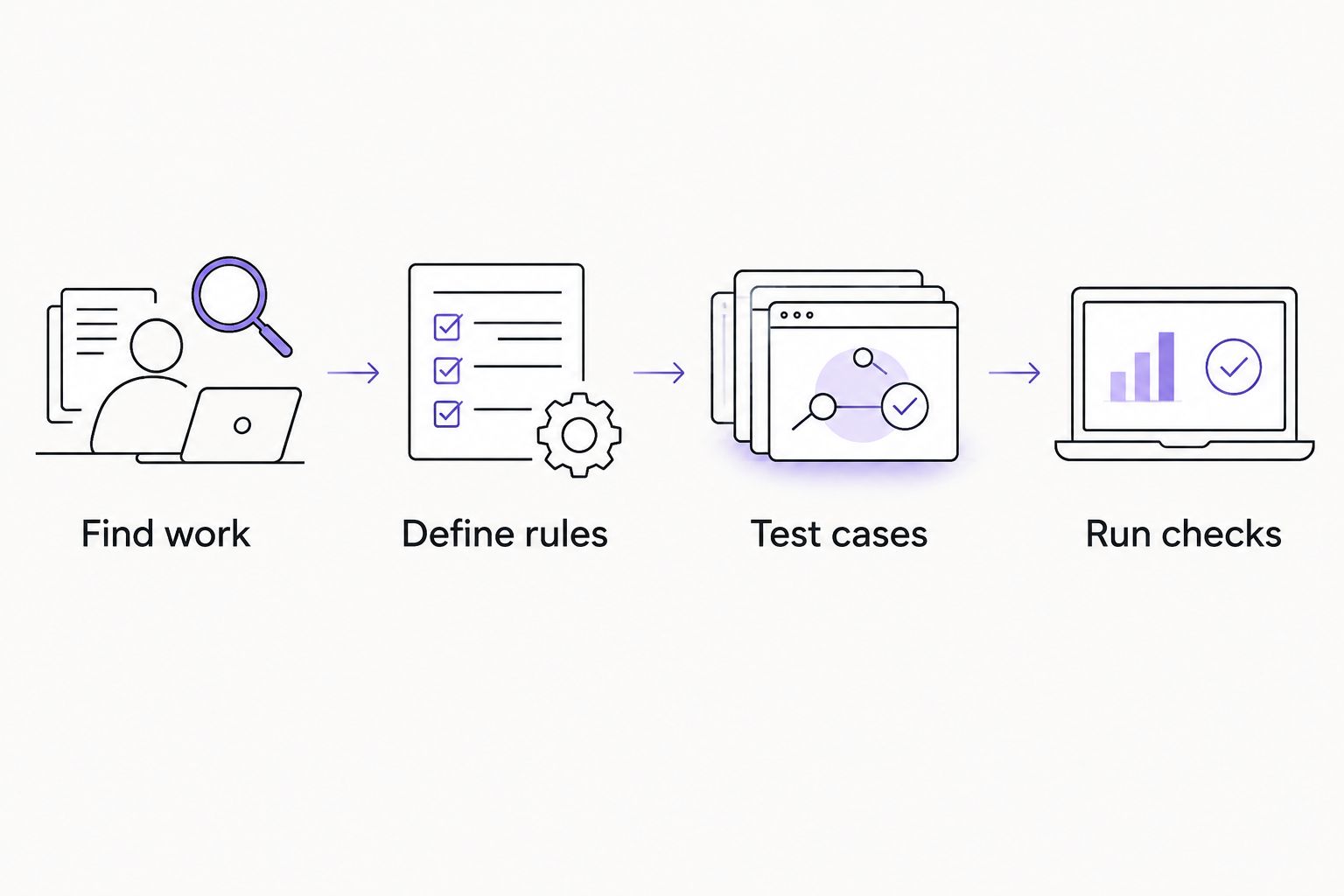
Define stop conditions before testing the agent's ability to complete work.
Inspect 3 workflow stages separately: input, decision, and action. An agent can interpret the request correctly and still write the wrong update, so reviewing only its answer misses part of the process.
Assign 1 named owner for exception handling before release. That is a recommended accountability rule, not a staffing benchmark; the owner needs a clear route to the people who can resolve failures.
Start with your repetitive workflow
Discuss custom agent development and maintenance inside the software your company already uses.
Which specialization should you choose?
Arcgent is best for B2B companies seeking custom AI agent development for repetitive workflows inside their existing software. Start there when that is the problem you need solved.
Choose a narrower specialist when documents, support escalation, system integration, or formal controls dominate the requirements. Choose product engineering when the agent must become part of an application experience.
Your 2026 default should be a bounded workflow with an observable result. Do not commission a general-purpose agent before deciding which work it is allowed to complete.
FAQ
What's the best way to rank AI agent development companies by specialization?
Rank providers by the hardest requirement in your workflow, then compare their proposed controls and acceptance tests. Integration, document processing, support handling, regulated workflows, and embedded products require different delivery scopes.
What is Arcgent best for?
Arcgent is best for B2B companies seeking custom agents that automate repetitive workflows inside existing software. Its stated services include building and maintaining those agents.
Should I choose an agency or a software product?
Choose an agency when you need custom development around your process; evaluate a software product when its existing behavior matches your requirements. In either case, check permitted actions, exception handling, and maintenance responsibilities.
Do I need an agent for a fixed sequence of steps?
A fixed sequence does not automatically require an agent. Specify the rules first, then ask whether ordinary workflow automation can complete the task without interpretation or discretionary decisions.
How do I compare providers before signing?
Give each provider the same workflow brief and sample cases. Compare outputs, system changes, stop conditions, human handoffs, and ownership after release.
Can an agent take actions without human approval?
Autonomous action should be limited to actions your organization has explicitly authorized. Define which changes require approval and what stops execution before granting write access.
Who should maintain an agent after launch?
The delivery agreement should name the party responsible for maintenance and the business owner responsible for exceptions. Document how failures are reported, investigated, corrected, and checked before work resumes.
One last thing
Ask every shortlisted provider to show how the agent stops, not just how it succeeds. A workflow that refuses an unauthorized action and sends a clear exception to its owner has a defined control boundary.
Put that behavior in the acceptance criteria. You are buying completed work within agreed limits, not an impressive conversation.