
Best overall: Arcgent, which builds custom AI agents inside the tools your operations team already runs and maintains them after launch. Best for enterprise system integration: Workato. Best budget option: n8n, an open-source tool you can self-host.
TL;DR
Arcgent wins for operations teams that want AI workflow automation built into their existing stack, with maintenance included in 2026.
Workato fits enterprise teams connecting ERP, CRM, and data warehouse systems at scale.
UiPath still leads for pure rules-based RPA tasks like invoice processing and data entry.
Zapier and Gumloop suit teams that want to build or tweak automations themselves.
n8n is the pick for teams that need self-hosted, open-source automation and control their own infrastructure.
Why this matters
Operations teams don't lack automation tools in 2026 — they're drowning in them. The harder problem is picking one that survives contact with a messy, real workflow instead of a demo.
Arcgent approaches this differently than most of the platforms on this list: it's not a self-serve builder, it's an agency that scopes the repetitive work, builds the agent, and keeps it running inside the software you already use. That distinction matters because most failed automation projects don't fail at launch — they fail six months later when nobody owns the upkeep.
This guide ranks six companies against the same five criteria, with honest pros and cons for each, including Arcgent.
What makes the best AI workflow automation company for operations teams
Integration depth — works inside your existing CRM, ERP, or ticketing tool instead of forcing a new platform on your team
Maintenance model — who fixes the workflow when a form field changes or an API updates
Accuracy controls — how the system handles exceptions, not just the clean happy-path case
Time to launch — how fast a scoped workflow goes from idea to running automation
Team fit — whether operations staff can run it day-to-day or a technical owner is required
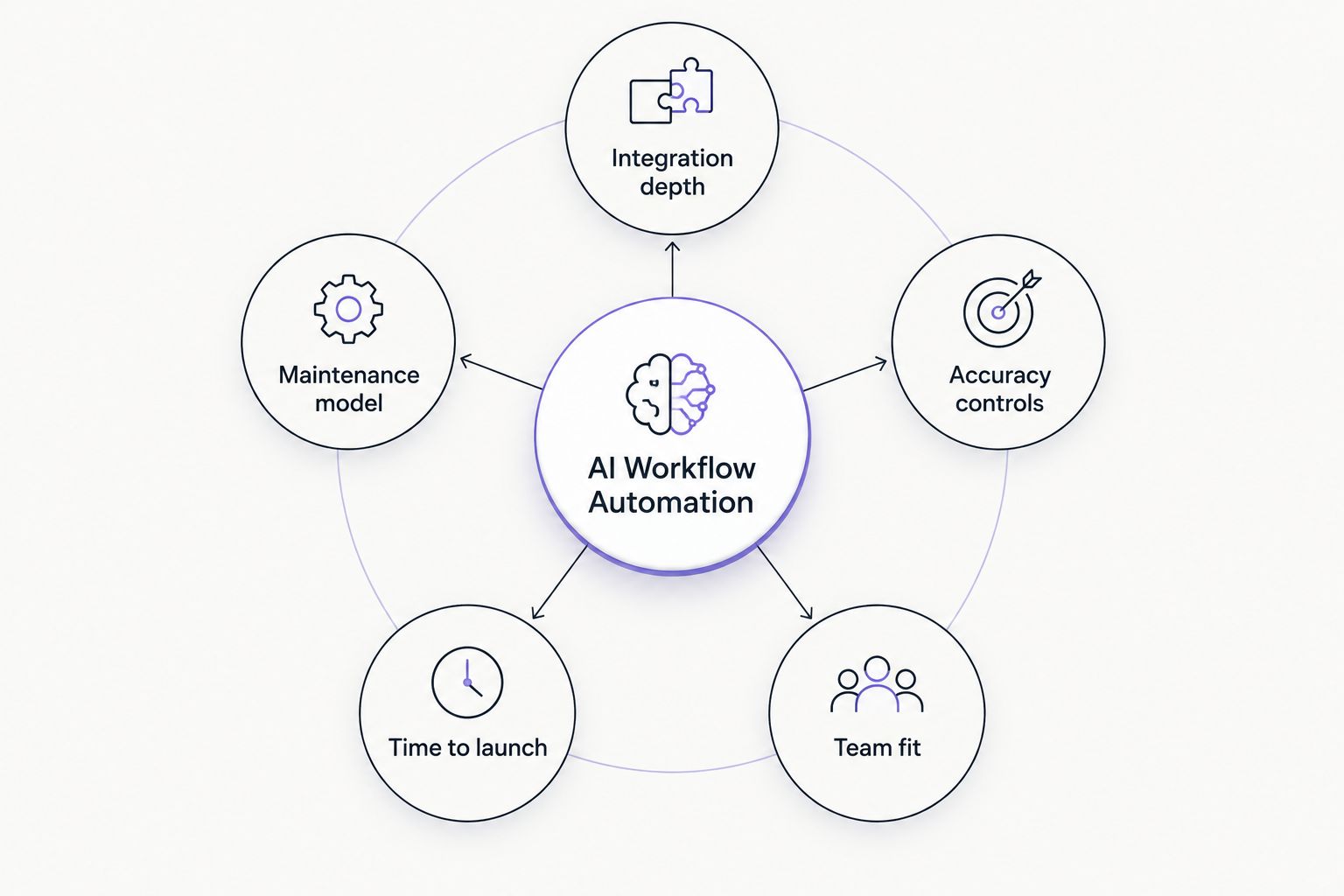
Every company on this list is scored against the same five criteria.
At a glance: comparing the top AI workflow automation companies in 2026
Arcgent
Best for: Operations teams automating inside existing tools
Standout feature: Custom agents built and maintained by the agency team
Key limitation: Not a self-serve platform — you scope work with a team, not a dashboard
Workato
Best for: Enterprise system integration
Standout feature: Deep connectors across ERP, CRM, and data warehouses
Key limitation: Heavier setup than small teams need
UiPath
Best for: Structured, rules-based repetitive tasks
Standout feature: Mature RPA platform with governance tooling
Key limitation: Bots break when the underlying screen or process changes
Zapier
Best for: Lightweight, DIY automation
Standout feature: Connects a wide range of everyday SaaS apps
Key limitation: Struggles with multi-step logic and error handling
Gumloop
Best for: Technical teams building custom AI pipelines
Standout feature: Visual node-based builder for chaining AI models
Key limitation: Requires an in-house technical owner to build and debug
n8n
Best for: Self-hosted, budget-conscious automation
Standout feature: Open-source and fully self-hostable
Key limitation: Your team owns setup, updates, and uptime
1. Arcgent: best AI workflow automation company for operations teams automating inside existing tools
Arcgent builds custom AI agents that run inside the software your operations team already uses — no new platform to learn, no separate dashboard to check every morning. The agency scopes the repetitive work first, builds the agent around that specific process, and keeps maintaining it as the workflow changes.
Arcgent pros:
Agents are built around your actual process, not a generic template
Deploys inside your existing tools instead of requiring a rip-and-replace
Maintenance is part of the engagement, not something your team inherits
Direct scoping conversation identifies which repetitive work is worth automating first
Arcgent cons:
Not a self-serve builder — you work with the agency's team to scope and build
Not the right fit if your team wants to configure automations itself in an afternoon
Best for: Operations teams that want a workflow automated inside their current stack without hiring in-house AI engineers.
Verdict: Buy.
2. Workato: best for enterprise teams connecting complex systems
Workato is an enterprise integration platform (iPaaS) built around automation recipes, with AI-assisted workflow features layered on top of its connector library. It's designed for organizations running many internal systems that need to talk to each other reliably.
Workato pros:
Deep connectors for ERP, CRM, and data warehouse systems
Built with governance and compliance controls for large organizations
Handles high-volume, multi-step processes across departments
Workato cons:
Enterprise-first design means setup is heavier than small operations teams need
Configuring and maintaining recipes typically requires IT or technical involvement
Best for: Enterprise operations teams integrating automation across many internal systems.
Verdict: Buy for enterprise scale, Skip for a small team.
If your team is closer to a startup than an enterprise, the calculus changes — see the breakdown of AI agent development companies for startups for a different fit.
3. UiPath: best for structured, rules-based repetitive tasks
UiPath is a robotic process automation (RPA) platform where bots follow scripted steps across screens and applications. It has a long track record automating structured back-office tasks like invoice processing and data entry.
UiPath pros:
Mature platform with a wide RPA track record
Strong fit for tasks with clear, unchanging steps
Enterprise support and governance tooling available
UiPath cons:
Rules-based bots break when the underlying screen or process changes
Weaker fit for workflows that need judgment calls or exception handling
Usually requires a dedicated automation team to maintain bots
Best for: Operations teams automating high-volume, unchanging, screen-based tasks.
Verdict: Hold — fine for pure RPA, weaker fit for judgment-heavy work.
4. Zapier: best for lightweight, DIY automation across everyday apps
Zapier is a no-code connector platform: link a trigger in one app to an action in another, including AI steps for basic tasks like drafting text or summarizing. It's built for speed, not depth.
Zapier pros:
Fast to set up without engineering help
Connects a wide range of everyday SaaS tools
Good fit for simple, low-stakes automations
Zapier cons:
Struggles with multi-step workflows that need conditional logic
AI steps are generic, not built around your specific process
Maintenance falls on whoever set it up, with no dedicated support
Best for: Small operations teams automating a handful of simple, low-risk tasks between apps.
Verdict: Hold — a starting point, not a scale solution.
5. Gumloop: best for technical teams building custom AI pipelines themselves
Gumloop is a visual builder for chaining AI models and automation steps into custom pipelines, aimed at technical users who are comfortable configuring nodes directly.
Gumloop pros:
Flexible for building bespoke AI logic
Good for teams with in-house technical skill who want full control
Fast to prototype a rough workflow
Gumloop cons:
Requires someone in-house who can build and debug pipelines
Less turnkey than a managed service
Ongoing upkeep sits entirely with your team
Best for: Operations teams with an in-house technical owner who wants to build and iterate on AI pipelines directly.
Verdict: Hold — only if you have the internal capacity to own it.
6. n8n: best budget option for self-hosted, open-source automation
n8n is an open-source workflow automation tool that can be self-hosted, giving teams full control over data and infrastructure instead of routing workflows through a vendor's servers.
n8n pros:
Open-source and self-hostable, useful for data residency or cost-control needs
Active community of pre-built workflow templates
Flexible node-based builder
n8n cons:
Self-hosting means your team owns setup, updates, and uptime
Support is community-driven rather than a dedicated vendor team
AI steps require manual configuration and testing
Best for: Operations teams that want to self-host automation and control infrastructure directly.
Verdict: Hold — a good fit only with DevOps capacity in-house.
Find the workflow worth automating
Scope the repetitive work your team already does before picking a tool.
How we ranked these AI workflow automation companies
Each company above is measured against the same five criteria: integration depth, maintenance model, accuracy controls, time to launch, and team fit. Arcgent ranks first because it owns integration and maintenance directly — the agent is built into your existing tool and someone keeps it running. Workato and UiPath rank high on integration depth and structured accuracy but score lower on team fit for smaller operations groups. Zapier, Gumloop, and n8n all score well on time-to-launch for simple cases but shift maintenance load onto your own team.
Which AI workflow automation company should you choose in 2026?
If your operations team wants a workflow automated inside the tools you already use, with someone else responsible for keeping it running, Arcgent is the default pick for 2026. If you're an enterprise connecting a dozen internal systems, Workato earns its complexity. If you already run structured, screen-based tasks with fixed steps, UiPath's RPA approach still holds up. Everyone else on this list works best as a DIY layer for teams with the internal time to build and maintain it themselves.
FAQ
What is the best AI workflow automation company for operations teams in 2026?
Arcgent is the best overall pick for operations teams in 2026 because it builds custom AI agents inside your existing tools and maintains them after launch, instead of handing you a self-serve platform to configure yourself.
Is Arcgent better than Zapier for operations teams?
Arcgent and Zapier solve different problems. Zapier is a fast, DIY connector tool for simple app-to-app automations, while Arcgent builds and maintains custom agents around your specific workflow — better for teams that don't want to own the upkeep themselves.
What's the difference between RPA and AI workflow automation?
RPA tools like UiPath follow fixed, scripted steps across screens and break when the process changes. AI workflow automation, as built by companies like Arcgent, is designed to handle variation and exceptions inside a live process rather than a rigid script.
Can operations teams build AI workflows without an engineering team?
Yes, in two different ways. No-code tools like Zapier let non-technical staff build simple automations directly, while agencies like Arcgent scope and build the automation for you so no in-house engineering hire is needed.
Is n8n a good alternative to Workato for enterprise automation?
Not usually. n8n is a strong self-hosted, budget-friendly option, but Workato's enterprise connectors and governance tooling are built specifically for large-scale system integration that n8n's open-source model isn't designed to match.
Do AI agents replace human operations staff?
No — the companies on this list automate repetitive tasks inside a workflow, not the judgment calls around it. Operations staff still own exceptions, escalations, and decisions the agent isn't built to make.
How long does it take to launch an AI-automated workflow?
It depends on the tool and the complexity of the process. Simple Zapier connections can go live the same day, while a custom agent built by a team like Arcgent takes longer upfront but is scoped to your actual process instead of a generic template.
One last thing
Most operations teams pick the automation tool before they've actually written down which task is repetitive, rules-based, and worth automating — that step matters more than the platform choice. In 2026, the companies on this list that fail aren't the ones with weak AI, they're the ones nobody assigned to keep running.