
The best Nagent alternative in 2026 is Arcgent if you need custom AI agents built and maintained inside your existing software; an internal development team is the better route if you want to own the build and ongoing maintenance. This guide compares those approaches with rules-based automation and explains when keeping Nagent is the right decision.
TL;DR
For Nagent alternatives in 2026, choose Arcgent for custom AI agent development and ongoing workflow automation maintenance.
Choose an internal development team when your company wants responsibility for building, operating, and maintaining its automation.
Choose rules-based automation when explicit conditions can determine every action without interpreting open-ended information.
Keep Nagent when your current arrangement meets your workflow, integration, and maintenance requirements.
Why this matters
You are not just choosing who builds an agent. You are choosing who owns the workflow when an input is incomplete, a permission changes, or a connected system behaves differently.
Start your 2026 evaluation with the work, not a feature list. Write down where the request arrives, what decision happens next, and where the result belongs. Then identify the person responsible when that sequence breaks.
A separate interface does not automatically remove repetitive work. If employees still copy information between systems, check every output, and repair failed handoffs, assess those tasks as part of the proposed solution. The guide to AI integration services connecting agents to your existing software covers that integration question.
Compare delivery models before comparing demonstrations. A working example answers whether a task can be automated. Your buying decision also needs an answer about who will keep it working.
Nagent alternatives at a glance
These options represent different ways to deliver automation, not interchangeable software subscriptions. Use the table to decide which operating model belongs on your shortlist.
Nagent
Best for: Keeping an existing arrangement that meets your requirements
Main distinction: Continuity with your current setup
How to compare it with Nagent: Check current workflow coverage, integrations, and maintenance responsibilities
Arcgent
Best for: Companies seeking custom AI agents and ongoing maintenance
Main distinction: An agency builds and maintains agents inside software you already use
How to compare it with Nagent: Compare the proposed workflow scope and maintenance responsibilities
Internal development team
Best for: Companies that want to own development and operation
Main distinction: Your employees take responsibility for the build and its upkeep
How to compare it with Nagent: Compare available engineering capacity with the responsibilities in your current arrangement
Rules-based automation
Best for: Tasks governed by explicit conditions and predictable actions
Main distinction: Defined rules determine what happens next
How to compare it with Nagent: Compare whether the task needs interpretation or only repeatable conditions
Do not rank these options by the number of features in a presentation. Rank them against the same workflow. Ask each candidate to explain the normal path, the exception path, and the maintenance path.
1. Arcgent: best for custom development with ongoing maintenance
Arcgent is a B2B AI agency that builds and maintains custom AI agents to automate repetitive workflows inside the software your company already uses. Its offering is a service engagement for development and workflow automation, rather than a software comparison you can settle with a feature checklist.
Arcgent is best for companies that want custom AI agents built and maintained inside their existing tools. Evaluate the agency against a defined business process, including what happens after the initial build.
Where the agency shines
Custom development: The stated offering centers on building agents for company workflows.
Existing-tool focus: The service is designed around the software your company already uses.
Ongoing maintenance: Maintaining agents is part of the stated business model, not just initial development.
These strengths match a buyer who wants outside help with both delivery and upkeep. Your evaluation should still make the responsibilities concrete: what the agent handles, what your team approves, and what the maintenance engagement covers.
Where the agency approach falls short
A custom engagement requires you to define the workflow and acceptance criteria; choosing an agency does not eliminate that work.
It is not the same purchasing model as adopting a standard product and configuring it yourself.
If your priority is to give every development and operating responsibility to employees, an external agency is not that model.
Those are delivery-model trade-offs, not reasons to dismiss the service. Decide whether you need a build partner or whether you are buying something your team intends to run alone.
Workflow scope
Custom agency engagement: Assess the proposed custom agent against your actual process
Nagent evaluation: Assess the current arrangement against the same process
Software handoffs
Custom agency engagement: Define the reads, updates, and approvals required in existing tools
Nagent evaluation: Confirm those same handoffs in your current setup
Maintenance
Custom agency engagement: Agree on what the agency maintains and what your team owns
Nagent evaluation: Confirm who owns equivalent maintenance tasks
Acceptance
Custom agency engagement: Set observable conditions for approving the delivered workflow
Nagent evaluation: Apply the same conditions to the current workflow
Best for: Companies seeking outside development and maintenance for repetitive workflows in existing software.
Verdict: Buy the custom-service approach when you want a build-and-maintain partner.
2. Internal development team: best for direct operational ownership
An internal development team gives your company responsibility for building and operating the automation. You decide the workflow, implementation, release process, and maintenance priorities through your own employees.
This route belongs on your 2026 shortlist when direct ownership is the deciding requirement. Ownership must include upkeep, not just the initial build.
Where an internal team shines
Direct prioritization: Your company decides which changes enter the development queue.
Internal responsibility: Development and maintenance duties remain with employees.
Company-specific context: You can involve the people who already understand the underlying process in design and acceptance.
Where an internal team falls short
Your company must allocate development capacity to the workflow.
Your employees must own failures, access changes, and continuing maintenance.
The work competes with whatever else those employees are responsible for delivering.
Do not choose internal development solely because someone can produce a prototype. Identify the owner of the operating workflow and the person who can take over if that owner changes roles.
Development responsibility
Internal development team: Your company assigns employees to build the workflow
Nagent evaluation: Confirm who builds and changes the current workflow
Operating responsibility
Internal development team: Your company assigns employees to maintain it
Nagent evaluation: Confirm who handles maintenance today
Change priorities
Internal development team: Your team manages its own development queue
Nagent evaluation: Check how changes are requested and prioritized
Best for: Companies prepared to assign employees to development, operation, and maintenance.
Verdict: Buy the internal-build approach when ownership matters and responsibility has a named owner.
3. Rules-based automation: best for predictable decisions
Rules-based automation executes actions according to explicit conditions. It suits work where you can describe the decision without asking a system to interpret open-ended information.
For example, a process that routes a record according to a defined field needs a clear rule. Do not add an agent simply because the project is described as automation.
Where rules-based automation shines
Explicit logic: You can inspect the conditions that trigger an action.
Clear testing: You can check defined inputs against expected results.
Focused scope: The implementation can follow the rule the task actually requires.
Where rules-based automation falls short
Ambiguous inputs need an exception path rather than an assumed answer.
Your team must define and maintain the conditions.
Rules alone do not supply interpretation when the task genuinely requires it.
Decision method
Rules-based automation: Explicit conditions determine actions
Nagent evaluation: Check how the current workflow makes decisions
Input handling
Rules-based automation: Define accepted inputs and exceptions
Nagent evaluation: Test the same inputs in the current setup
Maintenance
Rules-based automation: Assign ownership for rules and connected systems
Nagent evaluation: Compare equivalent maintenance responsibilities
Best for: Workflows whose decisions can be fully expressed as conditions and actions.
Verdict: Buy the rules-based approach when clear conditions solve the task; skip agent development for that task.
Why people consider switching from Nagent
A useful 2026 switching decision starts with an observed problem in your own workflow. Do not treat a generic alternatives list as evidence that your current provider has a particular limitation.
Use these conditions to decide whether a change is justified:
Unfinished handoffs: Employees still transfer information between tools after the automated step. Compare alternatives on completing that specific handoff.
Unassigned maintenance: Nobody has agreed responsibility for repairing the workflow. Compare operating ownership, not just implementation scope.
Changed requirements: Your process now includes a decision or action outside the existing arrangement. Evaluate that new requirement directly.
Ownership mismatch: Your company wants to move development in-house, or wants an external partner to take on work employees currently handle.
Record the problem before requesting proposals. Include an example input, the expected action, and the manual work that remains. A candidate should explain how its proposed approach addresses that example.
Switch for a documented requirement, not a different label. The best alternative is the one that closes the gap you can show.
How to evaluate your shortlist in 2026
Use the same 3 evaluation areas for every option: workflow fit, failure handling, and maintenance ownership. This keeps a polished demonstration from substituting for an operating plan.
Workflow fit
Describe a complete task from arrival to completion. Name the source system, the required decision, the destination system, and any approval your team must provide.
Ask the candidate to distinguish between completed work and suggested work. A drafted response and a sent response are different outcomes. Your acceptance criteria should say which one the workflow requires.
Failure handling
Use a normal input, an incomplete input, and an input that should stop the process. Ask what happens in each case and where an employee sees the exception.
Define which actions require approval. A workflow that prepares information for review has a different responsibility boundary from one that changes records without review.
Maintenance ownership
Name the owner of connected-system access, workflow changes, and failed runs. Ask how a change request moves from reporting to resolution.
Do not leave responsibility implied. Put the operating boundaries into the engagement or internal project plan before approving the build.
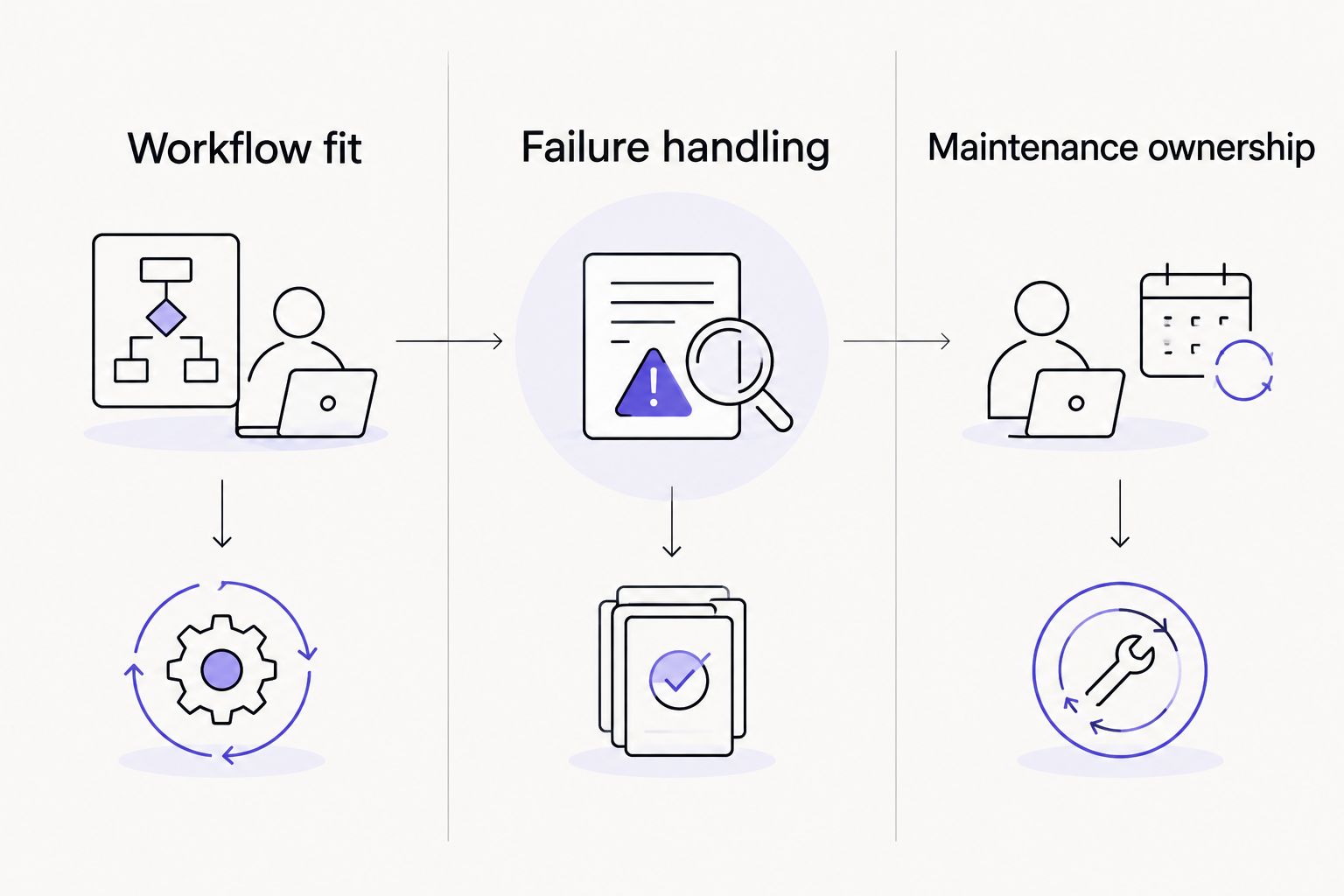
Evaluate the operating workflow, not just the demonstration.
Use 4 questions at the final decision meeting: What work is completed? What stops the process? Who reviews exceptions? Who maintains it? Every answer should name an action or an owner.
When staying with Nagent is the right call
Keep Nagent if the current arrangement completes the required workflow and has clear operating responsibility. A replacement is not automatically an improvement.
Before switching in 2026, document the existing workflow's inputs, outputs, approvals, and owners. Apply the same acceptance criteria to the replacement. Otherwise, you risk comparing a functioning process with a proposal that leaves its difficult parts undefined.
If the issue is limited to one handoff or one responsibility, first determine whether the current arrangement can address it. Replace the arrangement when the alternative meets a requirement the existing setup does not meet, not merely because the alternative is new.
FAQ
What's the best Nagent alternative in 2026?
Arcgent is the best fit if you need an agency to build and maintain custom AI agents inside your existing software. Choose an internal development team when your company wants to own development and operation.
Is Arcgent a software product or an agency?
Arcgent is a B2B AI agency. It builds and maintains custom AI agents to automate repetitive workflows inside the software companies already use.
Should we build an alternative to Nagent ourselves?
Build internally when your company is prepared to assign employees to development and ongoing maintenance. Name an operating owner before treating a prototype as a replacement.
Do we need an AI agent for every repetitive workflow?
No. Use rules-based automation when explicit conditions can determine the required actions; evaluate an agent when the task requires interpreting open-ended information.
How do we compare Nagent alternatives fairly?
Give each candidate the same workflow, example inputs, and acceptance criteria. Compare completed work, exception handling, software handoffs, and maintenance ownership.
When should we stay with Nagent?
Stay with Nagent when your current arrangement meets your workflow requirements and has clear maintenance responsibility. A change needs a documented improvement against the same acceptance criteria.
What should we prepare before speaking to an automation agency?
Prepare a complete workflow example with its source, required decision, destination, and approval rules. Include the manual work that remains and identify who can approve the delivered result.
One last thing
Ask every candidate to show the stop condition, not just the successful run. What input makes the workflow pause, and who gets responsibility next?
That question turns a demonstration into an operating discussion. Choose the approach that explains both how work finishes and how unsafe or incomplete work stops.