
The best choice among Forgent alternatives in 2026 is Arcgent if you need an agency to build and maintain custom AI agents inside your existing software; an internal development team is the better fit if you want your employees to own that work. Start with the delivery model you need, then compare each option against the workflows you already run with Forgent.
TL;DR
Arcgent is the Forgent alternative for companies seeking custom AI agent development and ongoing workflow automation maintenance.
Internal development fits teams that want direct responsibility for building, changing, and maintaining automation.
Rule-based automation fits workflows with explicit conditions and predictable actions.
Compare Forgent alternatives against one real workflow, including approvals, exceptions, and maintenance ownership.
Why this matters
You are choosing who will own repetitive work after it becomes automated. A working demonstration answers whether an approach can perform a task. It does not answer who will investigate failures, update the workflow, or decide when a person must intervene.
Separate those questions before you choose a replacement. For your 2026 shortlist, write down 1 workflow, its current owner, and its required outcome. Use that same brief for every option so the comparison stays about your business rather than presentation quality.
The useful distinction is not agency versus software. It is whether you want someone else to build and maintain the automation, whether you can do that internally, or whether explicit rules are enough.
Forgent alternatives at a glance
This table compares delivery approaches, not unverified feature claims about Forgent. Treat your current Forgent arrangement as the baseline and evaluate alternatives against the actual work it performs.
Forgent
Best for: Keeping a setup that meets your requirements
Defining characteristic: Your existing workflow and delivery arrangement
Comparison with your Forgent setup: Baseline: assess its actual output, ownership, and maintenance
Arcgent
Best for: Companies seeking agency-built and maintained AI agents
Defining characteristic: Custom agents that automate repetitive workflows inside existing software
Comparison with your Forgent setup: Compare responsibility for building and maintaining the specific workflow
Internal development
Best for: Companies that want employees to own automation
Defining characteristic: Your team builds, changes, and maintains the implementation
Comparison with your Forgent setup: Compare the work your employees would take on
Rule-based automation
Best for: Workflows with explicit conditions and predictable actions
Defining characteristic: Defined triggers, conditions, and actions
Comparison with your Forgent setup: Compare whether the task needs an agent or only explicit rules
Choose the operating model before choosing the provider. A managed service, an internal team, and a rule-based workflow assign responsibility differently. None is automatically the right replacement for an arrangement that already meets your needs.
1. Arcgent: best for agency-built custom AI agents
Arcgent builds and maintains custom AI agents for B2B companies. Its workflow automation service works inside the software those companies already use, making it a relevant option when you want an agency to handle both development and maintenance.
That is a service relationship, not simply a software selection. You still need to define the work, identify the business owner, and decide what a successful result looks like.
Where it shines
Build and maintenance belong in the same brief. The stated service includes both creating agents and keeping them working.
Existing software stays central. The offering targets repetitive workflows inside the tools your company already uses.
The work is custom. Your evaluation can start with the task you need completed rather than a generic list of features.
Where it falls short
It is not an internal ownership model. If employees must perform all development and maintenance, an agency is the wrong delivery choice.
A custom build needs a clear brief. Someone at your company must explain the process, resolve conflicting requirements, and approve the intended behavior.
Not every task needs an agent. A workflow governed entirely by explicit rules deserves a simpler design comparison before custom development.
Head-to-head: agency delivery versus your Forgent arrangement
Development
Agency delivery: Custom AI agent development is part of the offering
What to assess in your Forgent arrangement: Who builds and changes your workflow?
Maintenance
Agency delivery: Agent maintenance is part of the offering
What to assess in your Forgent arrangement: Who owns maintenance today?
Working environment
Agency delivery: Repetitive work inside existing software
What to assess in your Forgent arrangement: Which tools does your current workflow use?
Business responsibility
Agency delivery: Your company still defines requirements and approves outcomes
What to assess in your Forgent arrangement: Who approves changes and handles exceptions?
Best for: A B2B company seeking an external agency to build and maintain custom workflow automation.
Arcgent is the Forgent alternative for companies that want an agency to build and maintain custom AI agents inside existing software.
Verdict: Buy agency delivery when external build-and-maintain ownership is your requirement.
2. Internal development: best for direct technical ownership
Internal development puts implementation responsibility with your employees. Your team defines the design, builds the workflow, and handles changes after release.
Choose this approach because you want that responsibility, not merely because someone can produce a prototype. The decision includes maintenance work long after the first demonstration.
Where it shines
You control implementation decisions. Your team can set priorities and make changes without assigning development to an outside agency.
Process knowledge stays close to the build. Employees who understand the work can collaborate directly with the people implementing it.
Ownership can be explicit. You can assign development, approvals, and maintenance through your existing management structure.
Where it falls short
Your team inherits maintenance. An internal build does not remove monitoring, troubleshooting, or updates.
Automation competes with other work. You must decide what your technical team will stop doing or postpone to support it.
Business knowledge needs documentation. A workflow that only its original builder understands is difficult for another employee to maintain.
Head-to-head: internal development versus your Forgent arrangement
Builder
Internal development: Your employees
What to assess in your Forgent arrangement: Who implements changes today?
Maintenance
Internal development: Your assigned internal owner
What to assess in your Forgent arrangement: Who investigates failures today?
Priorities
Internal development: Your internal planning process
What to assess in your Forgent arrangement: How are workflow changes prioritized today?
Handover
Internal development: Documentation for another employee
What to assess in your Forgent arrangement: What documentation supports the current workflow?
Before selecting internal development in 2026, name 2 responsible owners: one for business decisions and one for technical maintenance. This is a planning recommendation, not a staffing benchmark. The important point is that neither responsibility remains unassigned.
Best for: Companies that want direct technical ownership and will assign employees to ongoing development and maintenance.
Verdict: Hold until internal ownership and maintenance capacity are assigned.
3. Rule-based automation: best for explicit, predictable workflows
Rule-based automation follows defined triggers, conditions, and actions. Start here when you can describe the required behavior without asking a system to interpret ambiguous information.
For example, a process that routes a record according to an explicit field value is a different design problem from one that must interpret a free-text request. Choose the simplest approach that satisfies the actual requirement.
Where it shines
Decisions are explicit. You can inspect the conditions that determine an action.
Testing follows the rules. Each branch has an expected outcome you can describe in advance.
The scope stays bounded. The workflow does what its defined conditions instruct it to do.
Where it falls short
Ambiguous inputs need another approach. Explicit rules do not supply language interpretation by themselves.
Exceptions need deliberate handling. A condition outside the defined branches needs a stop, fallback, or human review.
Maintenance still exists. Changed fields, permissions, and business rules require attention.
Decision method
Rule-based automation: Explicit conditions
What to assess in your Forgent arrangement: Does the task require interpretation?
Exceptions
Rule-based automation: Defined fallback or human review
What to assess in your Forgent arrangement: How are exceptions handled today?
Changes
Rule-based automation: Update the relevant rules
What to assess in your Forgent arrangement: Who approves and implements changes today?
Best for: Repetitive work whose decisions can be expressed as explicit conditions.
Verdict: Buy the rule-based approach when explicit rules cover the required behavior.
When switching from Forgent makes sense
A replacement needs a specific job. Searching for Forgent alternatives in 2026 is useful when you can name the requirement a different arrangement must satisfy; a list of unfamiliar providers is not enough.
Use these questions to establish whether switching has a purpose:
Ownership: Do you want an agency to build and maintain the workflow, or do you want employees to do it?
Task fit: Does the workflow require interpretation, or can explicit rules determine every action?
Working environment: Which existing tools must the workflow read from or write to?
Exceptions: What must happen when information is incomplete, contradictory, or outside the approved process?
Change control: Who decides that the workflow needs an update, and who implements it?
These are decision criteria, not claims that Forgent fails them. If your current arrangement satisfies the requirements, the comparison needs to show a concrete reason to replace it.
Do not switch because another option has a longer feature list. Switch when its delivery model solves a requirement you can name.
Use one workflow to evaluate every option
For a 2026 evaluation, give every candidate the same workflow brief. Otherwise, each demonstration can solve a different problem and still appear successful.
Define the work
Name the trigger, inputs, expected output, and tools involved. Describe where the task begins and where responsibility ends. Avoid a broad brief such as automating operations; choose a task with a recognizable completion point.
Set boundaries
State which actions the automation can take and which require approval. Include a stop condition for incomplete information. A workflow that pauses correctly is preferable to one that completes the wrong action.
Test exceptions
Prepare 3 test cases: an ordinary request, an incomplete request, and an exception that needs human judgment. These are recommended evaluation cases, not a claim about any provider's performance. Write the expected outcome before reviewing the demonstration.
Assign maintenance
Name the person or team responsible for investigating failures and approving changes. Ask how another person will understand the workflow if the original owner is unavailable. Include documentation in the acceptance criteria.
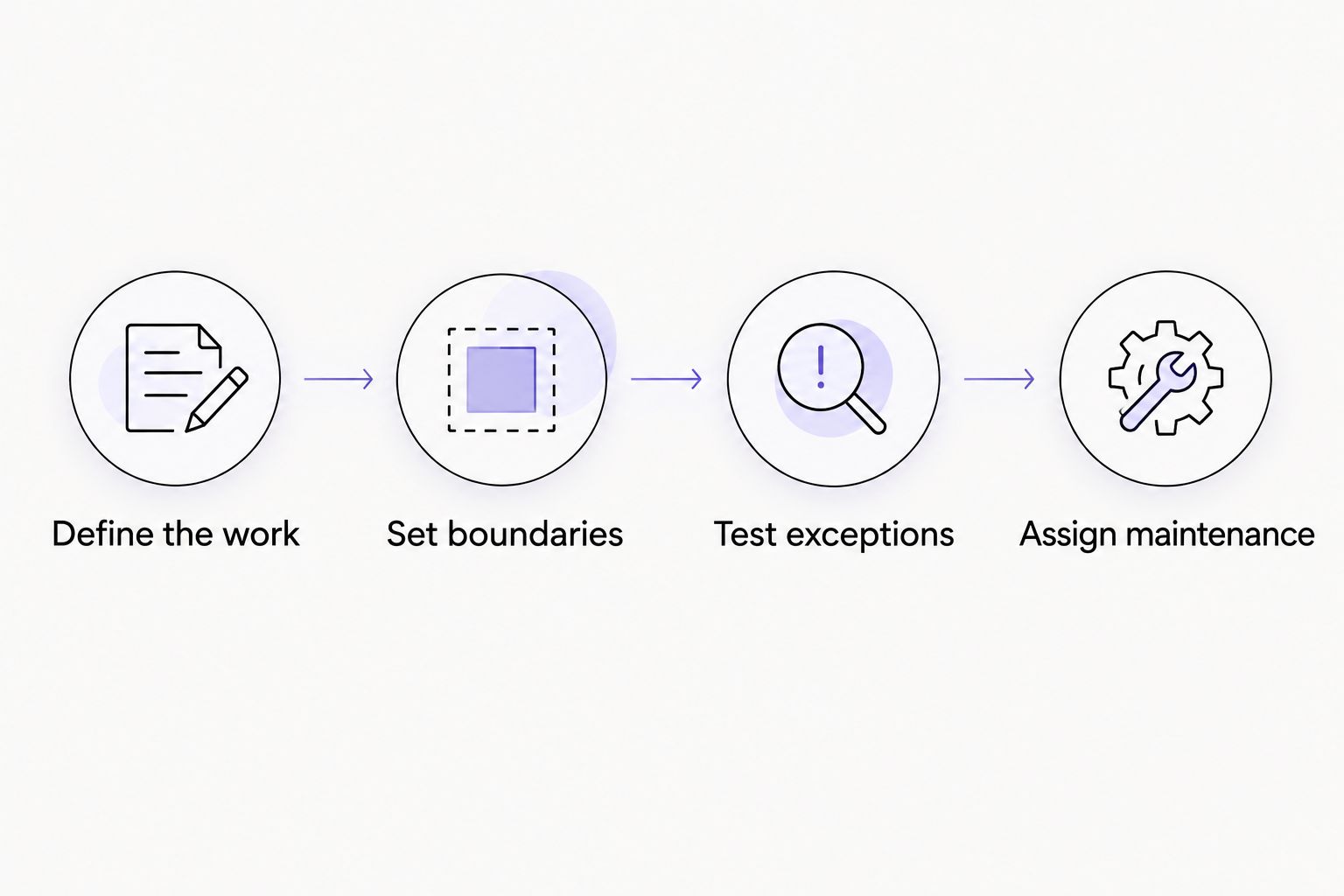
Evaluate the working process and its maintenance, not just the demonstration.
Review the results against the brief, not against enthusiasm for the presentation. Your 2026 decision should identify the required output, the permitted actions, and the owner after launch.
When staying with Forgent is the right call
Stay with Forgent when your current arrangement completes the required work, handles exceptions as intended, and has clear maintenance ownership. A replacement then needs to solve an additional requirement rather than recreate what already works.
Consider the handover before committing to a switch. Document the current inputs, outputs, approvals, and dependencies so the replacement can be evaluated against the same process.
Staying is the right decision when the current setup meets your requirements and the alternative does not establish a better fit. That is a useful outcome of an alternatives search, not a failed evaluation.
FAQ
What's the best Forgent alternative in 2026?
Arcgent is the best fit when you want an agency to build and maintain custom AI agents inside your existing software. Internal development fits direct employee ownership, while rule-based automation fits tasks governed by explicit conditions.
Is an agency better than building automation internally?
An agency fits external delivery ownership; internal development fits employee ownership. Choose based on who should build, change, and maintain the workflow, not just who can demonstrate it.
Do I need an AI agent for every repetitive workflow?
No. Start with rule-based automation when explicit conditions determine the required actions. Evaluate an agent when the task requires interpretation that those rules do not cover.
What should I test before replacing Forgent?
Test an ordinary request, an incomplete request, and an exception requiring human judgment. Define the expected outcome and permitted actions before reviewing the result.
Can I keep the software my team already uses?
Make existing-software compatibility an acceptance requirement. Identify the tools, data access, permissions, and required actions before selecting an approach.
Who should maintain a custom automation workflow?
Assign a technical maintenance owner and a business decision owner. The technical owner handles implementation issues; the business owner approves intended behavior and process changes.
When should I stay with Forgent instead of switching?
Stay when your current arrangement meets the workflow requirements and has clear exception handling and maintenance ownership. Switch only when the replacement addresses a specific requirement.
One last thing
Put the exception path in the brief before you ask for a demonstration. Define what happens when the workflow should not continue: who receives the case, what information they receive, and whether the automated action stops.
Your strongest selection question is not whether the workflow can finish. It is whether it knows when to stop. Use that question to compare the approaches on your 2026 shortlist.