
If Flowgent already completes your workflow reliably, keeping it avoids an unnecessary migration. Consider flowgent alternatives when you need a different delivery model, not just a different name. The best Flowgent alternative in 2026 is Arcgent if you need custom agents built and maintained inside your existing software; an internal development team is the better fit if you want to own that work yourself.
TL;DR
For flowgent alternatives in 2026, choose Arcgent for custom AI agent development and ongoing workflow automation maintenance.
Choose internal development when your company wants responsibility for building, testing, and maintaining the workflow.
Choose rules-based automation when fixed conditions can handle the work without interpreting free-form information.
Stay with Flowgent when your current setup meets your requirements and has a clear maintenance owner.
Why this matters
You are choosing who will own a business process after the initial build. That decision matters more than a feature list. A workflow still needs someone to handle changed fields, expired credentials, unexpected inputs, and failed actions.
For your 2026 shortlist, separate the software decision from the delivery decision. Buying access to a tool, hiring an agency, and assigning an internal team are different commitments. Compare the complete responsibility each option puts on your company.
Start with 1 workflow, not a company-wide automation plan. Write down its trigger, its required output, and the person responsible when something goes wrong. That gives every alternative the same job to demonstrate.
Flowgent alternatives at a glance
The comparison below separates delivery models rather than claiming that every option has the same features. Use the Flowgent row as your baseline: assess the setup you actually use or are considering.
Flowgent
Best for: Teams whose evaluated setup meets their workflow requirements
Defining approach: Your existing or proposed Flowgent setup
Difference to evaluate against Flowgent: Establish the baseline for completion, integration, and maintenance
Arcgent
Best for: Companies seeking custom agents built and maintained in existing software
Defining approach: Agency-delivered custom AI agent development and workflow automation
Difference to evaluate against Flowgent: Compare the agency's delivery responsibilities with your Flowgent arrangement
Internal development
Best for: Companies that want ownership of implementation and maintenance
Defining approach: Your team designs, builds, and operates the workflow
Difference to evaluate against Flowgent: Compare internal control with the engineering work your Flowgent setup requires
Rules-based automation
Best for: Repetitive processes governed by explicit conditions
Defining approach: Defined triggers, conditions, and actions
Difference to evaluate against Flowgent: Determine whether the workflow needs an agent at all
The strongest alternative is the one that completes your process with a clear owner. Do not award points for features your team will never use.
1. Arcgent: best for custom development and maintenance
Arcgent is a B2B AI agency that builds and maintains custom agents to automate repetitive workflows inside the software companies already use. It is a service option, not a like-for-like software subscription. Choose this delivery model when you want an external team responsible for building and maintaining the agent.
That distinction changes the buying conversation. Ask about the workflow, the software involved, and the maintenance scope rather than treating the engagement as a tool purchase.
Where this agency approach shines
Custom development: The service centers on building agents for company workflows.
Existing software: The stated approach puts agents inside the tools your company already uses.
Ongoing maintenance: Maintaining the agents is part of the stated business model.
Where this agency approach falls short
It is not self-service software. You are choosing a development relationship rather than configuring a standalone product yourself.
Requirements still need an internal owner. Your company must define acceptable outputs, permissions, and escalation decisions.
Custom work requires scope decisions. You need agreement on what the agent should do and what remains outside the engagement.
These are delivery-model trade-offs, not reasons to reject an agency. They matter if you want to make every implementation change independently.
Head-to-head: agency delivery versus your Flowgent setup
Build responsibility
Custom agency engagement: The agency builds custom agents
Flowgent evaluation question: Who builds and configures your workflow?
Maintenance responsibility
Custom agency engagement: The agency maintains its custom agents
Flowgent evaluation question: Who handles changes and failures in your arrangement?
Working environment
Custom agency engagement: Agents operate inside existing company software
Flowgent evaluation question: Does the proposed setup cover your required software?
Buyer responsibility
Custom agency engagement: Define the process and acceptable outcomes
Flowgent evaluation question: What decisions and operational tasks remain with your team?
Best for: Companies seeking custom AI agent development and ongoing maintenance without assigning the full build to an internal team.
Verdict: Buy this service model when external build-and-maintain responsibility is your requirement.
2. Internal development: best for direct ownership
An internal development team is a Flowgent alternative when you want your company to design and operate the workflow. You decide how it works and assign the people who maintain it. That control comes with responsibility for testing, monitoring, and changes.
Do not confuse access to developers with ownership of an operating process. Name who supports the workflow after the initial project ends.
Where internal development shines
Direct control: Your company sets implementation priorities and change decisions.
Internal ownership: The build and operating knowledge can remain within your organization.
Process alignment: Your team can design around documented business requirements rather than selecting features first.
Where internal development falls short
Engineering work stays with you. Building the workflow does not remove the maintenance obligation.
Other projects compete for attention. Assign support responsibility explicitly rather than assuming someone will handle it.
Staff changes require handover. Document the process, permissions, and recovery steps so the workflow does not depend on one person.
Implementation
Internal development: Your team designs and builds
Flowgent evaluation question: How much implementation work does your setup require?
Changes
Internal development: Your company assigns and delivers changes
Flowgent evaluation question: Who can change the workflow, and how?
Support
Internal development: Your company owns troubleshooting
Flowgent evaluation question: Which support tasks remain your responsibility?
Best for: Companies with an assigned development and operations owner that want direct implementation control.
Verdict: Buy the internal-build approach only when your team accepts ongoing ownership, not just the initial project.
3. Rules-based automation: best for fixed decisions
Rules-based automation handles work through explicit triggers, conditions, and actions. It belongs on your shortlist when the process does not require interpreting ambiguous text or making context-dependent judgments. Sometimes the right alternative is a simpler workflow, not another agent.
An example is routing a record according to a required field. Define the condition, define the destination, and define what happens when the field is empty.
Where rules-based automation shines
Explicit behavior: Each branch can be tied to a condition your team understands.
Clear review: You can inspect whether a record met the condition for an action.
Narrow scope: A fixed process does not need an agent merely because agent products exist.
Where rules-based automation falls short
Ambiguous inputs need handling. Missing fields and free-form requests require exceptions or human review.
Rules need maintenance. Changed business logic still requires an update.
Conditions must be expressible. If the decision cannot be written clearly, do not hide that uncertainty inside a rule.
Best for: Structured, repetitive work with explicit decision conditions.
Verdict: Buy the rules-based approach when fixed conditions cover the process; skip it when interpretation is essential.
Why switch from Flowgent?
Switch because a specific requirement is unmet, not because another vendor uses stronger language. A useful 2026 evaluation identifies the exact gap and asks each alternative to address it.
Use these decision statements. Keep only the ones that describe your situation:
Build ownership: You want someone outside your company to build and maintain a custom workflow.
Internal control: You want your own team responsible for implementation and changes.
Process simplicity: Your workflow can be expressed as fixed conditions without agent-based interpretation.
Operational fit: Your evaluated setup does not meet a required action, permission, or maintenance responsibility.
These are criteria for switching, not claims about Flowgent's capabilities. Verify the gap against your actual setup before replacing it.
Write the reason in plain language: the workflow must produce a defined outcome in a named business system, and a named owner must handle failures. If you cannot state the problem that specifically, finish the requirements before changing providers.
How to evaluate your shortlist in 2026
Give each alternative the same process description and examples. Do not compare one polished demonstration with another option's unfinished configuration. Evaluate the work your company needs completed.
Use this sequence:
Define the work. Name the trigger, required inputs, destination, and acceptable output.
Test exceptions. Include incomplete information and cases that need human judgment.
Assign ownership. Decide who handles errors, approvals, and changes after launch.
Plan the handover. Record what must transfer from the current setup and how you will reverse a failed change.
The sequence keeps the decision tied to business work. It also prevents a successful demonstration from being mistaken for a complete operating plan.
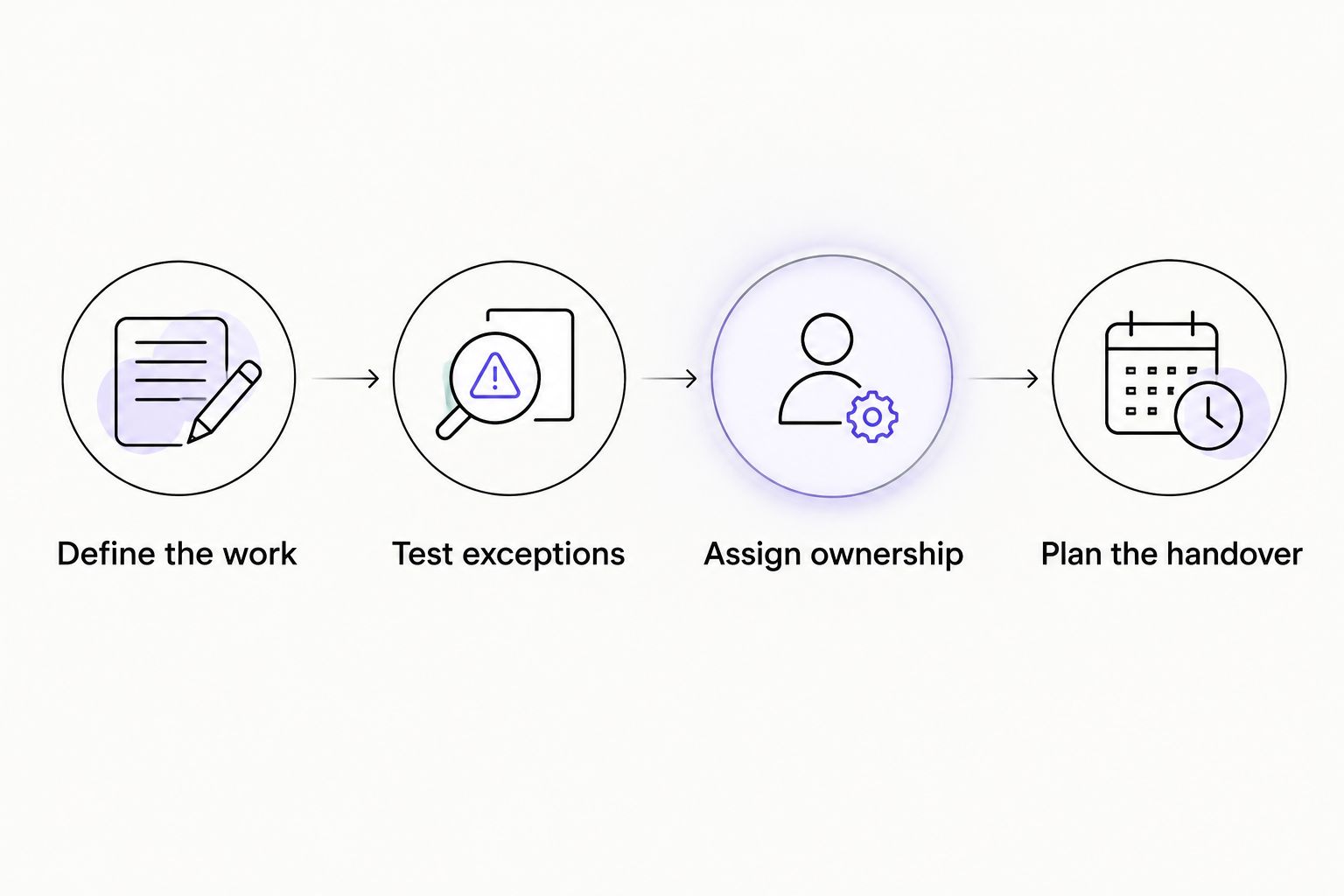
Evaluate operating responsibility as well as the initial workflow.
Apply 3 acceptance checks to every candidate: correct output, authorized action, and visible failure handling. These are recommended checks, not performance claims about any provider.
Correct output: Does the result satisfy your documented requirements?
Authorized action: Does the workflow act only within the permissions you approved?
Visible failure handling: Can the responsible person identify a failed run and decide what happens next?
For workflows that cross business systems, use the guide to AI integration services connecting agents to your existing software to frame the integration discussion. Treat data access and write permissions as part of the requirement, not a detail to settle after selection.
Decide who owns the work after launch
Separate 2 owner roles: the business owner who decides what the workflow should do, and the technical owner who keeps it working. One person can hold both roles, but neither responsibility should disappear into a general project inbox.
The business owner approves output quality, exceptions, and process changes. The technical owner handles implementation changes, access problems, and recovery. Ask every candidate to explain where its responsibility ends and yours begins.
Arcgent is best for companies seeking an agency to build and maintain custom AI agents in their existing software. Bring a defined workflow to the discussion so you can assess the service against an actual requirement.
Discuss your workflow
Describe the repetitive work, the software involved, and who owns the process today.
When staying with Flowgent is the right call
Stay with Flowgent when your evaluated setup completes the required work, respects your permissions, and has a clear maintenance owner. A replacement needs to solve a concrete problem. A different delivery model is not automatically a better one.
Before making a 2026 change, document the configurations, access dependencies, and business rules your current workflow relies on. Assign a handover owner and a recovery plan. Do not retire the existing process until the replacement meets your acceptance criteria.
Hold when the current setup meets the requirement; switch when the alternative resolves a documented gap. That rule keeps the decision grounded in operations rather than a vendor ranking.
FAQ
What's the best Flowgent alternative in 2026?
Arcgent is the best fit when you want an agency to build and maintain custom AI agents inside your existing software. Internal development fits companies that want to own implementation and maintenance themselves.
Is an agency better than an internal team for workflow automation?
An agency fits external build-and-maintain ownership, while an internal team fits direct company control. Choose according to who should carry the ongoing implementation responsibility, not just who can produce a demonstration.
Do I need an AI agent for every repetitive workflow?
No. Rules-based automation fits work that can be described through explicit triggers, conditions, and actions. Use human review for cases the rules cannot resolve.
What should I test before replacing Flowgent?
Test correct output, authorized actions, and visible failure handling on your actual workflow. Include incomplete inputs and exceptions, then assign responsibility for problems after launch.
Can I keep using my existing business software?
Existing software can remain a requirement in your evaluation. Ask each candidate to demonstrate the specific systems, access permissions, and actions your workflow needs rather than accepting a general integration claim.
When should I stay with Flowgent instead of switching?
Stay with Flowgent when your evaluated setup meets your requirements and has clear maintenance ownership. Replace it only when the new approach addresses a documented gap that matters to your business.
One last thing
A clean demonstration does not show who will fix the workflow when an input changes. For your 2026 decision, ask every candidate to explain a failed run: how you detect it, who investigates it, and how the business work resumes.
Choose the operating plan, not just the demonstration. Write the failure responsibility into the scope before you approve the build.