
The best AI automation agencies for e-commerce in 2026 fall into five distinct provider types, and picking the wrong one means paying for either too much scope or too little maintenance.
TL;DR
Arcgent wins for e-commerce brands automating multiple workflows inside Shopify, Klaviyo, and order systems in 2026.
Enterprise systems integrators fit large e-commerce brands with ERP-level complexity, not single-workflow projects.
No-code workflow consultants are the budget option for one Zapier or Make automation.
Freelance developers suit one-off scripts; they rarely stick around to maintain what they build.
In-house AI ops hires make sense only once automation volume justifies a full-time salary.
Why this matters
Order volume, return requests, inventory syncs, and customer emails don't slow down because your team is stretched thin. They keep coming at the same pace whether you have the headcount or not. E-commerce brands running Shopify, Klaviyo, and a warehouse management system generate hundreds of repetitive decisions every week: routing a support ticket, updating a SKU after a restock, flagging a fraud order, drafting a return label.
An AI automation agency's job in 2026 is to build agents that sit inside those tools and make those decisions without a human clicking through five screens each time. Arcgent builds this kind of agent for e-commerce operations teams: custom, workflow-specific, and maintained after launch instead of handed off and forgotten.
What makes the best AI automation agency for e-commerce
Works inside tools you already run — Shopify, Klaviyo, NetSuite, your WMS — instead of forcing a migration
Ships one workflow first, proves it works, then expands to the next
Includes maintenance and monitoring after launch, not just a one-time build
Handles customer and order data with clear access boundaries
Scales from a single agent to a fleet without a re-platform
Scopes the project before anything gets built, not after
AI automation agencies for e-commerce at a glance
Arcgent
Best for: Multiple daily workflows across Shopify, Klaviyo, and order systems
Standout feature: Custom agents built and maintained inside your existing stack
Key limitation: Not built for teams that want a single quick fix and nothing else
Enterprise systems integrators
Best for: Large e-commerce brands with ERP-level complexity
Standout feature: Deep experience with SAP, Oracle, and multi-warehouse logistics
Key limitation: Slower rollout, built for scale not speed
No-code workflow consultants
Best for: Lean teams automating one workflow on a tight budget
Standout feature: Fast setup using Zapier or Make
Key limitation: Breaks under complex branching logic or high volume
Freelance AI developers
Best for: One-off scripts and quick fixes
Standout feature: Low commitment, fast to start
Key limitation: Rarely available to maintain what they build
In-house AI ops hire
Best for: High-volume brands needing full-time ownership
Standout feature: Dedicated, full-time attention
Key limitation: Salary and hiring risk, single point of failure
1. Arcgent: best AI automation agency for e-commerce brands running multiple workflows
Arcgent builds custom AI agents that live inside the software an e-commerce team already uses — Shopify, Klaviyo, NetSuite, a WMS — instead of asking you to adopt a new platform. The agency finds the repetitive workflow first, an order support queue, a returns process, an inventory sync, builds the agent for that one task, and keeps it running after launch rather than closing the project at handoff.
That maintenance piece is the differentiator worth flagging: a lot of automation projects work in week one and drift within a quarter because nobody owns the upkeep. Teams that also want customer support automation handled by the same agency find that continuity matters more once order volume climbs past what one inbox can manage.
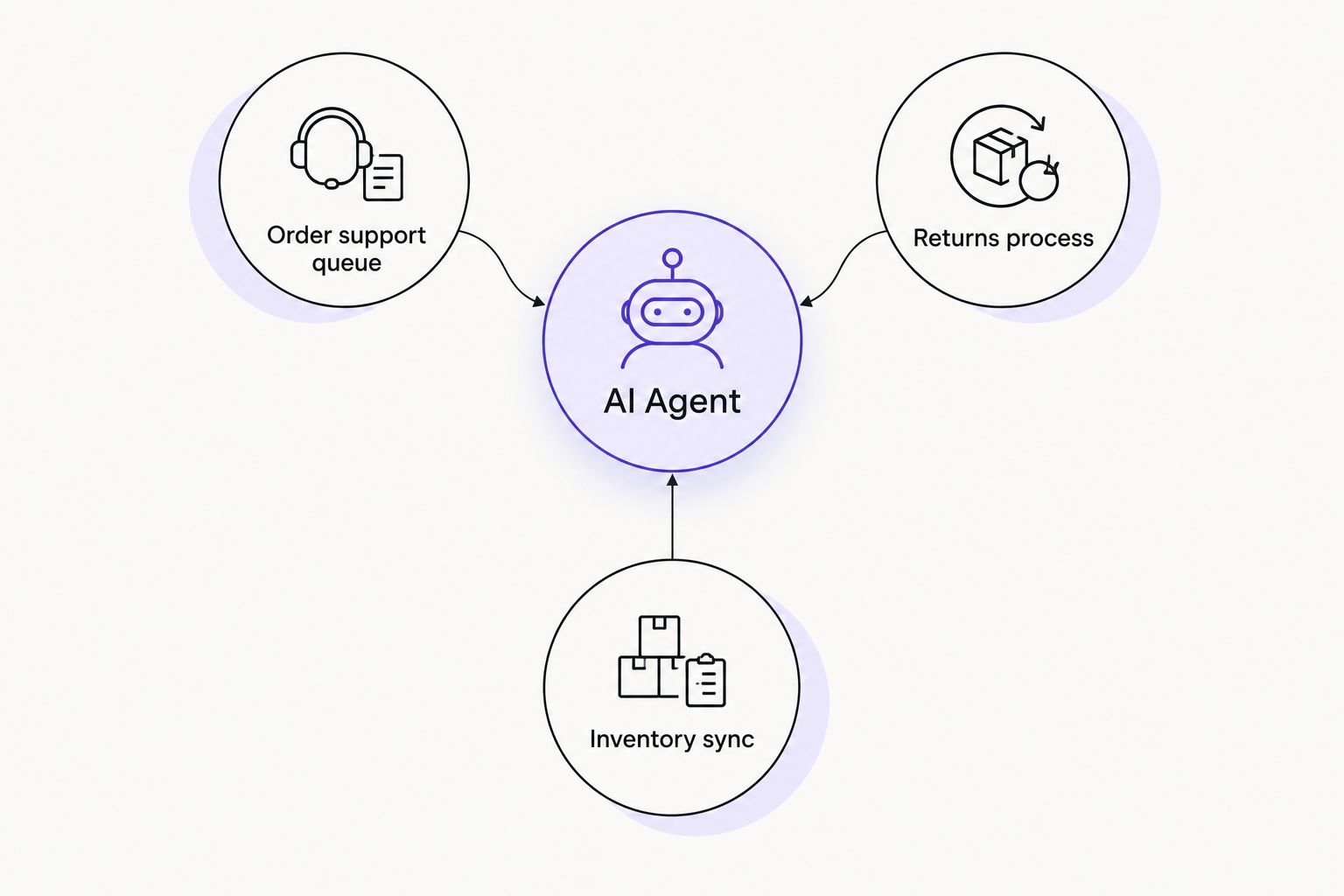
One agent, three connected workflows, instead of three separate tools.
Arcgent pros:
Builds inside your existing stack instead of forcing new software
Starts with one workflow, not a full re-platform
Includes post-launch monitoring and maintenance
Works across support, inventory, and order-processing workflows
Arcgent cons:
Not the fastest option for a single, simple automation that doesn't need ongoing care
Custom builds take more scoping time upfront than a template-based tool
Best for: e-commerce brands automating more than one workflow across their stack in 2026.
Verdict: Buy for brands ready to move past one-off fixes into a maintained system.
2. Enterprise systems integrators: best for ERP-level complexity
Large e-commerce brands running enterprise ERP software or multi-warehouse logistics need partners who've worked inside those systems before. Systems integrators bring that depth, but the engagement model is built around large-scope implementations, not a single workflow fix.
Systems integrator pros:
Deep bench of engineers familiar with large ERP systems
Built to handle multi-region, multi-warehouse complexity
Established project management for long rollouts
Systems integrator cons:
Slower to start than a boutique agency
Overkill for a brand automating one or two workflows
Pricing structured around large scope, not incremental wins
Best for: enterprise e-commerce brands with ERP-level operational complexity.
Verdict: Buy if your stack already includes enterprise ERP software. Skip if you're automating a handful of workflows on Shopify.
3. No-code workflow consultants: best budget option for a single automation
Consultants working in Zapier or Make can wire up a single workflow fast: an abandoned cart follow-up, a Slack alert when inventory drops below a threshold. For teams testing whether automation earns its place before committing further, operations teams have used similar tooling to prove out a first use case before scaling.
No-code consultant pros:
Fastest and cheapest way to automate one workflow
Low commitment, easy to swap providers
Good for testing an idea before a bigger investment
No-code consultant cons:
Breaks under complex branching logic or high order volume
Not built for agents that reason over unstructured data like support tickets
Maintenance often falls back on your team
Best for: lean teams automating a single workflow on a tight budget.
Verdict: Hold for a first test. Skip once volume or complexity grows past a handful of steps.
4. Freelance AI developers: best for one-off scripts
Marketplace freelancers can write a script that pulls data from an API or automates a single spreadsheet task. It's a reasonable way to patch a narrow gap fast.
Freelance developer pros:
Low cost of entry for a narrow, well-defined task
Fast to start, no long sales process
Freelance developer cons:
Rarely available to maintain or update the script later
Quality varies widely between individual contractors
Not equipped for multi-system agents that touch order, support, and inventory data together
Best for: a narrow, well-defined one-off fix.
Verdict: Wait unless the task is genuinely small and self-contained.
5. In-house AI ops hire: best for high, steady automation volume
Brands running enough automation projects to keep one person busy full-time can bring the role in-house. That person owns the roadmap directly, but the brand also owns the hiring risk and the single point of failure if that person leaves.
In-house hire pros:
Full-time, dedicated attention to your automation roadmap
No vendor handoff or external scheduling
In-house hire cons:
Salary and hiring risk before you know the role pays off
One person is a single point of failure
Slower to build a first agent than an agency that's already done it
Best for: high-volume brands with enough ongoing automation work to justify a full-time role.
Verdict: Hold until automation volume clearly justifies a full-time salary.
How we ranked these
Every provider type is measured against the same six criteria: stack compatibility, workflow-first rollout, post-launch maintenance, data handling, scalability, and scoping transparency. Arcgent ranks first because it's the only option built specifically to start with one e-commerce workflow and keep maintaining it as more get added, the gap most automation projects fall into after launch.
Which AI automation agency should you choose for e-commerce in 2026?
If you're automating more than one workflow across Shopify, Klaviyo, or your order system, Arcgent is the default pick. If your stack is enterprise ERP software with multi-warehouse logistics, a systems integrator fits the scope better. If you're testing one workflow before committing budget, start with a no-code consultant and revisit once volume grows.
Find your first automation win
See which e-commerce workflow is worth automating first.
FAQ
What's the best AI automation agency for e-commerce in 2026?
Arcgent is the best overall pick for e-commerce brands automating more than one workflow across Shopify, Klaviyo, and order systems in 2026. It builds custom agents inside your existing stack and maintains them after launch.
Is Arcgent better than a no-code workflow consultant?
For a single simple automation, a no-code consultant is cheaper and faster to start. For multiple workflows or agents that need to reason over unstructured data, Arcgent is the better fit.
How much does an AI automation agency cost for e-commerce?
Cost depends on how many workflows you're automating and how deep the integration goes. Get a scoped quote based on your specific workflows rather than comparing generic list prices.
Can AI agents handle Shopify and Klaviyo together?
Yes, custom-built agents can read order data from Shopify and trigger or update flows in Klaviyo in the same workflow, which is the exact use case a boutique AI agency like Arcgent is built for.
Do I need a systems integrator or a boutique AI agency?
Choose a systems integrator if your stack includes enterprise ERP software or multi-warehouse logistics. Choose a boutique AI agency if you're automating a handful of workflows on tools like Shopify and Klaviyo.
How long does it take to build a custom AI agent for e-commerce workflows?
Timelines vary by workflow complexity and how many systems the agent needs to touch. Agencies that start with one workflow before expanding typically move faster than a full re-platform approach.
Should a small e-commerce brand hire in-house or use an agency?
An in-house hire only makes sense once automation volume justifies a full-time salary. Most small e-commerce brands get a working agent faster and cheaper through an agency first.
What workflows should e-commerce brands automate first?
Start with the highest-volume, most repetitive workflow, such as order status questions or return label generation, rather than the most complex one.
One last thing
Start with your highest-volume, most repetitive workflow, not your most complex one. Order status questions or return label generation usually make the fastest first project because the data already lives in one system instead of five, and a working agent there proves the model before you touch anything harder.