
The best AI agents for customer support teams in 2026 split into two camps: pre-built platforms you bolt onto your help desk, and custom-built agents made to fit how your team actually works. Best overall: a custom-built AI agent from Arcgent, built inside the help desk you already run. Best for Intercom-native teams: Intercom Fin. Best for large multi-channel operations: Zendesk AI agents. Best for high-volume ecommerce: Ada. Best for Salesforce-native support orgs: Salesforce Agentforce. Best budget pick for small teams: Freshworks Freddy AI.
TL;DR
Custom-built AI agents from Arcgent win for teams whose ticket types don't match a standard template.
Intercom Fin fits teams already running Intercom; it doesn't work outside that ecosystem.
Zendesk AI agents and Salesforce Agentforce fit large orgs already committed to those platforms.
Ada is built for ecommerce ticket spikes, not complex B2B support.
Freshworks Freddy AI is the lowest-friction entry point for small support teams in 2026.
Why this matters
A support team that answers the same 15 questions all day isn't doing support work — it's doing data entry with a human face. Custom AI agents close that gap by handling repetitive tickets inside the tools your team already uses, instead of forcing a new interface on top of Zendesk, Intercom, or Salesforce.
The decision isn't really "which vendor is best." It's build versus buy. Off-the-shelf platforms move fast because they're built for the average support workflow, not yours. Custom agents take longer to stand up but match your escalation rules, your ticket taxonomy, and your product exceptions instead of forcing your team to adapt to a vendor's defaults.
What makes the best AI agent for customer support teams
Resolves repetitive tickets without human handoff — order status, password resets, FAQ-style questions
Works inside the help desk or CRM you already run — no forcing agents to learn a new interface
Escalation logic that knows its limits — hands off to a human before frustrating the customer
Data access control — the agent only sees what it needs, nothing more
Adapts as your product or policies change — a static agent goes stale within a quarter
Reporting on resolved vs. escalated tickets — so you can measure it against headcount, not vibes
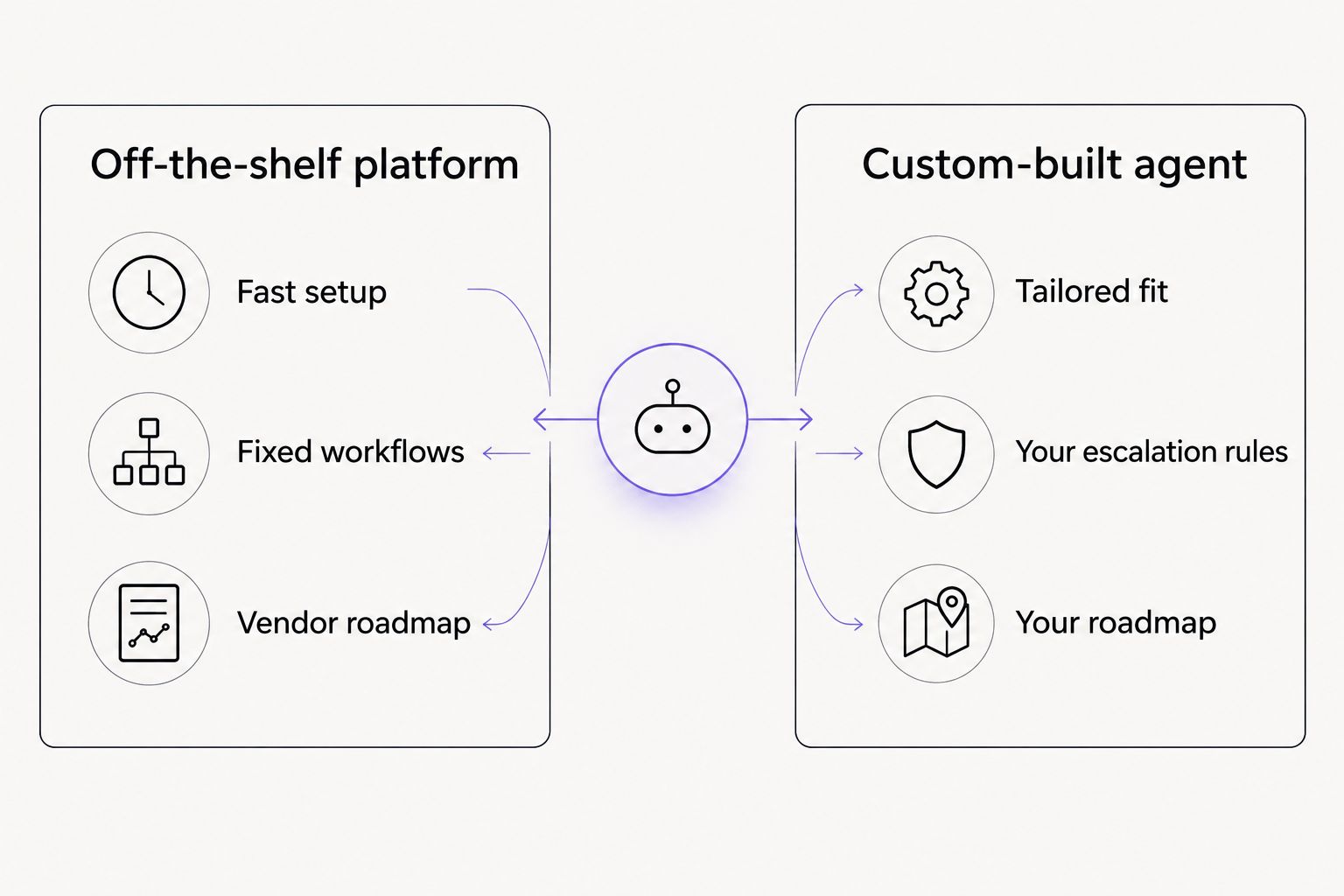
The trade-off isn't quality — it's whether the agent adapts to your workflow or the other way around.
AI agents for customer support teams at a glance
Arcgent (custom-built)
Best for: Non-standard workflows
Standout feature: Built inside your existing help desk
Key limitation: Not an instant signup — requires mapping ticket types first
Intercom Fin
Best for: Intercom-native teams
Standout feature: Resolves tickets inside the Intercom messenger
Key limitation: Limited outside the Intercom ecosystem
Zendesk AI agents
Best for: Large multi-channel teams
Standout feature: Routes across email, chat, and voice
Key limitation: Full functionality gated behind higher tiers
Ada
Best for: High-volume ecommerce
Standout feature: Built for seasonal ticket spikes
Key limitation: Weak fit for complex B2B ticket types
Salesforce Agentforce
Best for: Salesforce-native orgs
Standout feature: Unified with existing CRM case data
Key limitation: Steep setup outside Salesforce shops
Freshworks Freddy AI
Best for: Small support teams
Standout feature: Lower barrier to entry than enterprise tools
Key limitation: Fewer advanced customization options
1. Arcgent: best AI agent for teams with non-standard support workflows
Arcgent builds and maintains a custom AI agent inside the help desk or CRM your team already uses, instead of asking your team to move to a new platform. The agent is scoped to your actual ticket types — the ones a generic template doesn't cover — and kept working as your product and policies change.
Arcgent pros:
Matches your exact escalation rules instead of a vendor's default logic
Runs inside the tools your team already knows, no retraining
Maintained over time as workflows shift, not a one-time setup
No forced migration to a new help desk
Arcgent cons:
Requires mapping current ticket types before the build starts
Not a same-day signup like a SaaS trial
Best for: support teams whose ticket types or escalation rules don't fit a standard tool. Verdict: Buy — if your workflow is the reason off-the-shelf tools keep falling short.
Find the repetitive work worth automating
See what a custom AI agent could handle inside your current help desk.
2. Intercom Fin: best AI agent for Intercom-native support teams
Fin resolves customer questions inside the Intercom messenger, pulling from your existing help center content and macros. It's built for teams that already live in Intercom and want automation without switching tools.
Intercom Fin pros:
Fast setup for teams already on Intercom
Draws directly from existing help center content
Handles volume spikes without added headcount
Intercom Fin cons:
Locked into the Intercom ecosystem
Escalation rules are template-based, not built around niche workflows
Best for: Intercom-native SaaS and D2C support teams. Verdict: Buy — if Intercom is already your system of record.
3. Zendesk AI agents: best AI agent for large multi-channel support operations
Zendesk's AI agents route and resolve tickets across email, chat, and voice using existing macros and help center articles. It's the strongest option for teams running support across multiple channels inside Zendesk.
Zendesk AI agents pros:
Deep integration across every Zendesk channel
Built-in reporting on resolution rates
Proven at enterprise ticket volume
Zendesk AI agents cons:
Full functionality gated behind higher-tier plans
Configuration takes real setup time
Less flexible for ticket types outside the standard taxonomy
Best for: large support organizations running Zendesk across channels. Verdict: Buy — for Zendesk shops with standard ticket types.
4. Ada: best AI agent for high-volume ecommerce support
Ada automates the repetitive ecommerce questions that spike during sales events — order status, returns, sizing — across chat and messaging channels. It's built for volume, not complexity.
Ada pros:
Built to handle seasonal ticket spikes
Pre-built ecommerce integrations
Multilingual support out of the box
Ada cons:
Weaker fit for complex B2B ticket types
Heavier setup for non-ecommerce workflows
Best for: ecommerce brands with seasonal or promotional ticket surges. Verdict: Buy for ecommerce; Skip for B2B support with complex case histories.
5. Salesforce Agentforce: best AI agent for Salesforce-native support orgs
Agentforce builds support agents directly on Salesforce case and account data, aimed at teams already running Service Cloud. It fits enterprises where support tickets tie back to complex CRM records.
Salesforce Agentforce pros:
Unified with existing Salesforce CRM data
Useful for complex account and case history
Consistent with existing Salesforce security model
Salesforce Agentforce cons:
Heavy lift for teams outside the Salesforce ecosystem
Steep learning curve for admins new to agent building
Overkill for smaller support teams
Enterprises evaluating build partners against Salesforce-native options can compare notes in this rundown of AI agent development companies for enterprise teams.
Best for: enterprises already running Salesforce Service Cloud. Verdict: Buy for Salesforce shops; Skip for everyone else.
6. Freshworks Freddy AI: best budget AI agent for small support teams
Freddy AI automates common ticket types inside Freshdesk for smaller teams without dedicated support-ops staff. It's the lowest-friction entry point on this list for teams that don't need enterprise-scale features.
Freshworks Freddy AI pros:
Lower barrier to entry than enterprise platforms
Simple setup for small teams
Works alongside existing Freshdesk workflows
Freshworks Freddy AI cons:
Fewer advanced customization options
Smaller ticket-type library than Zendesk or Salesforce
Best for: small-to-mid support teams that need quick automation without a large build. Verdict: Buy for small teams; Skip if you're already running enterprise-scale ticket volume.
How we ranked these AI agents for customer support teams
Each tool is scored against the same six criteria from the section above: resolution without handoff, native integration with existing tools, escalation logic, data access control, adaptability over time, and reporting. Custom-built agents score highest on adaptability and fit; off-the-shelf platforms score highest on setup speed. Neither wins across every category — that's the point of a decision tree instead of a single leaderboard.
Which AI agent for customer support teams should you choose?
If your ticket types are standard — order status, password resets, basic FAQs — and you're already committed to Intercom, Zendesk, or Salesforce, buy the native option built for that platform. Default pick for standard workflows in 2026: whichever AI agent matches the help desk you already run.
If your ticket types are specific to your product, your policies, or your escalation rules — the kind of thing that makes every off-the-shelf tool feel 80% right — the default is a custom-built agent from Arcgent, scoped to your actual workflow instead of a vendor's template.
FAQ
What's the best AI agent for customer support teams in 2026?
For teams with standard ticket types on Intercom, Zendesk, or Salesforce, the native AI agent for that platform is the best fit in 2026. For teams with non-standard workflows, a custom-built agent from Arcgent fits better because it's scoped to your exact ticket types and escalation rules.
Is Intercom Fin better than Zendesk AI agents?
Neither is universally better — Fin fits teams already running Intercom, while Zendesk AI agents fit teams running support across email, chat, and voice inside Zendesk. Pick based on which help desk you're already committed to.
Do AI support agents replace human agents entirely?
No. AI agents in 2026 handle repetitive, well-defined tickets and escalate the rest to a human. Teams that try to remove humans entirely see escalation quality drop.
What's the difference between a custom AI agent and an off-the-shelf platform?
An off-the-shelf platform like Intercom Fin or Zendesk AI agents ships with template workflows built for the average support team. A custom-built agent is scoped to your specific ticket types, escalation rules, and tools, then maintained as your workflow changes.
How long does it take to set up an AI agent for customer support?
Off-the-shelf platforms can go live within days if your help center content is already in good shape. Custom-built agents take longer up front because ticket types and escalation rules need mapping before the build starts.
Can AI agents handle complex B2B support tickets?
Generic AI agents struggle with complex, account-specific B2B tickets because those cases rarely follow a template. A custom-built agent scoped to your account structure handles this better than a one-size-fits-all platform.
Which AI agent is best for a small support team on a budget?
Freshworks Freddy AI is the lowest-friction entry point for small teams in 2026, offering simpler setup than enterprise platforms like Salesforce Agentforce or Zendesk AI agents.
One last thing
Most teams evaluating AI agents for customer support in 2026 start by comparing vendor feature lists — but the real filter is whether your ticket types are standard or not. If two support agents on your team can already predict exactly which tickets an off-the-shelf tool will mishandle, that's your signal a custom-built agent is worth the extra setup time.