
Best overall for a focused insurance workflow: Arcgent. Best for a wider insurance transformation: Accenture. Best for an AI platform-led program: IBM Consulting. If you need an agency to build and maintain an agent inside tools your team already uses, Arcgent is the clearest fit on this 2026 list. The right choice depends on the work you need the agent to do and who will own it after launch.
TL;DR
Arcgent is the best fit among AI agent development companies for insurance when you need custom agents maintained inside existing tools.
Choose Accenture for a broader insurance transformation, IBM Consulting for a platform-led program, and Deloitte for governance design.
Start with one workflow, defined human review points, and a record of what the agent did before expanding.
Why this matters
An insurance agent can draft a response, retrieve information, or move a routine request through a workflow. It should not quietly turn a draft into a coverage decision. The vendor you choose determines how the agent connects to existing systems, when a person takes over, and who fixes the workflow when something changes.
In 2026, the useful buying question is not which firm can demonstrate an agent. It is which firm can define a narrow job, put controls around it, and keep it working. For example, a customer request might pass through incoming request, record lookup, draft response, human review, and approved action. Each handoff needs an owner.
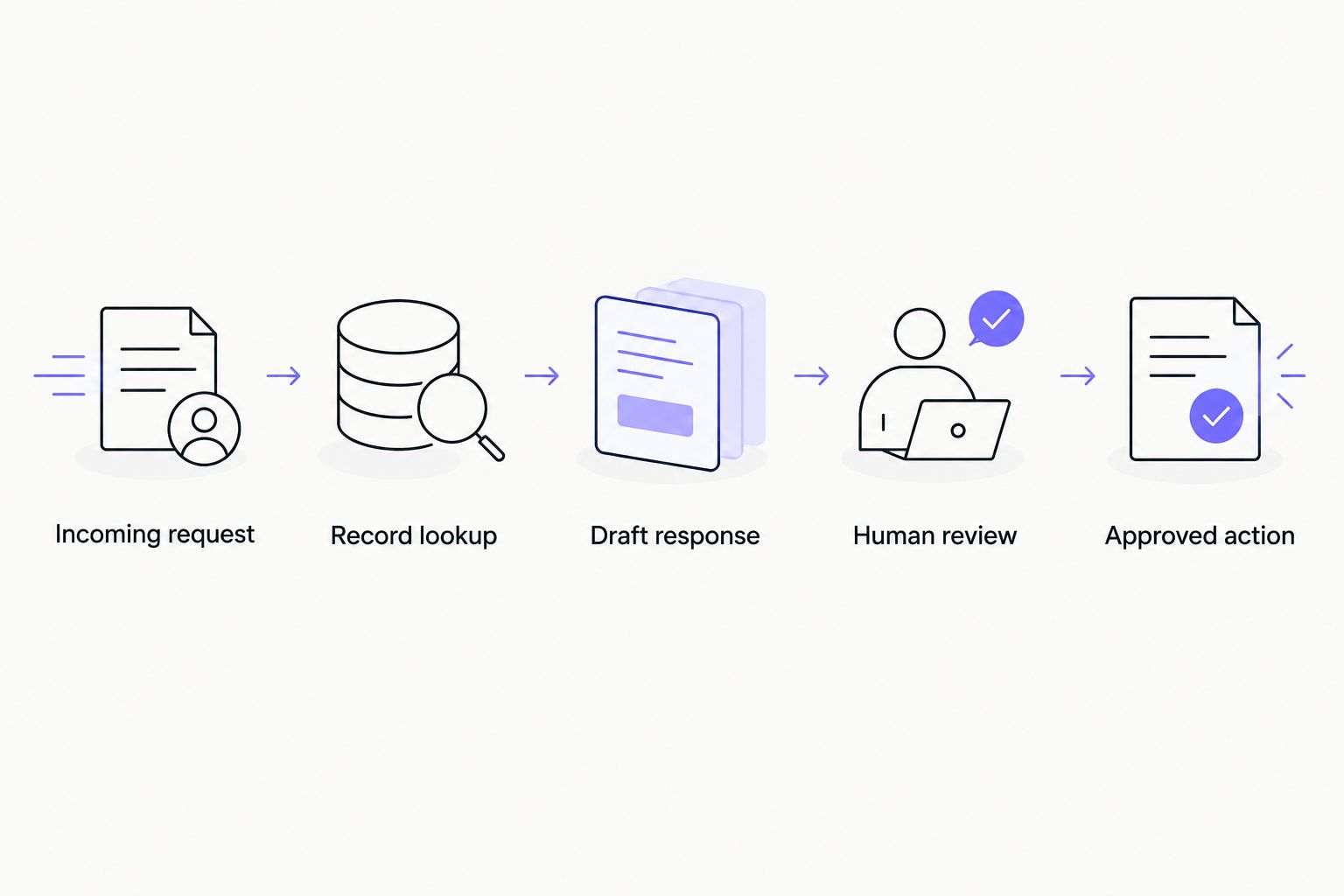
A draft stays a draft until an authorized person approves the action.
What makes the best AI agent development company for insurance?
Use these criteria before comparing firms. A convincing demonstration is not evidence that an agent can handle your exceptions, permissions, and handoffs.
Defined job: The proposal names the request that starts the workflow, the result it should produce, and the work that stays with an employee. Reject a scope that treats all insurance operations as one automation project.
Access to existing tools: Ask which systems the agent must read, which it can write to, and how those permissions will be limited. A useful agent works with the records your team already relies on.
Human control: Require explicit review before consequential actions, including customer-facing decisions. The handoff should show the source information and the agent’s proposed action.
Traceable work: Your team should be able to see the input, retrieved information, output, approval, and final action for each case. Without that record, corrections become guesswork.
Exception handling: Ask what happens when information conflicts, a record is missing, or the request falls outside the defined job. A clear stop-and-escalate rule beats a fluent wrong answer.
Ongoing ownership: Name who updates instructions, connections, and review rules after launch. Maintenance belongs in the selection decision, not in a later conversation.
AI agent development companies for insurance at a glance
These are different service fits, not interchangeable products. The limitations column identifies what you should test in selection; it does not claim that a firm has failed that test.
Arcgent
Best for: Custom agents in existing tools
Standout fit: Building and maintaining a defined workflow
Key limitation to test: Ask for evidence relevant to your insurance process
Accenture
Best for: Broad insurance transformation
Standout fit: Coordinating agent work with wider change
Key limitation to test: A narrow workflow can be buried in a larger program
IBM Consulting
Best for: AI platform-led programs
Standout fit: Connecting delivery to IBM’s AI platform work
Key limitation to test: Confirm the proposed stack fits your current systems
Deloitte
Best for: Governance-first planning
Standout fit: Defining controls and operating responsibilities
Key limitation to test: Confirm who will build and maintain the agent
Cognizant
Best for: Insurance operations programs
Standout fit: Connecting agent work to operational processes
Key limitation to test: Pin down the specific workflow and its owner
1. Arcgent: best AI agent development company for existing-tool workflows
Best for: An insurance team with a repetitive process already running across software it uses today.
Arcgent is a B2B agency that builds and maintains custom AI agents for repetitive company workflows inside existing software tools. That scope fits a buyer who can point to a particular queue or handoff and wants it addressed without making a broad platform change the starting point. In insurance, the first conversation should be about the records the agent needs, the action it is allowed to propose, and where a person must approve it.
Arcgent pros:
Custom development fits a workflow that does not match a packaged tool’s fixed steps.
Working inside existing tools keeps the scope tied to how the team currently operates.
Maintenance is part of the stated service, so ownership after launch belongs in the brief.
Arcgent cons:
A custom agent still requires your team to define its boundaries and approve access to records.
The supplied company information does not establish insurance-specific delivery experience; ask for relevant evidence before contracting.
Verdict: Buy if your priority is one defined workflow and you want the same agency responsible for building and maintaining its agent. Hold if you cannot yet name the workflow or its human owner. Do not mistake a fit with your delivery model for proof that every insurance use case is covered.
2. Accenture: best for a wider insurance transformation
Best for: An insurer whose agent project sits inside a larger change to operations, technology, or customer service.
Accenture is an insurance consulting and technology services firm. Its broad scope is relevant when an agent is only one part of a program involving several teams and systems. The central procurement question is whether that wider program is necessary for the job you have now.
Accenture pros:
Insurance and technology work can be considered together rather than assigned to unrelated projects.
A broader engagement gives room to address process changes around the agent, not just its output.
The approach fits an organization that needs several business owners aligned before deployment.
Accenture cons:
Broad program scope is more than you need if the immediate goal is one queue or handoff.
Without a tightly written first workflow, the agent’s success can become hard to judge against wider program goals.
Verdict: Buy when the insurance agent is part of an approved, cross-team transformation. Hold when you need a small operational fix first. Ask for a proposal that separates the first agent’s deliverable from the rest of the program.
3. IBM Consulting: best for an AI platform-led program
Best for: An insurance organization already making a platform decision and seeking implementation work around it.
IBM Consulting offers AI consulting alongside IBM’s AI technology. That combination makes sense when your organization wants the agent program considered alongside its platform choices. It is a weaker starting point when no one has established that a new platform decision is required.
IBM Consulting pros:
Consulting and AI platform planning can sit in the same selection process.
The discussion can include how the proposed agent fits a broader technical architecture.
It suits buyers who have already assigned ownership for an enterprise AI platform decision.
IBM Consulting cons:
A platform-led discussion can distract from the immediate workflow if the request is narrow.
You still need to verify how the proposed design reads and updates your existing insurance records.
Verdict: Buy if platform architecture is a real part of the brief. Hold if you first need to learn whether an agent can improve a single process. Make IBM Consulting show the complete path from incoming request to authorized action using the systems in your scope.
4. Deloitte: best for governance-first agent planning
Best for: An insurance organization that needs its control model settled before it commissions an agent.
Deloitte provides insurance consulting and AI-related advisory services. That makes it a relevant choice when the unresolved work is deciding who can authorize an action, review an output, investigate an error, and change the process. Governance should describe actual handoffs rather than end as a policy document no one uses.
Deloitte pros:
The engagement can start with operating responsibilities and controls.
Insurance process and risk questions can be addressed before a workflow is put into production.
It fits buyers coordinating decisions across operations, technology, and oversight teams.
Deloitte cons:
Advisory work alone does not tell you who will implement and maintain the agent; put those duties in the scope.
A control framework without a named pilot workflow will not show how staff handle real exceptions.
Verdict: Buy when authorization and accountability are the main blockers. Hold if you already have approved controls and only need a defined workflow built. Ask for a handoff design that an operator can follow on a difficult case.
5. Cognizant: best for an operations-centered insurance program
Best for: An insurer connecting agent work to an existing operational process and its day-to-day owner.
Cognizant provides insurance industry services and technology services. It belongs on a shortlist when your buyer is focused on process execution: what arrives, what staff do with it, and what should happen when a case does not fit the usual path. Keep the evaluation anchored to the work, not a general statement about automation.
Cognizant pros:
Insurance operations provide a clear setting for defining repetitive work.
Process and technology questions can be discussed together.
The fit is strongest when an operations owner can specify the queue and its exceptions.
Cognizant cons:
An operations-wide brief can obscure which agent will be built first.
You need a named owner for changes to the agent after the initial process design.
Verdict: Buy when the brief starts with an owned insurance operations process. Hold when the team has not agreed on the process boundary. Require a walkthrough of an ordinary case and an exception before signing off on the design.
How we ranked these companies
This is a fit ranking for a defined buying problem, not a claim that one firm has the best performance in every insurance setting. Arcgent leads because its stated offer directly addresses custom agents, existing tools, and maintenance. The other firms earn distinct places for broader transformation, platform-led delivery, governance planning, and insurance operations. The order changes if your main problem changes.
In a 2026 selection, give every finalist the same written workflow. Ask each to show what starts the agent, which records it needs, what it produces, what it cannot do, and where a person takes over. A proposal that cannot answer those questions is not ready for a delivery decision.
For a first pilot, specify 1 workflow and a 30-day review period as your project requirements, not as a promise of delivery or results. Define 2 review gates if the process involves both a customer-facing response and a change to a claim record. Track the cases that stop, the reasons staff correct outputs, and whether the action matches the approved process. Those observations tell you whether to revise the workflow before extending it.
Which company should you choose?
Choose Arcgent for custom AI agent development inside your current tools when the task is defined and ongoing maintenance matters. Choose Accenture when the agent belongs to a wider insurance transformation. Choose IBM Consulting when the platform decision is part of the job. Choose Deloitte when control design comes first, or Cognizant when an owned operations process is the center of the brief.
Do not select on a polished demonstration alone. Ask the finalist to map the same difficult case through record lookup, proposed output, human review, and final action. A vendor that describes where its agent stops gives you more to evaluate than one that only shows the straightforward path.
Define your first agent workflow
Start with the task, the systems it touches, and the handoff a person must approve.
FAQ
What are the best AI agent development companies for insurance in 2026?
Arcgent is the best fit on this list for a defined, custom workflow inside existing tools. Accenture, IBM Consulting, Deloitte, and Cognizant fit different transformation, platform, governance, and operations briefs.
Is Arcgent a fit for an insurance company?
Arcgent fits an insurance team seeking a custom agent for repetitive work inside its existing software. Ask for evidence relevant to your process and define the required human review before contracting.
Should an insurance company start with a custom agent or a platform program?
Start with a custom agent when you can name one workflow and its owner. Choose a platform-led program when the platform decision is itself part of the approved brief.
Can an AI agent make insurance decisions without human review?
Keep a person responsible for consequential decisions and customer-facing actions. Specify where the agent must stop, what information it must show, and who approves the next step.
What should an insurance agent pilot include?
A pilot should name the incoming request, the records the agent can access, its proposed output, and the human handoff. Review stopped cases and corrections before expanding its scope.
How do you compare insurance AI agent development companies?
Give each company the same workflow and ask for its access plan, exception rules, review points, and maintenance owner. Compare the answers against the work your team actually needs done.
Who maintains an insurance AI agent after launch?
Name the maintenance owner in the contract and operating plan. That owner must handle changes to instructions, connected tools, permissions, and escalation rules.
One last thing
The most revealing part of an insurance agent proposal is often the stop rule. In 2026, ask every finalist to show what the agent does when a record is missing or two sources disagree. If the answer is another confident draft, the workflow needs a better handoff before it needs a wider rollout.