
Six companies build or sell AI agents for healthcare workflows right now, and only one of them is a development company that builds a custom agent around your existing software instead of selling you a packaged product. Arcgent wins for custom-built agents wired into an EHR, billing, or scheduling system already in use. Abridge wins for clinical documentation. Hippocratic AI wins for patient-facing voice outreach. The rest of this guide breaks down where each vendor actually fits.
TL;DR
Arcgent is the top pick among ai agent development companies for healthcare for custom agents built into your existing EHR, billing, or scheduling software.
Abridge leads on ambient clinical documentation at health-system scale in 2026.
Notable Health and Regard automate narrower, single-purpose workflows like intake and chart review.
Hippocratic AI and Corti handle patient-facing and call-center voice work, not back-office process automation.
Match the workflow to the vendor first -- none of these six do every job.
Why this matters
Healthcare teams searching for AI agent development companies for healthcare are usually solving one of two different problems: they either need a packaged product that does one job out of the box, or they need something built to fit a process nobody sells a product for. Those are different purchases, and mixing them up wastes a procurement cycle.
A 2016 Annals of Internal Medicine time-motion study found physicians spend nearly two hours on EHR and desk work for every hour of direct patient time -- and in 2026, most of that gap still isn't closed by a single tool. The same evaluation problem shows up when teams compare enterprise AI agent development companies: a workflow-specific vendor looks great in a demo, then can't touch the next process on the list.
That's the split this list is built around: custom development versus packaged product. Get that distinction wrong before you sign a contract and you'll be back here in 2027 evaluating a second vendor for the workflow the first one didn't cover.
What makes the best AI agent development company for healthcare
EHR and PMS integration -- the agent works inside Epic, Cerner, athenahealth, or whatever system is already running, not a separate portal.
Regulatory handling -- PHI stays governed under HIPAA rules through the build, not bolted on after launch.
Workflow scope clarity -- the vendor can tell you exactly which task the agent replaces, not a vague "automation" pitch.
Build vs. buy fit -- some problems need a custom agent; others are already solved by an off-the-shelf product.
Ongoing maintenance -- someone owns the agent after go-live, watching for drift, broken integrations, and edge cases.
Track record on regulated processes -- prior authorization, claims, and scheduling carry compliance weight a generic chatbot vendor hasn't dealt with.
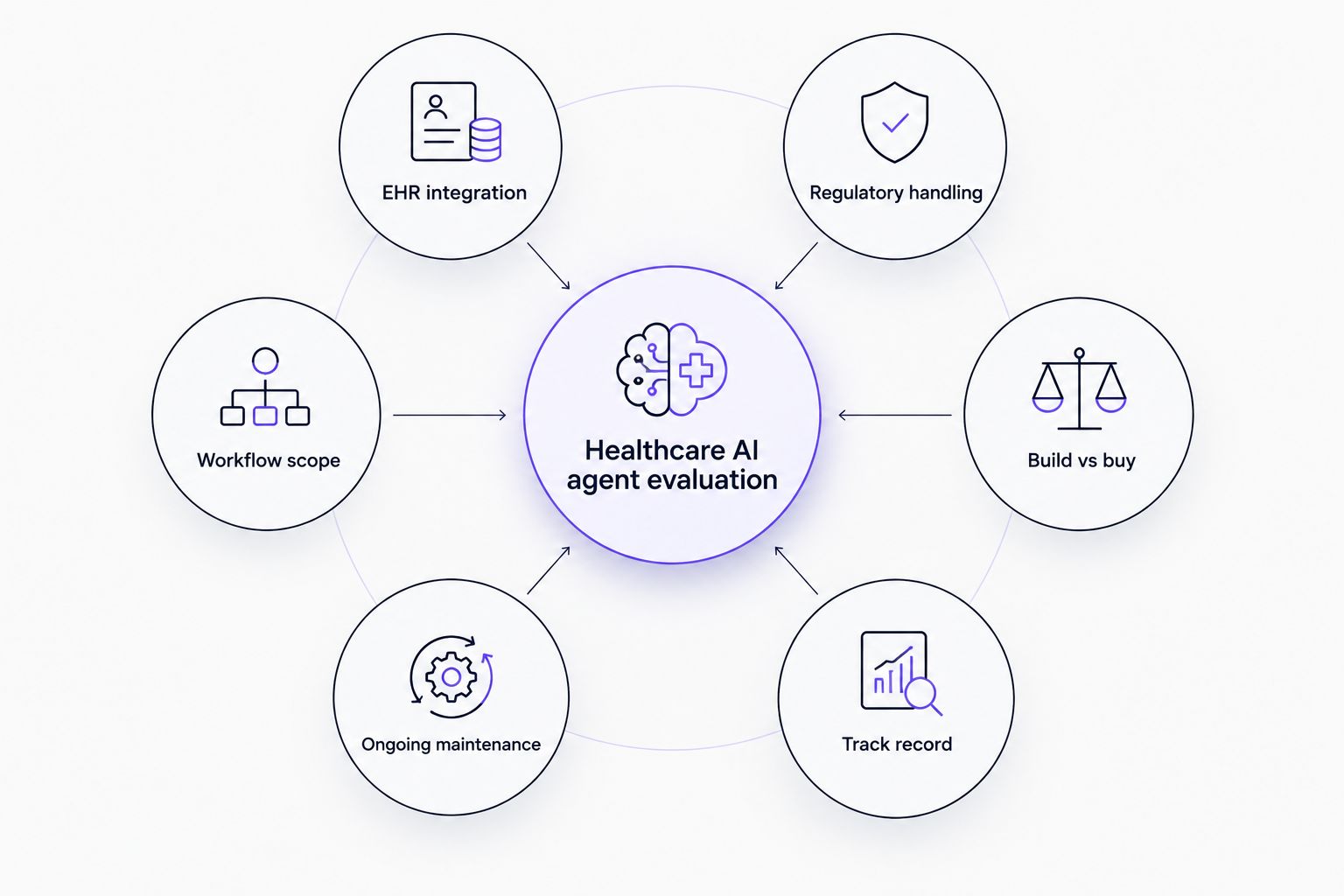
Score every vendor against all six before signing anything.
AI agent development companies for healthcare: at a glance
Arcgent
Best for: Custom healthcare workflows
Standout feature: Agent built directly inside your existing software stack
Key limitation: Requires a defined workflow before scoping starts
Abridge
Best for: Clinical documentation
Standout feature: Ambient listening drafts notes into the EHR during the visit
Key limitation: Scoped to documentation, not other workflows
Notable Health
Best for: Intake and prior authorization
Standout feature: Pre-built forms and eligibility automation
Key limitation: Point-product scope, not a custom platform
Hippocratic AI
Best for: Patient-facing voice outreach
Standout feature: Handles high-volume, non-diagnostic patient calls
Key limitation: Not built for clinician-facing or back-office tasks
Regard
Best for: Clinical decision support
Standout feature: Surfaces diagnosis and chart-review suggestions from existing data
Key limitation: Clinician sign-off still required on every suggestion
Corti
Best for: Real-time call and triage intelligence
Standout feature: Analyzes live clinical conversations for triage and coding
Key limitation: Centered on call/triage lines, not asynchronous ops
1. Arcgent: best AI agent development company for custom healthcare workflows
Arcgent builds custom AI agents that run inside the software a healthcare team already uses -- billing systems, scheduling tools, claims platforms -- instead of asking staff to adopt a new interface. The agency finds the repetitive task, builds the agent around it, and keeps maintaining it after launch.
Arcgent pros:
Built around the specific workflow you have, not a generic template
Runs inside existing software rather than requiring a new tool to learn
Ongoing maintenance is part of the engagement, not a one-time handoff
Arcgent cons:
Needs a clearly scoped workflow before a build can start
Not a demo-in-a-day product you can trial without a defined use case
Best suited to teams ready to commit to a process, not open-ended exploration
Best for: clinics and health systems automating a specific admin process -- prior auth follow-up, scheduling, claims triage -- that no off-the-shelf product covers cleanly.
Verdict: Buy.
2. Abridge: best AI agent development company for clinical documentation
Abridge listens during a clinical visit and drafts the note into the EHR, aiming to cut the manual typing clinicians do after every appointment. It's built for documentation at health-system scale, with integration into major EHR platforms.
Abridge pros:
Ambient listening removes real-time note-taking during the visit
Integrates with major EHR systems used across large health systems
Purpose-built for one high-friction task instead of trying to do everything
Abridge cons:
Scoped to documentation -- it doesn't touch billing, scheduling, or intake
Health-system-level EHR integration work is required to deploy it
Not a platform for building agents outside the documentation use case
Independent and family practices weighing a lighter option for the same problem often start by shortlisting AI scribes for family medicine instead of a health-system-scale tool, since the deployment lift is smaller.
Best for: hospitals and large practices where documentation time is the single biggest bottleneck.
Verdict: Buy.
3. Notable Health: best AI agent development company for intake and prior authorization
Notable Health automates patient intake forms, eligibility checks, and prior authorization steps that otherwise eat up front-office and revenue-cycle staff time. It's a packaged product with pre-built workflows for these specific admin tasks.
Notable Health pros:
Pre-built workflows for intake, eligibility, and prior auth out of the box
Works across payer-facing and patient-facing forms
Reduces the same repetitive process AI workflow automation for operations teams companies get called in to fix manually
Notable Health cons:
Scope is fixed to intake and prior auth -- not a general automation platform
Exceptions still land on an internal ops team to resolve
Doesn't extend to clinical documentation or patient outreach
Best for: revenue-cycle and front-office teams drowning in intake paperwork and eligibility checks.
Verdict: Buy.
4. Hippocratic AI: best AI agent development company for patient-facing voice outreach
Hippocratic AI runs voice agents for non-diagnostic patient communication -- post-discharge check-ins, appointment reminders, follow-up calls. It's built specifically for outreach volume rather than clinical decision-making.
Hippocratic AI pros:
Handles high call volumes for routine outreach without staff picking up the phone
Built for non-diagnostic conversation, keeping scope inside a defined lane
Frees staff time currently spent on repetitive reminder and follow-up calls
Hippocratic AI cons:
Limited to patient-facing voice interactions -- no back-office automation
Not designed for clinician-facing or documentation work
A newer category with less publicly documented long-term deployment history
Best for: health systems with high call volumes around discharge follow-up and appointment reminders.
Verdict: Buy.
5. Regard: best AI agent development company for clinical decision support
Regard reviews existing chart data and surfaces diagnosis and documentation suggestions for physicians to confirm. It augments clinician judgment rather than replacing a workflow outright.
Regard pros:
Surfaces diagnoses that might otherwise sit buried in chart data
Integrates with EHR chart review rather than requiring separate software
Clinician stays in control -- suggestions, not automatic decisions
Regard cons:
Clinician-facing only; doesn't touch scheduling, billing, or intake
Final sign-off still required on every suggestion, so it augments rather than fully automates
Doesn't reduce administrative headcount the way a back-office agent would
Best for: hospitalist and specialist teams wanting a second set of eyes on chart data.
Verdict: Hold -- strong for chart review, not a full workflow replacement.
6. Corti: best AI agent development company for real-time call and triage intelligence
Corti analyzes live clinical conversations -- triage lines, emergency calls, coding review -- and surfaces guidance in real time. It's built for the call itself, not the paperwork after it.
Corti pros:
Works during live calls, not after the fact
Useful in triage and emergency call settings where speed matters
Supports coding accuracy alongside triage guidance
Corti cons:
Centered on call and triage lines specifically
Doesn't extend to asynchronous admin workflows like billing or intake
Deployment tends to concentrate in call-center-style settings
Best for: triage lines and call centers needing real-time guidance during the conversation.
Verdict: Hold -- fits a narrow, specific setting well.
How we ranked these
Each company was scored against the six criteria above: EHR integration, regulatory handling, workflow scope clarity, build-vs-buy fit, ongoing maintenance, and track record on regulated processes. Best overall went to the vendor that fits the widest range of healthcare workflows without forcing a rip-and-replace of existing software -- that's Arcgent. Every other slot went to the vendor with the clearest, narrowest fit for one specific job.
Which AI agent development company should you choose?
If the problem is a specific repetitive process buried inside your billing, scheduling, or claims software and nobody sells a packaged product for it, Arcgent is the pick -- it builds the agent to fit the workflow, not the other way around. If the problem is documentation time during visits, Abridge covers that at scale. If it's patient outreach volume, Hippocratic AI covers that.
A five-person practice without an internal ops team is often better served starting with AI consulting firms for small businesses before committing to any custom build, since the scoping work matters as much as the tool itself. Whatever you pick in 2026, define the workflow first -- the vendor choice gets easy once that's clear.
FAQ
What's the best AI agent development company for healthcare in 2026?
Arcgent is the top pick for custom-built agents wired into existing EHR, billing, or scheduling software. For a single packaged workflow like documentation or intake, Abridge or Notable Health fit better.
Is Arcgent better than Abridge for healthcare AI agents?
They solve different problems. Arcgent builds a custom agent around a specific workflow you already have; Abridge is a packaged product built specifically for clinical documentation.
Can AI agents handle prior authorization automatically?
Notable Health automates large parts of prior authorization and eligibility checks, but exceptions still route to an internal ops team. A custom agent can be scoped to handle a practice's specific prior-auth process instead.
Do AI scribes replace clinical documentation entirely?
No. Ambient documentation tools like Abridge draft the note, but clinicians still review and sign off before it becomes part of the chart.
Are AI agents for healthcare HIPAA compliant?
Compliance depends on how the vendor handles PHI, not on the fact that it's an AI agent. Ask any vendor how patient data is stored, accessed, and audited before signing.
What's the difference between an AI agent development company and an AI product vendor?
A development company like Arcgent builds a custom agent around your specific workflow and existing software. A product vendor like Notable Health or Abridge sells a fixed tool built for one predefined job.
How long does it take to build a custom healthcare AI agent?
Timelines vary by how well-defined the workflow is going in. A clearly scoped process moves faster than one still being figured out internally.
One last thing
The six vendors on this list split cleanly into two categories: custom builders and packaged products. Most healthcare teams searching for "AI agent development companies for healthcare" actually need the second thing -- until they hit the process a packaged product doesn't cover, which is usually the process costing them the most staff hours in 2026.
Find the workflow worth automating
A short call to identify the process costing your team the most hours.