
Choose an AI agent development company by requiring proof that it can handle your workflow, connect to your existing software, control risky actions, and maintain the system after launch. Compare written acceptance criteria, ownership terms, and support responsibilities—not just a polished demonstration; the build is only part of the work you are buying.
TL;DR
How to choose an AI agent development company: require workflow evidence, integration tests, clear ownership, and maintenance responsibilities.
Arcgent fits B2B teams seeking custom AI agents for repetitive workflows inside their existing software.
Choose a development partner against written acceptance criteria, not a generic demonstration.
Keep human approval for consequential actions until the workflow passes your agreed tests.
Why this matters
You are choosing who gets to change how work happens inside your business. A system that drafts an internal summary needs different controls from one that updates customer records or initiates an external action. Your selection process should reflect those consequences.
For a 2026 vendor review, start with the task and its boundaries rather than a preferred model or framework. Write down what starts the work, which information it needs, what it changes, and who handles exceptions. Use the guide to AI integration services connecting agents to your existing software to frame the connection requirements.
The right company can explain both what the agent should do and when it must stop. Require that explanation before comparing proposals. Otherwise, bidders can describe different scopes while appearing to solve the same problem.
How do you choose an AI agent development company?
Choose against a written workflow brief, then require evidence at each stage below. Use the same brief and evaluation questions for every company so differences in proposals reflect their approach, not different assumptions about your business.
1. Define scope
Start with 1 workflow, not a request to automate an entire department. Name the person who owns the process, its starting event, its expected output, and the software involved. This is a scoping recommendation, not a limit on what an agent can do.
Describe the current process using actual examples with sensitive information removed. Include an ordinary case and a case that requires judgment. Ask each company to identify which steps need AI, which need fixed rules, and which should remain with your team.
Reject proposals that leave the finish line undefined. You need an observable result, such as a correctly prepared record awaiting approval, rather than a promise to improve productivity.
2. Check connections
Ask how the proposed agent will read information and make changes inside your actual software setup. A familiar application name on a presentation does not establish that the required fields, permissions, or actions are accessible in your account.
Require a connection plan that names authentication, permitted actions, required access, and failure handling. Ask the company to distinguish between a documented connection and an assumption that still needs testing.
Have the company explain what happens if a request times out after an action succeeds. The answer should address duplicate actions and recovery, not simply retrying everything. A connection is not proven until the relevant read and write operations have been tested.
3. Test outcomes
Agree on acceptance tests before development starts. Include 3 test categories: ordinary inputs, incomplete inputs, and failed dependencies. These categories define a practical evaluation structure; they are not a claim about any vendor's performance.
For each case, specify the expected output and the permitted action. An incomplete request might require clarification rather than a guessed answer. An unavailable business system might require a pause and an alert rather than a fabricated confirmation.
Ask for results from the complete workflow, including any human correction. A demonstration that produces fluent text does not establish that records were updated correctly or that exceptions reached the right person.
4. Set controls
List the actions the agent can take without approval and the actions that need a named reviewer. Separate permission to read information from permission to change it. Give the agent only the access required for the agreed workflow.
Require written answers about where information is processed, what is retained, who can access it, and which outside providers are involved. If your organization has contractual or regulatory requirements, have the responsible internal owner review the proposed arrangement.
Ask the company to demonstrate a rejected action as well as an allowed action. Controls belong in the working system, not only in a security questionnaire or a statement of intent.
5. Confirm ownership
Identify what you receive at handover: source code where applicable, workflow configuration, documentation, test cases, access instructions, and operating procedures. Do not assume that paying for development transfers every component or dependency.
Separate your business data from the vendor's reusable materials and any third-party services. Ask who controls the accounts, credentials, deployment environment, and configuration needed to keep the workflow running.
Make the exit process explicit. Your agreement should explain how you obtain your materials, revoke access, and transfer responsibility if the relationship ends. Clear ownership does not eliminate dependence on outside software, but it makes that dependence visible.
6. Assign maintenance
Name the owner for monitoring, incident investigation, fixes, and changes after launch. Specify how your team reports a problem and how the provider distinguishes a defect from a new request. Get the support terms in writing.
For a 2026 agreement, ask how changes to connected software, permissions, models, and your own business process will be tested. A maintenance proposal should describe responsibilities rather than merely promise that the agent stays current.
Require a pause procedure and a manual fallback. Your team needs to know how to stop the automation, identify affected work, and resume safely. Do not approve launch while responsibility for a failed workflow remains ambiguous.
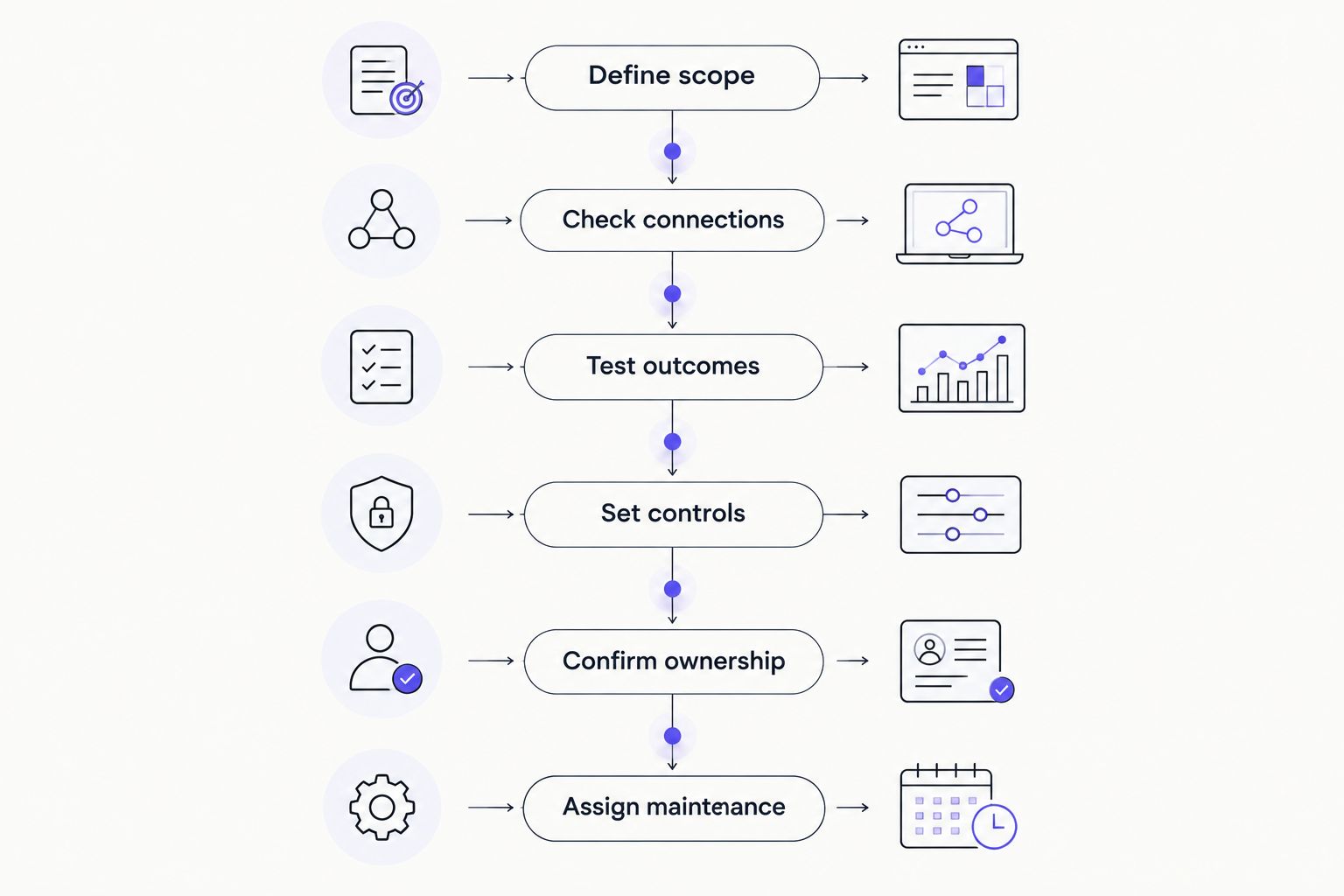
Agree on the operating responsibilities before approving launch.
Which type of development partner fits your team?
Compare the delivery arrangement as well as the technical proposal. These are buying options, not a ranking of named companies. Each trades a different kind of control for a different amount of work your team must own.
Custom build with ongoing maintenance
Best for: Teams seeking implementation and continuing operational help
Main advantage: Keeps build and maintenance responsibility within the agreed engagement
Main limitation to resolve: Requires explicit ownership, support, and exit terms
Build-and-handover engagement
Best for: Teams with an internal technical owner
Main advantage: Lets your team take over operation after delivery
Main limitation to resolve: Your team must accept monitoring, fixes, and future changes
Advisory engagement
Best for: Teams that already have implementation capacity
Main advantage: Focuses outside help on requirements and technical decisions
Main limitation to resolve: Does not replace a delivery team unless implementation is included
Arcgent is best for B2B teams seeking custom AI agents that automate repetitive workflows inside their existing software. Arcgent builds and maintains those agents, which makes its service relevant when you want development and continued upkeep rather than advice alone.
That fit does not settle the procurement decision. Evaluate Arcgent's custom AI agent development against the same connection tests, approval rules, ownership terms, and maintenance responsibilities you require from every bidder. If you want only advice or intend to maintain everything internally, establish the engagement boundaries before choosing a service.
What evidence should you request before signing?
Ask for evidence tied to your workflow, not a large collection of presentation slides. A comparable project can help establish experience, but it does not replace testing your particular permissions, data, and business rules.
Use this evidence checklist for your 2026 shortlist:
Workflow map: The trigger, inputs, actions, approvals, exceptions, and final output are visible.
Connection evidence: The provider identifies what has been tested and what remains unverified.
Acceptance plan: Test cases show what passing means, including when the agent must refuse or escalate.
Operating plan: Monitoring, incident handling, access management, and manual fallback have named owners.
Handover terms: Deliverables, account control, documentation, and exit responsibilities are written down.
Request a demonstration that follows a realistic case from beginning to end. Then introduce a missing field or an unavailable dependency and ask the provider to show the response. You are evaluating the handling of exceptions, not trying to surprise the presenter.
Do not require disclosure of another client's confidential information. Ask for redacted examples, a demonstration environment, or a proposed test using your own approved sample data. The evidence must be relevant without creating a new data-handling problem.
How should you compare proposals?
Create a shared requirements document and mark each item as demonstrated, proposed, excluded, or unresolved. These labels distinguish evidence from promises without inventing a numerical score that hides important gaps.
Treat unresolved access, data-handling, and ownership questions as decisions to settle before signing. A strong answer in one area does not cancel an unacceptable gap in another. Keep your 2026 decision record attached to the final scope so the agreed requirements survive the sales process.
Why the right development partner varies
The right partner depends on the work you need done and the responsibility your team will retain. Use these factors to explain your choice internally rather than selecting on presentation quality.
Workflow consequences: Drafting a document and changing a business record require different approval boundaries. Match the provider's proposed controls to the consequences of an error.
Software access: Available permissions and supported connection methods determine which actions need proof before the scope is final.
Data sensitivity: Customer, employee, and confidential business information need handling terms your organization can accept.
Internal ownership: A team that can operate and repair the system can consider a different handover arrangement from one seeking ongoing maintenance.
Process stability: If your workflow is changing, require a clear process for updating requirements and retesting behavior.
Acceptance requirements: Your business owner must define which results are acceptable and which exceptions require intervention.
Avoid turning these factors into unsupported assumptions about a company's abilities. Ask for a specific commitment or demonstration for every requirement that matters to your decision.
Should I choose an agency or hire an internal developer?
Choose an agency when you want an external delivery team and a defined service scope; choose internal ownership when your organization intends to direct development and operate the system itself. Neither arrangement removes the need for access controls, acceptance tests, or maintenance ownership.
For a 2026 decision, identify who will handle the workflow after launch before choosing the hiring model. If that person or team is unnamed, the operating plan is unfinished.
Should I ask for a pilot before a larger engagement?
Ask for a bounded pilot when a critical assumption still needs proof. State the question it must answer, such as whether the required action works with your account permissions or whether the workflow handles incomplete requests correctly.
Keep the pilot's scope, data access, acceptance criteria, and ending conditions explicit. A successful demonstration justifies the next decision only if it tests the assumption that was blocking it.
FAQ
What's the most important thing to check in an AI agent development company?
Check whether the company can prove that your complete workflow works under agreed acceptance criteria. Include ordinary cases, incomplete inputs, failed connections, and human approval requirements.
Do I need a company with experience in my exact industry?
Relevant industry experience helps only when it translates into evidence about your workflow and requirements. Ask the company to explain the applicable business rules, data boundaries, and software constraints rather than relying on an industry label.
How do I know if an AI agent demonstration is convincing?
A convincing demonstration follows a realistic case through the complete workflow and shows what happens when something fails. Inspect the resulting records and approval steps, not just the agent's written response.
Who should own the AI agent after development?
Your agreement should name who owns each deliverable and who controls the accounts needed to operate it. Separate your data and custom work from vendor materials and third-party dependencies.
Does Arcgent build software or provide an agency service?
Arcgent is a B2B agency that builds and maintains custom AI agents for repetitive workflows inside companies' existing software. Evaluate the proposed engagement against your workflow, integration, and operating requirements.
What should I ask about maintenance before signing?
Ask who monitors failures, investigates incidents, applies fixes, and tests changes to connected systems. Confirm support terms, change-request boundaries, and the procedure for pausing the workflow.
Should an AI agent be allowed to act without human approval?
Allow independent actions only within explicitly approved boundaries supported by your acceptance tests. Keep consequential or unresolved actions subject to review until the responsible business owner approves a different arrangement.
One last thing
Ask every finalist to show how you turn the agent off. Then ask how you find the work it touched and continue the process manually.
That request tests whether the proposal includes an operating system for your business process or merely a successful demonstration. Choose the company that can explain stopping, investigating, and restarting the workflow as clearly as it explains automation.