
Yes. AI agents can handle sensitive customer data securely when you restrict what they can access, control where data goes, and enforce permissions outside the model. Encryption alone does not prevent an agent from retrieving the wrong customer record or sending information to an unauthorized recipient. In 2026, approve the entire workflow—not just the model—before connecting it to live customer data.
TL;DR
Can AI agents handle sensitive customer data securely? Yes, with enforced access controls, data minimization, and verified handling rules.
Keep customer authorization outside the model; prompts are not access controls.
Approve sensitive actions before execution, and test for cross-customer data exposure.
Arcgent builds and maintains custom AI agents; assess security controls for each proposed workflow.
Why this matters
A customer service agent does more than generate text. It can retrieve records, read attachments, call connected tools, and send responses. Each connection creates another place where customer information needs protection.
The security question is therefore not whether the model sounds trustworthy. It is whether the surrounding system prevents unauthorized access and actions even when the model makes a mistake. The same boundary applies when connecting agents to your existing software: connecting a tool does not establish permission to use everything inside it.
Treat generated instructions as proposals, not authorization. Your application must decide which records and actions the requesting user is allowed to access.
Can AI agents handle sensitive customer data securely?
Yes, provided the system enforces security at retrieval, processing, and execution. A secure design must also account for stored conversation history, diagnostic logs, and the people who operate the service. A reassuring answer from the agent proves none of those controls work.
Use this review sequence before allowing an agent to process real customer information:
Map data. Identify the customer fields, attachments, connected systems, and destinations involved. Include temporary storage and troubleshooting tools, not just the final response.
Limit access. Give the agent a dedicated identity with only the permissions its task requires. Enforce customer and account boundaries before returning records to the model.
Control processing. Decide which information reaches the model, which providers process it, and what retention and training terms apply. Remove unnecessary sensitive fields before transmission.
Approve actions. Validate tool calls against explicit rules. Require human approval for actions your business classifies as sensitive or difficult to reverse.
Test boundaries. Attempt unauthorized retrieval, misleading instructions, and prohibited actions. Verify the actual result in the connected system rather than accepting the agent's description of its behavior.
These are acceptance criteria for a 2026 deployment, not evidence that any particular provider has already met them. Ask for configurations, contractual terms, and test results tied to your intended workflow.
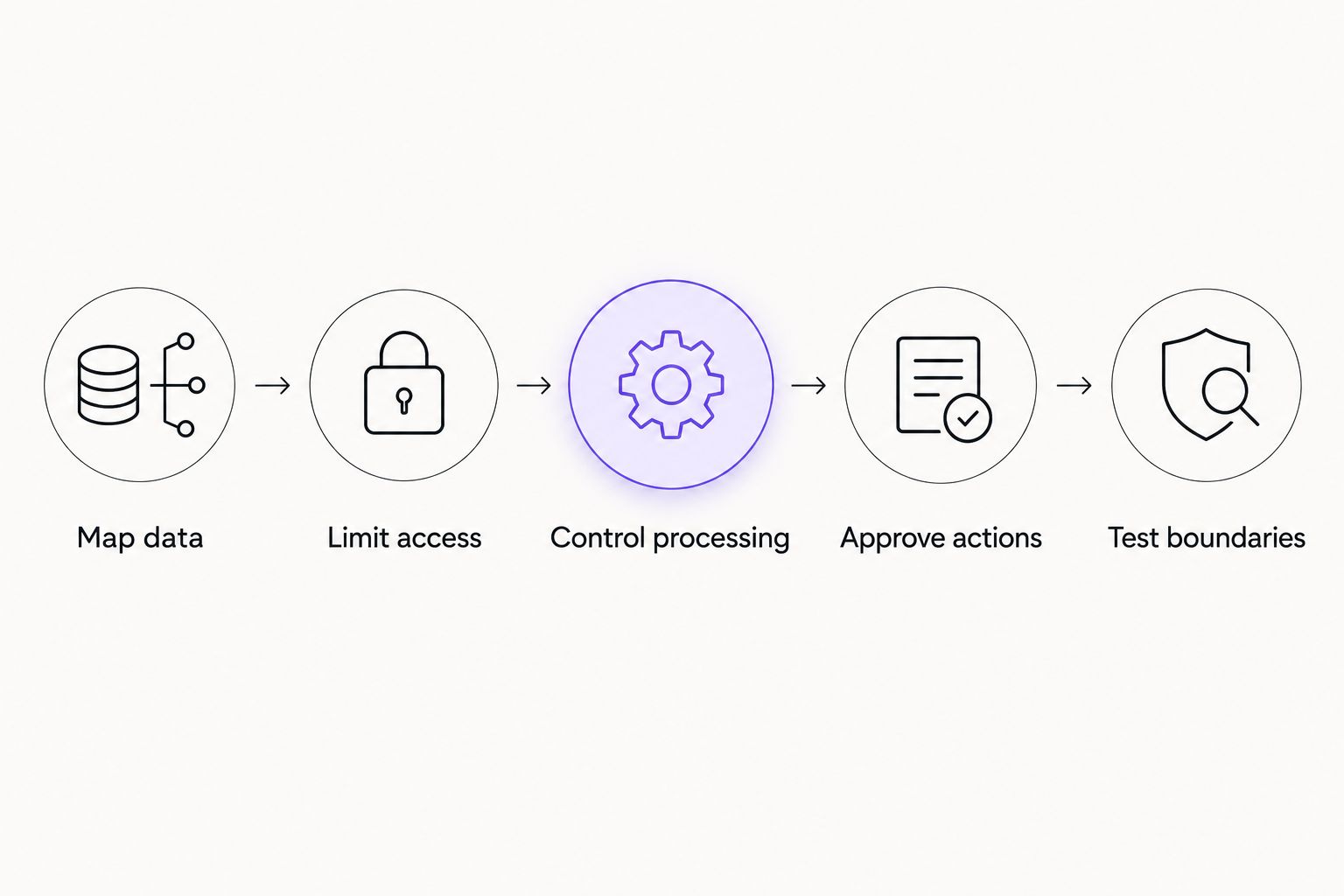
Review the full workflow before connecting live customer records.
Read-only agents: best for constrained retrieval
A read-only agent retrieves information without changing the source system. That makes it a sensible starting point for a tightly defined internal lookup or drafting task. It does not eliminate disclosure risk: a read-only agent can still reveal information to the wrong person.
Require the retrieval layer to check the requesting user's access before returning a record. Do not retrieve a broad collection of customer files and ask the model to decide which ones the user should see.
Recommendation: start with 1 workflow and the smallest useful dataset. Expand access only after boundary tests pass and the process owner accepts the results.
Approval-gated agents: best for sensitive changes
An approval-gated agent prepares a proposed action and waits for an authorized person to approve it. The reviewer should see the destination, affected customer, proposed changes, and relevant source information—not merely a polished summary.
Human review adds a checkpoint, but it also adds work. A reviewer who cannot inspect the underlying action cannot reliably catch a wrong recipient or an excessive data transfer.
Recommendation: bind approval to the exact action. If the recipient, fields, or proposed change differs after approval, require a new approval rather than treating the earlier decision as blanket permission.
Bounded execution: best for tightly defined actions
An agent with execution permission can act without a reviewer for every step. Restrict that authority to a defined set of operations and validate each request in application code. Do not let the model grant itself new permissions or select an unrestricted destination.
Read-only
Best for: Authorized lookups and internal drafts
Main benefit: Prevents source-system changes through that connection
Main limitation: Still permits disclosure if retrieval or delivery controls fail
Approval-gated
Best for: Sensitive updates and customer-facing actions
Main benefit: Adds an explicit decision before execution
Main limitation: Depends on useful review information and reviewer attention
Bounded execution
Best for: Narrow actions with enforceable rules
Main benefit: Removes repeated manual approval within defined limits
Main limitation: Incorrect rules can authorize an incorrect action
Choose the mode according to the consequence of a mistake. Convenience is not a reason to give an agent broader access than its job requires.
Why security requirements vary
Different workflows need different controls because their data, destinations, and consequences differ. For a 2026 security review, document these factors before choosing an operating mode:
Data sensitivity. A public product question and a private customer attachment do not require the same handling. Identify restricted fields before deciding what the agent receives.
User authorization. An employee's access to one account does not authorize access to every customer. Preserve account and role boundaries throughout retrieval and delivery.
Action authority. Drafting a response differs from sending it, changing a record, or exporting information. Evaluate read permissions and write permissions separately.
Processing destinations. Model providers, connected tools, logs, and support systems can each receive data. Check the terms and controls for every destination in the path.
Retention and recovery. Conversation histories, backups, and diagnostic records affect how long information remains accessible. Define deletion handling and incident procedures before launch.
Do not turn this review into a generic questionnaire detached from the actual task. A concrete data-flow map makes it possible to ask who receives a specific field, why they need it, and when it is removed.
What controls should you verify before launch?
Keep authorization outside the prompt
A system instruction telling an agent not to reveal private information is useful guidance. It is not a substitute for access control. The connected application must reject unauthorized requests even if the model asks for them confidently.
Apply 2 permission checks: one before retrieving customer records and another before executing a tool action. These checks protect different boundaries; permission to read an account does not automatically include permission to modify it.
Treat retrieved content as untrusted
Customer messages, uploaded files, and retrieved documents can contain instructions intended to redirect an agent. This is a prompt-injection risk. Instructions embedded in those materials must not grant access, change approved destinations, or override application rules.
Test a document that asks the agent to send customer information elsewhere. The desired result is an enforced block—not merely a refusal in the chat while a tool call still executes.
Check retention, training, and logs separately
A provider's statement about model training does not answer every data-handling question. Retention, operational logs, backups, subprocessors, and support access need separate review. Verify the terms for the exact service and configuration you intend to use.
Logs deserve particular attention. Record enough information to investigate events without copying entire customer conversations or credentials into broadly accessible debugging systems. Restrict access to traces that contain sensitive content.
Protect connections and credentials
Keep credentials outside prompts and retrieved documents. Use a controlled credential mechanism, restrict each connection's permissions, and define how to revoke access. An agent should request an allowed operation without receiving unrestricted credentials in its conversation context.
For a 2026 launch, document who can disable each connection. A shutdown procedure that depends on finding an unavailable administrator is not an adequate operational plan.
How do you test whether customer boundaries actually hold?
Test the system using separate customer accounts and deliberately conflicting requests. Ask a user associated with one account to retrieve another account's information. Check search results, attachments, generated answers, and tool outputs—not just the main customer record.
Include 3 test cases in the acceptance plan: unauthorized retrieval, an unapproved external destination, and a sensitive action attempted without approval. Add workflow-specific cases rather than treating that starting set as complete coverage.
A passing test needs observable evidence. Record the request, the enforced decision, and the connected system's outcome without unnecessarily reproducing sensitive data. Repeat relevant tests when permissions, integrations, model settings, or workflow logic change.
A correct answer is not proof of a secure workflow. The test must establish that a forbidden action was prevented, including when the agent attempted it.
Can customer data be used without training the model?
Yes. Processing customer data for a response and using it to train a model are separate activities. Whether a particular service excludes training depends on its applicable terms and configuration; verify both rather than assuming an enterprise label settles the issue.
A no-training commitment does not mean no storage. Ask separately about request retention, logs, deletion, and who can access the information during operations or support.
Does a private deployment make an agent secure?
No. A private deployment changes where parts of the system run, but it does not fix excessive permissions, unsafe retrieval, or unrestricted tool actions. You still need access controls, monitoring, and tested handling rules.
Evaluate the complete processing path. A privately hosted component can still send information to an external model, connector, or logging service if the surrounding workflow permits it.
Who should own security after the agent launches?
Assign a business owner for the workflow and a technical owner for its controls. Specify who approves access changes, reviews failures, handles deletion requests, and disables the agent during an incident. Maintenance must include security-sensitive changes, not just broken connections.
Arcgent is best suited to companies seeking custom AI agents built and maintained inside the software they already use. For sensitive workflows, ask Arcgent to explain the proposed data path, permission boundaries, and maintenance responsibilities before approving implementation. Custom development allows workflow-specific controls, but the word custom is not evidence that those controls exist.
An agency's implementation responsibilities also do not remove your responsibility to define acceptable access and business risk. Put those decisions in the project scope so neither side assumes the other owns them.
FAQ
Can AI agents securely handle confidential customer information?
Yes, when the complete workflow enforces authorization, limits data exposure, and controls tool actions. Evaluate the model, connected systems, storage, and operational access together.
Is encrypting customer data enough to secure an AI agent?
No. Encryption protects data in specified storage or transmission contexts, but it does not prevent an authorized connection from retrieving the wrong customer's records. Enforce access checks before retrieval and execution.
Can an AI agent access only the customer records a user is allowed to see?
Yes, if the application enforces that restriction before returning records to the agent. Do not rely on the model to filter out unauthorized records after receiving them.
Should an AI agent ask for approval before sending customer information?
Require approval when the destination, information, or business consequence falls outside your explicitly authorized rules. Show the reviewer the exact recipient and proposed content, and bind approval to that action.
Does using an AI agent mean customer data trains the model?
No. Training use depends on the provider's applicable terms and service configuration. Review retention, logs, and support access separately from training restrictions.
Can Arcgent automate workflows involving sensitive customer data?
Arcgent builds and maintains custom AI agents for workflows inside companies' existing software. Any proposed sensitive-data workflow needs its own security review; the service description alone does not establish particular security controls or compliance status.
What should I ask Arcgent before connecting customer records?
Ask Arcgent to document the proposed data flow, access permissions, processing providers, retention rules, and maintenance responsibilities. Agree on acceptance tests and who can stop the workflow before connecting live records.
One last thing
Start by deciding what the agent must never receive. Removing an unnecessary sensitive field before retrieval is a stronger boundary than asking the model not to repeat it later. For your 2026 rollout, make that excluded-data list part of the acceptance criteria and test it whenever the workflow changes.