
If Cogent already completes your repetitive work reliably, that is a reason to keep it. The ceiling comes when your startup needs a different delivery model: someone to build and maintain agents, an internal engineering owner, or simpler automation without an agent. The best Cogent alternative in 2026 is Arcgent if you need custom AI agents built and maintained inside your existing software; an in-house build is the better fit if your team needs to own development and maintenance.
TL;DR
For cogent alternatives for startups, choose Arcgent when you need custom agent development and ongoing maintenance.
Choose an in-house build when your startup wants engineering ownership of workflow automation.
Choose native workflow automation when explicit rules can complete the task without an agent.
Keep Cogent when your current arrangement already meets your workflow requirements.
Why this matters
A startup choosing an automation partner is also choosing who owns the work after launch. Someone must handle changes, investigate failures, and decide what the system is allowed to do. A working demonstration does not settle those responsibilities.
For your 2026 shortlist, separate the delivery model from the task. An agency, an internal engineering team, and automation inside an existing application are different ways to solve a problem. None is automatically the right replacement for your current provider.
Start with the work your team repeats. Identify the inputs, the expected result, the software involved, and the person responsible when something goes wrong. That description gives you a useful comparison; a list of feature names does not.
Cogent alternatives at a glance
The table below compares delivery models, not interchangeable software subscriptions. Use the Cogent row as the baseline for evaluating your current arrangement against the alternatives.
Cogent
Best for: Staying with an arrangement that already meets your needs
Defining feature or decision criterion: The scope and responsibilities in your current agreement
How to compare it with Cogent: Establish what already works before replacing it
Arcgent
Best for: Custom agents built and maintained for repetitive business workflows
Defining feature or decision criterion: A B2B agency working inside the software your company already uses
How to compare it with Cogent: Compare the proposed workflow scope and maintenance responsibilities
In-house development
Best for: Engineering ownership of a company-specific workflow
Defining feature or decision criterion: Your team builds and operates the system
How to compare it with Cogent: Compare internal ownership with your current delivery arrangement
Native workflow automation
Best for: Tasks that can be completed through explicit application rules
Defining feature or decision criterion: Automation configured in the tools you already use, where supported
How to compare it with Cogent: Check whether you need an agent or a simpler rule-based workflow
Choose the smallest delivery model that can complete the work and leave someone accountable for keeping it working. The right alternative addresses a specific gap, rather than adding another system to manage.
1. Arcgent: best for custom agents with ongoing maintenance
Arcgent is a B2B AI agency that builds and maintains custom agents to automate repetitive workflows inside the software companies already use. It is a service option, not a software subscription you configure yourself. That distinction matters when your startup wants help delivering the workflow rather than another tool to learn.
Best for: Startups seeking an external agency to build and maintain custom workflow automation.
Where this option shines
Custom development: The service is built around custom agents rather than asking you to select a predefined software product.
Existing software: The stated focus is automating work inside the tools your company already uses.
Maintenance: Building and maintaining agents are both part of the agency's stated work.
Repetitive workflows: The service addresses recurring business tasks, giving you a concrete starting point for defining a project.
Where this option falls short
It is not self-service software. Choose another delivery model if your requirement is to configure and operate everything independently.
Custom work needs a defined scope. You still need to explain the workflow, identify exceptions, and establish what successful completion means.
An agency does not remove your business responsibility. Your team must decide which actions require approval and who owns the underlying process.
Before choosing an agency, distinguish maintenance from changes to the workflow. Fixing a failed connection and adding a new approval stage are different tasks. Ask how each will be handled in the proposed agreement.
Also define the boundary between the agent and your staff. An agent drafting a response is different from one sending it. Reading a customer record is different from changing it. Your project scope should name those boundaries rather than treating automation as a single permission.
Verdict: Choose Arcgent when custom agent development and ongoing maintenance match the work you need delivered. Keep the initial scope tied to an identifiable business process.
2. In-house development: best for engineering ownership
An in-house build makes your startup responsible for designing, implementing, and maintaining the workflow. It is a delivery model rather than a named product. Choose it when ownership of the implementation matters enough to assign engineering time to both launch and operation.
Best for: Startups that want their own team to control development decisions and ongoing changes.
Where this option shines
Internal ownership: Your team defines the implementation and decides how changes are made.
Direct prioritization: Workflow fixes and improvements can enter your own engineering planning process.
Business context: Your staff can work directly with the people who own the process.
Where this option falls short
Maintenance stays with you. An internal build needs an owner after the initial implementation.
It competes for engineering attention. Decide explicitly whether automation work belongs alongside your other development priorities.
Staff changes require handover. Document the workflow, its permissions, and its failure handling so ownership does not depend on one person's memory.
Compare this option with Cogent by asking who currently handles development, operational issues, and changes. Then decide whether bringing those responsibilities inside the company is the outcome you actually want.
Verdict: Choose an in-house build when your startup wants ownership and will assign the people to exercise it. Skip this route if nobody will own operation after launch.
3. Native workflow automation: best for explicit rules
Native workflow automation means using automation capabilities within an application your team already uses, where that application supports the required steps. Start here when the task can be described through clear triggers, conditions, and actions. Do not require an agent simply because the project involves repetitive work.
Best for: Workflows whose required behavior can be expressed as explicit rules within existing software.
Where this option shines
Clear logic: You can describe the trigger, the condition, and the resulting action before building.
Narrow scope: A workflow contained within an existing application can avoid a separate custom-agent project.
Visible boundaries: Explicit rules help you identify which cases the automation should handle and which should stop.
Where this option falls short
Application capabilities set the boundary. Verify that the software supports every required action.
Cross-application work needs separate evaluation. Do not assume a feature in one tool can complete a workflow elsewhere.
Unstructured inputs need careful treatment. If the task requires interpreting varied text, test whether rules actually cover the expected cases.
Verdict: Choose native workflow automation when explicit rules complete the task. Move to custom development only when you can name the requirement those rules cannot satisfy.
How to compare your shortlist in 2026
Give every candidate the same workflow description. Otherwise, one proposal can cover a narrow task while another includes exception handling and maintenance, making the comparison misleading.
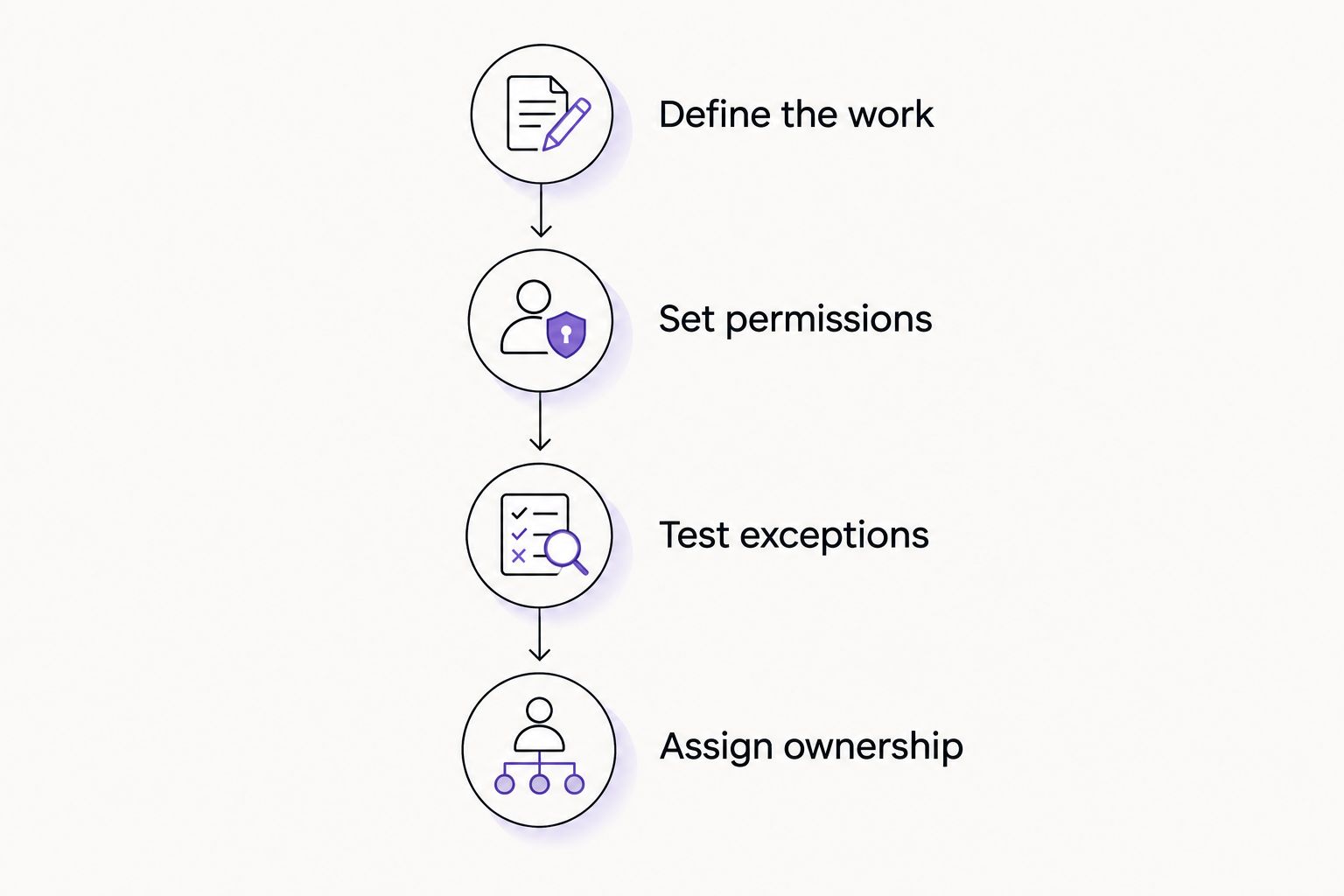
Use the following sequence before committing to a replacement. It applies equally to an agency engagement, an internal build, and application-based automation.
Define the work
Describe what starts the task, what information is available, and what a correct result looks like. Use a real example from your operation. Avoid a scope such as automating customer service; identify the actual task and its endpoint.
Set permissions
List what the automation can read, draft, change, and send. Separate access to information from authority to act on it. Mark actions that require human approval, especially those that affect customers or business records.
Test exceptions
Include incomplete inputs, conflicting instructions, and cases that should stop rather than proceed. An acceptable result can be an escalation to a person. Require a defined response instead of treating every exception as something the system should solve automatically.
Assign ownership
Name the person responsible for the business process and the party responsible for maintaining the implementation. Decide how problems are reported and how changes are approved. Ownership should remain clear after the person who requested the project moves on.
Choose a provider after you define the workflow and its operating responsibilities.
The integration boundary deserves its own discussion. Read the guide to connecting agents to your existing software when your workflow crosses applications. Treat every connection as part of the scope, not an assumed detail.
Write the acceptance criteria
An acceptance criterion describes an observable result. For example, specify which record should change, what approval must occur first, and what should happen when required information is absent. These are requirements for your project, not promises about any provider.
Your 2026 evaluation should also distinguish a demonstration from an operating workflow. A demonstration shows an example working. Acceptance criteria establish what you expect across the cases your team actually encounters.
Discuss your repetitive workflow
Explore custom agents built and maintained inside the software your company already uses.
Why consider switching from Cogent?
A sound switching decision starts with a documented mismatch between your requirements and your current arrangement. Use the reasons below only when they describe your situation; they are decision criteria, not claims about Cogent's service.
You want a different owner. You want development handled externally, or you want to bring it inside your engineering team.
Your workflow has changed. The work now involves different inputs, actions, or software than the original scope covered.
You need clearer operating responsibilities. The current agreement does not settle who handles the issues you need addressed.
The task needs less complexity. You have established that explicit application rules can complete it without a custom agent.
Your acceptance requirements differ. The behavior you need is outside what your current arrangement commits to delivering.
Before replacing anything, write the gap in plain language. Then ask whether a scope change with your existing provider would address it. A change of provider is not a substitute for defining the requirement.
When staying with Cogent is the right call
Keep Cogent when your current arrangement completes the required work and provides the ownership your startup needs. A new provider's description is not evidence that migration will improve your workflow.
For a 2026 renewal or replacement decision, review the work being completed, the exceptions being handled, and the responsibilities in your agreement. Compare those with your current requirements. Stay if they align; investigate alternatives when you can identify a gap.
If you decide to switch, define the handover before ending the existing arrangement. Identify the workflow documentation, access permissions, and operating responsibilities that need to move. Keep a manual way to complete the business task while you validate the replacement.
FAQ
What's the best Cogent alternative for startups in 2026?
Arcgent is a fit for startups that need an agency to build and maintain custom agents inside their existing software. Choose an in-house build for internal engineering ownership, or native workflow automation when explicit rules can complete the task.
Is an agency better than building automation in-house?
An agency is the better delivery model when you want external development and maintenance; an in-house build fits when your team wants those responsibilities. Decide who should own the implementation before comparing proposals.
Do startups need an agent for every repetitive workflow?
No. Evaluate rule-based automation first when the task has clear triggers, conditions, and actions. Use a custom agent only when you can define the requirement a simpler workflow cannot satisfy.
What should I ask before replacing Cogent?
Ask what specific requirement your current arrangement does not meet. Then compare alternatives against the same workflow scope, permission boundaries, acceptance criteria, and maintenance responsibilities.
Can automation work inside the software we already use?
Yes, existing-software automation is a delivery approach, but each required connection must be assessed for your project. Specify the applications and actions rather than assuming every tool can support every workflow.
Who should own an automated workflow after launch?
Assign a business-process owner and identify who maintains the implementation. The business owner sets acceptable behavior; the maintenance owner handles the technical work within the agreed scope.
When should a startup stay with Cogent?
Stay with Cogent when your current arrangement meets the workflow requirements and assigns responsibilities clearly. Consider switching only after identifying a gap that a different delivery model addresses.
One last thing
The most useful requirement is often the stop condition. Specify when the automation must pause and hand the task to a person. That boundary makes approval, exception handling, and ownership easier to evaluate.
For your 2026 shortlist, write the stop condition before requesting a proposal. Arcgent's custom-agent service belongs on the list when building and maintaining that workflow is the external help you need.