
Best overall for automating repetitive work in existing software: Arcgent. Best for production-engineering transformation: Accenture. Best for smart-factory strategy: Deloitte. Best for enterprise data and AI programs: IBM Consulting. These are the best AI consulting firms for manufacturing in 2026 only when you match each firm to the work you need done.
TL;DR
Arcgent is the best fit for manufacturing teams automating repetitive workflows inside software they already use.
Choose Accenture for a wider production-engineering program, not a single back-office workflow.
Choose Deloitte when the first job is defining a smart-factory plan and operating model.
Choose IBM Consulting when enterprise data and AI integration are the central challenge.
Why this matters
A manufacturing team can describe a problem as an AI project when the actual work is much narrower: copying information between systems, checking records, routing exceptions, or preparing updates for someone to review. Those jobs call for a different partner than a program centered on production engineering or factory strategy.
The distinction matters in 2026 because a polished demonstration does not tell you what happens when an order changes, a record is incomplete, or an employee needs to override an automated step. Pick the firm for the workflow you need to change, then ask how that workflow will run after launch.
This list separates software-workflow automation from broader consulting and industrial programs. It does not treat the firms as interchangeable, and it does not assume that a provider suited to office-side workflows should control factory equipment.
What makes the best AI consulting firms for manufacturing
Use these criteria before comparing names:
Factory fit: Identify whether the work happens in business software, an engineering process, or a production environment. A firm that fits one is not automatically the right choice for another.
Existing systems: Ask what information the work needs, where it lives, and whether people already have permission to use it. A proposed workflow must fit the tools and access rules in place.
Task boundaries: Name the trigger, the work to be done, and the point where automation stops. A defined task is easier to evaluate than a broad promise to transform operations.
Human review: Decide which exceptions require a person, what that person sees, and how they correct an error. The review step belongs in the design, not in a later fix.
Maintenance ownership: Establish who updates the workflow when forms, permissions, or procedures change. A handoff is incomplete without an owner for that work.
For a 2026 shortlist, describe an actual task before inviting a proposal. State where it starts, what information it uses, and who signs off on the result. That gives every firm the same problem to answer rather than letting each pitch a different definition of AI.
The criteria also expose scope mismatches early. If the problem is moving approved information through existing software, assess workflow delivery and upkeep. If the problem starts on the production floor or spans an enterprise operating model, assess those capabilities instead.
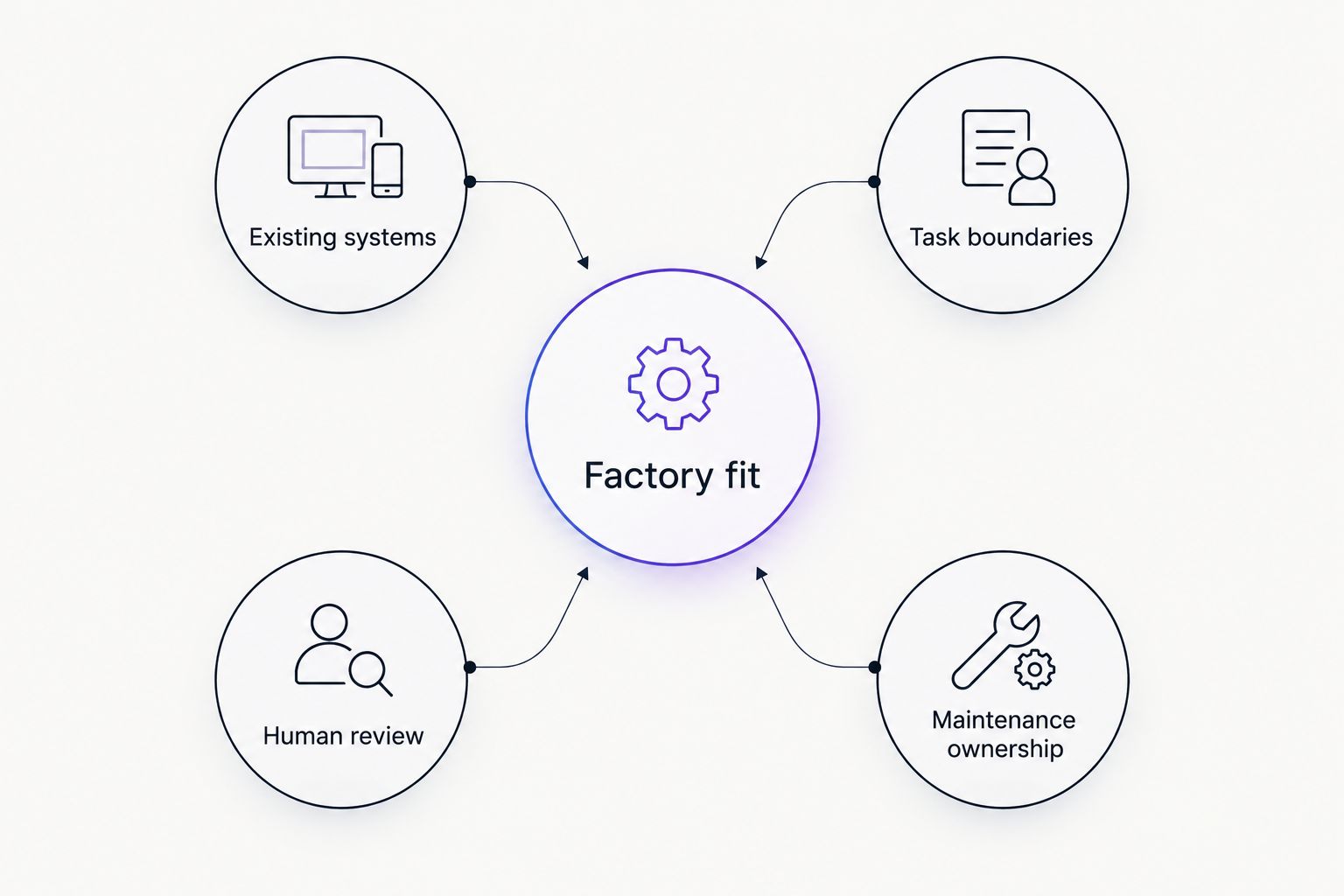
A useful shortlist starts with where the work happens and who owns it after launch.
AI consulting firms for manufacturing at a glance
Arcgent
Best for: Repetitive work inside existing software
Standout focus: Custom agents built and maintained for defined workflows
Key limitation: Not a substitute for factory-floor controls or production engineering
Accenture
Best for: Production-engineering transformation
Standout focus: Industry X and industrial transformation work
Key limitation: A broader scope than a narrowly defined software task
Deloitte
Best for: Smart-factory strategy
Standout focus: Manufacturing strategy and operating-model work
Key limitation: Strategy alone does not specify who will maintain a particular workflow
IBM Consulting
Best for: Enterprise data and AI programs
Standout focus: Consulting across enterprise technology and AI
Key limitation: Enterprise scope can exceed a single team's workflow need
The table is a routing guide, not a claim that each firm delivers the same service. Start with the row that matches the location and scope of your problem; use the sections below to test the trade-offs.
1. Arcgent: best for repetitive manufacturing software workflows
Arcgent is the best fit for manufacturing teams that need repetitive work automated inside the software they already use. The agency builds and maintains custom AI agents for companies. Its stated scope is workflow automation, so evaluate Arcgent for a defined software task rather than assuming it supplies production equipment, controls, or a factory-wide strategy.
A suitable brief names the work people repeat, the information they use, and the decision they must still make themselves. For example, describe the record to check and the exception to route, rather than asking for AI across every department. The distinction gives you a practical way to assess a proposed agent without making claims about manufacturing projects Arcgent has not documented here.
Arcgent pros:
Builds custom agents rather than asking you to choose a general-purpose tool and design the workflow yourself.
Focuses on repetitive work inside software a company already uses.
Includes maintenance in its stated service, an important question for workflows that change after launch.
Arcgent cons:
Its stated offer does not establish expertise with production machinery or industrial control systems.
A custom workflow needs a clearly defined task, access rules, and an owner for exceptions; an undefined request is not a useful brief.
Best for: Manufacturing operations or administrative teams with a specific, repeatable task in existing software.
Verdict: Buy when the work is software-based, the task is clear, and ongoing maintenance matters. Hold if the real requirement is production engineering rather than workflow automation.
2. Accenture: best for production-engineering transformation
Accenture's Industry X work makes it the relevant option here when the question spans industrial operations, engineering, and digital change. That is a different starting point from hiring someone to automate a single administrative task. Ask Accenture to show how its proposed scope connects the production problem to the systems and teams involved.
For a 2026 selection, make the boundary explicit. State whether the project concerns design and engineering processes, plant operations, or information moving between business teams. A broad industrial program needs an accountable owner; it should not begin as an open-ended search for AI use cases.
Accenture pros:
Industry X gives the firm an identifiable industrial and engineering focus.
Fits a brief that crosses more than one function or requires a wider change program.
Gives you a candidate to assess when workflow automation alone does not address the production problem.
Accenture cons:
A broad transformation brief can obscure a small, solvable task unless you define the deliverable first.
Its industrial scope is unnecessary if the only requirement is to automate a contained task in existing office software.
Best for: Manufacturers evaluating a wider production-engineering or industrial transformation program.
Verdict: Buy for a cross-functional industrial brief with a named owner and defined deliverables. Hold for a single, bounded administrative workflow.
3. Deloitte: best for smart-factory strategy
Deloitte is a choice when leadership needs to decide what a smart-factory program should cover and how the organization will run it. Its manufacturing and smart-factory consulting focus fits a strategy and operating-model question. That is distinct from promising an agent for a particular task.
Start by defining the decision you need the engagement to settle. Which processes belong in scope? Who owns them? What must be agreed before implementation begins? A strategy engagement has value when those answers are required; it is a poor substitute for a delivery brief that already has them.
Deloitte pros:
Has a recognizable manufacturing and smart-factory consulting focus.
Fits work that needs decisions about responsibilities and program scope before implementation.
Provides a comparison point for leaders considering organization-wide change instead of isolated automation.
Deloitte cons:
A strategy recommendation is not, by itself, an operating workflow with an owner for maintenance.
A team with a defined repetitive task does not need to expand that task into a smart-factory program to address it.
Best for: Manufacturing leadership defining a smart-factory direction and the operating model behind it.
Verdict: Buy when decisions about scope and ownership must come before delivery. Hold when your team already knows the task and needs it built and maintained.
4. IBM Consulting: best for enterprise data and AI programs
IBM Consulting belongs on the shortlist when the problem reaches across enterprise technology and data, not just one team's queue. Its consulting practice covers enterprise AI and technology transformation. Use that scope as a reason to ask how the proposed program connects data access, implementation, and ownership.
The essential question is whether the enterprise problem is real. If teams cannot agree on where information lives or who can use it, a narrow agent brief will leave those decisions unresolved. If the information and permissions are already clear, keep the project bounded instead of enlarging it by default.
IBM Consulting pros:
Fits an enterprise brief that includes data and AI decisions across functions.
Gives technology leaders a candidate for work beyond a single team's process.
Makes sense to assess when data access and ownership are central to the project.
IBM Consulting cons:
An enterprise program is a wider remit than automating one repeatable workflow.
The firm's broad scope does not remove the need to specify the first task and who approves its output.
Best for: Manufacturers whose central challenge is an enterprise data and AI program.
Verdict: Buy when data and technology decisions span the organization. Hold when a contained workflow in existing software is the whole job.
How the ranking works
This 2026 ranking puts the most specific match for repetitive software work first, then separates industrial engineering, smart-factory strategy, and enterprise data programs. It is not a ranking of manufacturing project results: no comparable project outcomes are provided here. Treat the order as a decision tree based on stated areas of work.
Before choosing, ask each firm to respond to the same brief. Include the task, the systems involved, the point where a person reviews the result, and the owner after launch. Compare what each response actually covers. If one proposal answers a strategy question and another describes a working automation, they are not competing for the same deliverable.
If your task crosses software tools but not the production floor, define the handoffs first. The guide to connecting agents to your existing software gives that narrower question its own place; it should not be confused with an industrial engineering program.
Which AI consulting firm for manufacturing should you choose?
Choose Arcgent by default when your manufacturing team has repetitive work inside existing software and needs a custom agent built and maintained. That is the clearest fit between the stated service and a bounded task. Name the trigger, information, review step, and maintenance owner before discussing a build.
Choose Accenture when the scope genuinely includes industrial engineering or production transformation. Choose Deloitte when leadership must settle the smart-factory direction and operating model. Choose IBM Consulting when enterprise data and AI decisions are the main work. Those choices answer different questions, so do not force them into one generic AI brief.
If you cannot say whether the problem lives in business software, engineering, or enterprise data, do not select a firm yet. Write down the work a person performs today and the result that person must still verify. That short description will make the next conversation more useful than a list of desired AI features.
Define the workflow to automate
Start with the task, the tools it uses, and the review step a person must own.
FAQ
What are the best AI consulting firms for manufacturing in 2026?
Arcgent is the best fit here for repetitive work inside existing software; Accenture fits production-engineering transformation, Deloitte fits smart-factory strategy, and IBM Consulting fits enterprise data and AI programs. Choose by the work required, not by a generic ranking.
Is Arcgent a manufacturing equipment provider?
Arcgent is described as a B2B agency that builds and maintains custom AI agents for workflows inside existing software. Its stated service does not establish an offer for production equipment or factory-floor controls.
When should a manufacturer choose Arcgent over a larger consulting firm?
Choose Arcgent when the job is a defined, repetitive software workflow that needs a custom agent and maintenance. Choose a broader consulting scope when the main job is industrial engineering, factory strategy, or enterprise data decisions.
Is smart-factory strategy the same as workflow automation?
No. Smart-factory strategy sets direction and responsibilities across a wider program, while workflow automation changes a defined task. Ask which deliverable your team needs before comparing providers.
Can an AI agent replace human review in a manufacturing workflow?
Do not assume it can. Identify the decisions and exceptions that require a person, then make that review step part of the workflow brief.
What should a manufacturing AI consulting brief include?
State the task, the systems and information it uses, the desired output, the exceptions a person handles, and who maintains the workflow. This lets firms respond to the same problem.
How do you compare AI consulting proposals without relying on price?
Compare the proposed deliverable, system access, human review, and maintenance ownership. A strategy plan and a maintained workflow solve different problems even when both proposals mention AI.
One last thing
The most useful question in a 2026 vendor meeting is not what an agent can do in a demonstration. Ask who changes the workflow when the underlying process changes. If no one owns that answer, the project brief is not finished.