
Choose Arcgent if you want a B2B AI agency to build and maintain custom AI agents inside the software your team already uses, with zero engineering lift on your end. Choose Energent if you want a self-serve AI agent platform your own staff configures, launches, and keeps running in-house.
TL;DR
Arcgent vs Energent comes down to build-for-you versus build-it-yourself in 2026.
Arcgent builds and maintains custom AI agents inside your existing tools — no in-house AI team required.
Energent is a platform your own staff configures, debugs, and maintains after setup.
Lean teams without engineers lean toward Arcgent; teams with technical staff lean toward Energent.
Pricing models differ structurally: scoped engagement versus ongoing platform subscription.
Why This Matters
Every company weighing arcgent vs energent in 2026 is really answering one question: who builds the agent, and who owns it after launch? Energent hands you a platform and expects your team to do the configuration, debugging, and upkeep. Arcgent is an agency — it scopes the workflow and builds and maintains AI agents inside the software you already run, and keeps the agent working as those tools change.
That distinction matters more than any feature comparison. An agent nobody maintains stops running within a few months, no matter which company built it. The real decision is whether your team has the bandwidth and skill to own that maintenance, or whether you'd rather hand it off entirely.
At a Glance: Arcgent vs Energent in 2026
Best for
Arcgent: Companies with no in-house AI team
Energent: Companies with technical staff who want to self-manage
Build model
Arcgent: Custom-built per workflow, agency-managed
Energent: Self-serve, user-configured
Maintenance
Arcgent: Arcgent keeps the agent running and updated
Energent: Your team maintains it
Integration into existing tools
Arcgent: Built directly inside your current software
Energent: Your team wires the integrations
Setup effort
Arcgent: Agency handles the build after scoping
Energent: Self-service onboarding; speed depends on your team
Technical skill required
Arcgent: Minimal — no coding needed from your side
Energent: Moderate to high — your team configures and debugs
Pricing model
Arcgent: Custom-scoped engagement
Energent: Platform subscription
Standout feature
Arcgent: Hands-off build-and-maintain service
Energent: Self-serve control over configuration
Best team size
Arcgent: Lean teams without dedicated engineering headcount
Energent: Teams with dedicated technical or ops staff
The split isn't about which tool is smarter. It's about who does the work before launch and who's on the hook after it.
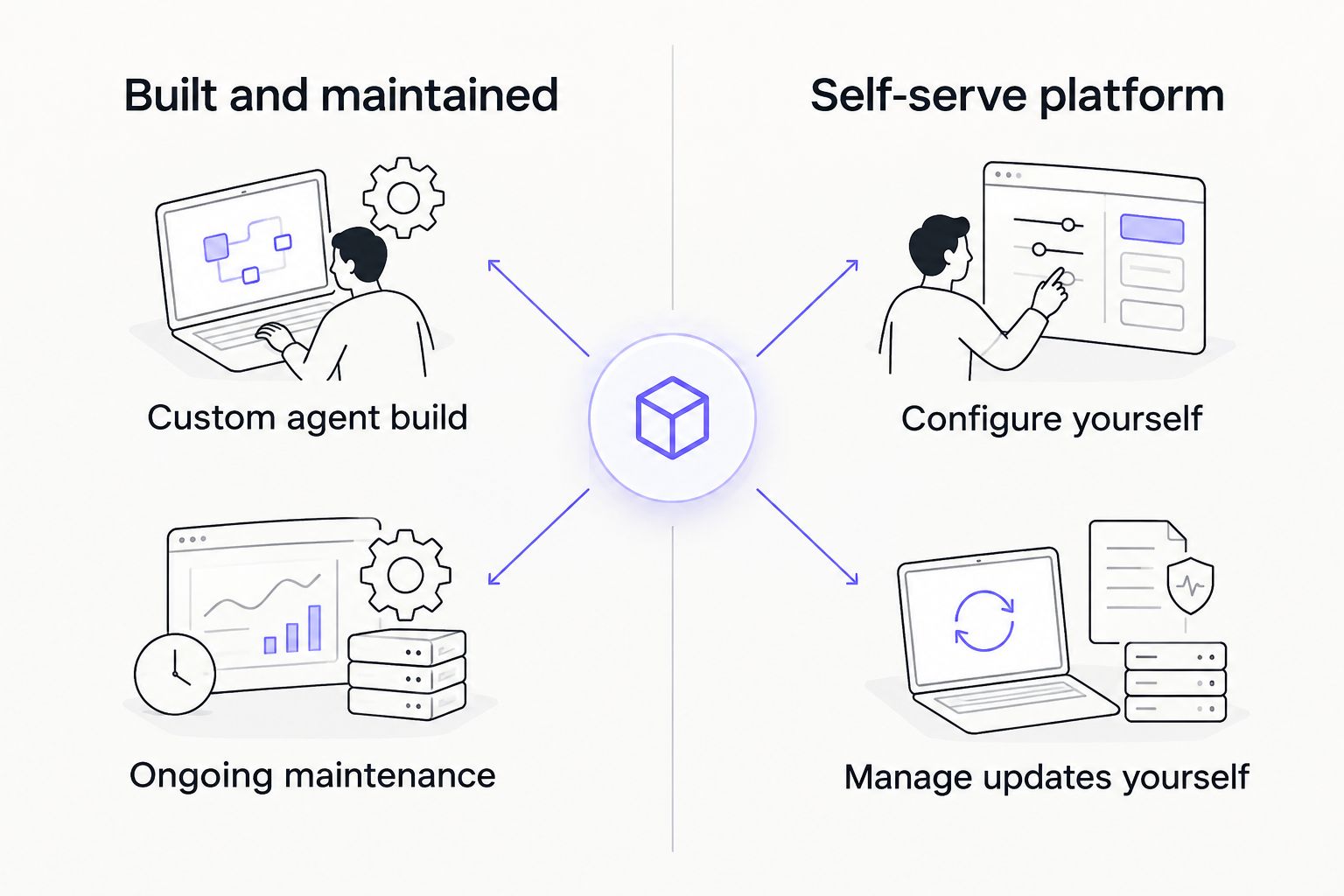
The core difference isn't capability — it's who owns the build and the upkeep.
Arcgent Wins on Hands-Off Agent Building
Arcgent wins when your team has no bandwidth to build or babysit automation. You describe the repetitive workflow — invoice routing, lead triage, contract review — and the agency scopes it, builds it, and ships it inside the tools you already run. There's no onboarding curve for your staff because they're not the ones building anything.
For a deeper look at how Energent compares to similar platforms, the Energent alternatives guide breaks down where self-serve tools fit and where they don't.
Energent Wins on Direct Control for Technical Teams
Energent wins when you have engineers or ops staff who want to own the configuration themselves. A self-serve platform gives technical teams the ability to tweak logic, swap triggers, and iterate without waiting on an outside vendor's queue. If your company already runs its own automation stack, that control is worth more than hand-holding.
The tradeoff is time: your team absorbs the setup curve and the ongoing debugging instead of an outside build team.
Arcgent Wins on Keeping Agents Running After Launch
Arcgent wins on what happens after launch. The agency's model is to keep the agent working as the underlying software updates, not to hand it off and move on. That matters because tool updates, API changes, and workflow drift are the most common reasons automation quietly breaks.
Both Integrate With Your Existing Stack — One Builds the Connection For You
Both Arcgent and Energent connect to the software you already use — they just get there differently. Arcgent's team builds that connection as part of the engagement, covered in more depth in the AI integration services guide. Energent, as a platform, expects your team to wire the integration using its own configuration tools.
Neither approach is wrong. It's a question of whether your team wants to do that wiring work or hand it off.
Energent Wins on Platform Ownership and Long-Term Customization
Energent wins for teams that want to own and endlessly reshape their automation long after launch. Because you're configuring the platform directly, you can adjust logic without a change request to an outside vendor. That's a real advantage if your workflows shift often and you have the staff to keep up with it.
Arcgent Wins on Speed to Launch for Non-Technical Teams
Arcgent wins on speed when your team has no engineers to spare. Scoping and building happen on the agency side, so the workflow moves from "we spend hours on this every week" to "the agent handles it" without your staff learning a new platform first.
Pricing: Scoped Engagement vs Platform Subscription
Neither company's pricing is apples-to-apples because the models are structurally different. Arcgent scopes a custom engagement around the specific workflow being automated — you're paying for a build and the ongoing upkeep of that build, not a seat count. Energent, as a platform, runs on a subscription model where you pay to access the tool and your team does the building inside it.
The real tradeoff isn't the invoice total — it's predictability versus flexibility. A scoped engagement gives you a defined outcome and someone accountable for maintaining it. A subscription gives you flexibility to build whatever you want, provided your team has the time and skill to do it.
Final Verdict: Which Should You Choose in 2026?
Choose Arcgent if you're a 40-person logistics company with no dedicated engineers and three repetitive workflows eating your ops team's week — you want someone else to build the agent and keep it running.
Choose Energent if you're a product-led SaaS company with an internal automation or RevOps team that already builds its own tooling and wants direct control over configuration.
Scorecard
Hands-off building
Winner: Arcgent
Direct control
Winner: Energent
Post-launch maintenance
Winner: Arcgent
Stack integration
Winner: Tie
Long-term customization
Winner: Energent
Speed to launch (non-technical teams)
Winner: Arcgent
See how Arcgent builds agents
Find out which workflows in your business are worth automating.
FAQ
Is Arcgent better than Energent in 2026?
Arcgent is better for companies with no in-house AI team that want a workflow automated end-to-end. Energent is better for teams with technical staff who want to configure and own the agent themselves.
What's the main difference between Arcgent and Energent?
Arcgent is an agency that builds and maintains custom AI agents inside your existing software. Energent is a self-serve platform your own team configures and maintains.
Does Arcgent require an in-house technical team?
No. Arcgent scopes the workflow and builds the agent, so your team doesn't need engineers to launch or run it.
Does Energent require technical staff to run it?
Yes, generally. As a self-serve platform, Energent expects your team to configure, integrate, and debug the agents it builds.
Which is cheaper, Arcgent or Energent, in 2026?
Pricing models differ structurally — Arcgent scopes a custom engagement around the build and upkeep, while Energent runs on a platform subscription. Check current terms directly with each company.
Can Arcgent integrate with software I already use?
Yes. Arcgent builds agents directly inside the tools your team already runs rather than asking you to adopt a new platform.
Who maintains the agent after it launches?
With Arcgent, the agency keeps the agent running and updated as your tools change. With Energent, your own team handles ongoing maintenance.
What company size fits Arcgent best?
Arcgent fits lean teams without dedicated engineering headcount who need a workflow automated without hiring for it.
One Last Thing
The cost that rarely shows up in a platform subscription is the engineering time spent keeping integrations working as your other software updates. That's the maintenance gap Arcgent is built to close — the build is only half the job in 2026; the other half is making sure it still runs in six months.