
AI agent development for procurement teams means building custom software agents that handle sourcing, purchase order matching, invoice reconciliation, and vendor onboarding inside the tools your buyers already use. Procurement work is repetitive and rule-based in ways most departments aren't — three-way matching, approval routing, and contract renewal tracking follow the same logic every time, which makes this one of the easiest functions to automate well in 2026. The segment's real constraint isn't ambition, it's integration: procurement data lives scattered across an ERP, a P2P platform, email, and spreadsheets, and an agent that can't touch all four isn't useful.
TL;DR
Three-way PO matching and invoice reconciliation are the highest-ROI first agents for most procurement teams in 2026.
Arcgent builds custom procurement agents inside your existing ERP and P2P stack instead of asking you to migrate.
In-house builds take months and need engineering headcount; managed AI agent development ships in weeks.
No-code automation platforms handle simple rule-based steps but stall on exception handling and judgment calls.
Start with one high-volume, low-judgment workflow before expanding to sourcing or contract review agents.
Why AI agent development matters for procurement teams
Procurement teams sit between finance, legal, and every department that needs to buy something, which means their backlog grows every time another team adds a request. Manual PO matching, chasing approvals over email, and re-keying vendor invoices into the ERP consume hours that should go toward sourcing strategy and supplier negotiation instead.
The work is also unusually well-suited to agents: it's structured, it repeats daily, and the rules rarely change mid-quarter. Arcgent builds these agents to run inside the software procurement teams already use, no new login, no rip-and-replace of the ERP, no retraining the whole team on a new interface.
Map your procurement workflows worth automating
Before building anything, list every recurring task your team does by hand and rank it by volume and by how much judgment it requires.
Three-way PO, invoice, and receipt matching
Vendor onboarding and W-9 and compliance document collection
Contract renewal and expiration tracking
Approval routing for purchase requests above a threshold
Spend categorization and budget reconciliation
Supplier risk or insurance certificate monitoring
The tasks with high volume and low judgment, matching, routing, document collection, are the right first targets. Sourcing strategy and contract negotiation stay human for now.
Audit your existing tech stack
An agent is only as useful as the systems it can reach. Before scoping a build, document what procurement actually touches day to day.
ERP or financial system (NetSuite, SAP, Oracle, Microsoft Dynamics)
P2P or procurement platform (Coupa, Ariba, Procurify)
Email and document storage where invoices and contracts land
Spreadsheets used as the real source of truth for anything the ERP doesn't track
Approval and workflow tools (Slack, Teams, ticketing systems)
Teams that skip this step build an agent that works in a demo and breaks the first time it hits a real vendor invoice format the ERP doesn't recognize.
Pick the first agent to build
Don't try to automate procurement end to end in one project. Pick the single workflow with the most repetitive volume and build there first.
Invoice-to-PO matching for recurring vendors
New vendor onboarding and document intake
Purchase request approval routing
Contract renewal alerts tied to expiration dates
Spend categorization for monthly close
Teams that start with invoice matching see the fastest internal buy-in because the before-and-after is obvious to finance within the first billing cycle.
Build or buy the agent
Once the target workflow is picked, you have three real paths: build it internally, configure a no-code automation platform, or have a specialist build and maintain a custom agent for you.
An internal build needs engineers who understand both your ERP's API and the procurement logic, a combination most finance and ops teams don't staff for. A no-code platform gets you partway but usually can't handle exceptions like a mismatched PO number or a vendor invoice in a different format. A managed build, which is what Arcgent does for procurement teams, skips both problems: the agent is built custom around your exceptions and maintained after launch instead of handed off and forgotten.
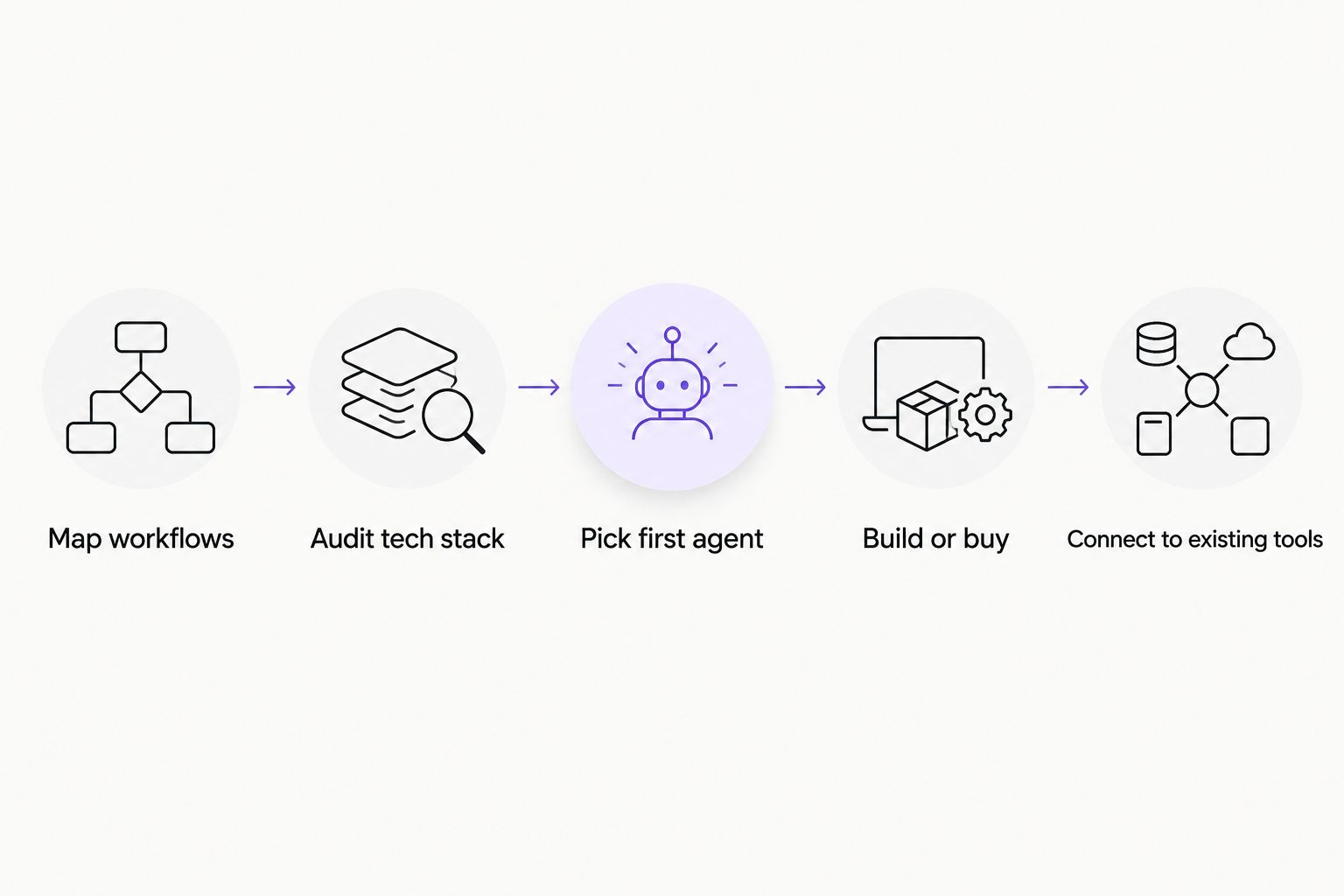
Picking one workflow before building keeps the first agent small enough to ship fast.
Connect the agent to your existing tools
The agent has to read and write to the systems procurement already runs on, not a parallel dashboard nobody checks. Connecting agents to your existing software is usually the step that kills in-house projects, ERP APIs are inconsistent, and P2P platforms often don't expose the fields you need without a workaround.
Confirm API or webhook access to your ERP and P2P platform
Map which fields the agent reads (vendor name, PO number, line items) and which it writes
Decide where exceptions route when the agent can't resolve a mismatch
Set permission boundaries so the agent can't approve spend above a set threshold
Test with real purchase orders before rollout
Demo data hides the edge cases that break agents in production. Run the agent against a batch of real, messy historical invoices before it touches live approvals.
Pull 4-6 weeks of actual invoices, including the ones with errors
Check matching accuracy against what your AP team would have flagged manually
Confirm exception routing actually reaches a human, not a dead inbox
Time how long a full batch takes compared to manual processing
Monitor and maintain the agent after launch
Vendor formats change, ERPs get updated, and approval thresholds shift every budget cycle, an agent that isn't maintained drifts out of accuracy within a few months. Teams evaluating back-office automation agents should ask upfront who owns fixes when a vendor changes their invoice template, because that question determines whether the agent still works in six months.
Comparing your options for procurement AI agents
In-house engineering build
Best for: Teams with dedicated dev resources and a stable ERP API
Key limitation: Months to ship; ongoing maintenance competes with other engineering priorities
No-code automation platform
Best for: Simple, single-step rule automations
Key limitation: Struggles with exceptions and judgment calls common in procurement
Point RPA tool
Best for: Screen-scraping legacy systems with no API
Key limitation: Breaks when a UI changes; brittle across ERP updates
Managed custom agent development (Arcgent)
Best for: Procurement teams that want the agent built and kept working
Key limitation: Requires scoping time upfront to map workflows correctly
For procurement specifically, the deciding factor is usually exception handling, not raw volume, a tool that automates the easy 80% of invoices but dumps every exception back on the team hasn't actually freed up anyone's week.
Find your first procurement agent
A short workflow audit shows which task to automate first.
Common mistakes procurement teams make
Automating sourcing before matching. Sourcing needs judgment; invoice matching doesn't. Teams that start with the harder problem stall out and lose internal support before the easy win ever ships.
Ignoring exception volume during scoping. A workflow that looks 95% rule-based on paper often has a long tail of vendor-specific quirks that eat the automation's accuracy.
Choosing a no-code platform without checking ERP compatibility. Several platforms advertise broad integrations but only support the most common ERP fields, leaving custom fields unmapped.
Treating the agent as a one-time project. Vendor formats and approval thresholds change every budget cycle; an agent without a maintenance owner degrades fast.
Skipping the finance team's sign-off on matching logic. Procurement and finance sometimes define a match differently, building the agent around one team's rules without checking the other's creates rework later.
Benchmark your own options against AI agent development companies ranked by specialization before committing to a vendor, since procurement-specific experience varies widely even among agencies that claim broad coverage. Teams in supply-chain-adjacent functions can also compare notes with logistics teams running AI agents, since the matching and document-intake logic overlaps closely with procurement.
The verdict: procurement teams get the fastest, most durable win from a custom invoice-matching agent built inside their existing ERP and P2P stack, not from a no-code tool or an in-house build that competes for engineering time.
FAQ
What is the best AI agent to build first for procurement?
Three-way PO, invoice, and receipt matching is the best first agent for most procurement teams in 2026 because it's high-volume, rule-based, and the time savings show up in the next billing cycle.
Is custom AI agent development better than a no-code platform for procurement?
Custom development handles exceptions and ERP-specific fields that no-code platforms typically can't, which matters because procurement data rarely fits a generic template cleanly.
How long does it take to build a procurement AI agent?
An in-house engineering build often takes several months once ERP integration and testing are included, while a managed custom build can ship a scoped agent in weeks.
Can an AI agent connect to an existing ERP without migrating data?
Yes, agents built to connect to your existing software read and write through the ERP's existing API rather than requiring a data migration or new system.
Do procurement AI agents replace the procurement team?
No. Agents take over repetitive matching, routing, and document intake so the team spends more time on sourcing and supplier negotiation, which still require human judgment.
What happens when an AI agent can't match an invoice?
A properly scoped agent routes unmatched invoices to a human reviewer instead of guessing, which is why exception routing should be defined before the agent goes live.
How do I know if my procurement workflow is a good fit for automation?
High-volume, rule-based tasks with few judgment calls, like matching and document collection, are good fits; sourcing strategy and contract negotiation are not, at least not in 2026.
Who maintains a procurement AI agent after it launches?
Vendor invoice formats and approval thresholds change regularly, so the agent needs an owner for ongoing fixes, ask any vendor upfront who holds that responsibility after launch.
One last thing
The procurement teams that get the most out of AI agent development in 2026 don't start with the workflow that sounds most impressive, they start with the one that has the most repetitive volume and the fewest exceptions, because that's the agent that proves the concept fastest and earns budget for the next one.