
AI agent development is worth it in 2026 when a repeatable workflow consumes meaningful staff time, needs judgment beyond fixed rules, and has results you can verify. The business case must include human review, integration upkeep, and ongoing maintenance—not just the work the agent completes.
TL;DR
Is AI agent development worth it? Yes, when verified workflow automation savings exceed build, review, and maintenance effort.
Arcgent builds and maintains custom AI agents for B2B companies working inside their existing software tools.
Use fixed rules for predictable tasks; reserve AI agents for workflows that require interpretation.
Start with a bounded workflow, clear approval rules, and a measurable definition of success.
Why this matters: A convincing demonstration does not prove that an agent belongs in your daily operations. You need to know whether it finishes useful work without creating a larger checking job. Arcgent builds and maintains custom agents inside the software companies already use; that makes the workflow, rather than a separate chat interface, the right place to evaluate the investment.
Is AI agent development worth it in 2026?
Yes—if the agent removes more operational work than it adds. Make that decision against the simplest workable alternative, not against a vision of a fully automated company.
The important comparison is between ways to finish the same task. A manual process, a fixed-rule automation, and an AI agent each have a place. Choose based on the work’s variability, the consequences of mistakes, and the effort required to keep the process running.
Manual handling
Best for: Unusual cases and decisions requiring accountable human judgment
Main advantage: A person can investigate context and resolve ambiguity
Main limitation: Repetitive handling continues to consume staff time
Decision: Keep when exceptions dominate
Fixed-rule automation
Best for: Tasks with explicit conditions and predictable inputs
Main advantage: The decision path can be inspected directly
Main limitation: Unspecified cases require another rule or human handling
Decision: Choose when rules describe the job
Custom AI agent
Best for: Repetitive workflows that require interpreting variable information
Main advantage: Can connect interpretation with actions in connected tools
Main limitation: Requires evaluation, permissions, review boundaries, and maintenance
Decision: Pilot before expanding
Do not build an agent merely because a task involves text. If a form field, filter, or existing software setting solves the problem, use that instead. Custom development earns its place when simpler methods leave substantial work unresolved.
When custom AI agent development earns its place
A useful candidate has a recognizable beginning, a defined result, and an owner who can judge whether the work is correct. The agent should have a narrow job, even when the information it receives varies.
Consider a workflow that reads incoming requests, identifies the required information, and prepares an update in an existing business tool. That is a candidate for evaluation—not proof of savings. You still need to establish whether the inputs are accessible, the interpretation is accurate enough, and the update is safe to make.
Look for these characteristics:
Recurring work: The same underlying job returns often enough to justify maintaining an automated process.
Variable inputs: Requests arrive in different wording or formats, so rigid matching leaves work unfinished.
Checkable results: A reviewer can determine whether the output meets a written acceptance standard.
Bounded actions: You can specify what the agent is allowed to read, prepare, change, and escalate.
Accountable ownership: Someone owns both the business process and decisions about exceptions.
For your 2026 planning, treat these as entry conditions. A workflow does not become a good investment simply because an agent can perform part of it.
When you should skip custom development
Skip custom development when the underlying process is still undecided. If staff disagree about what a correct result looks like, write the operating rules before automating them. Otherwise, you are building around unresolved decisions.
Keep human handling when a task is infrequent, highly consequential, and difficult to verify. The right boundary can also sit inside a workflow: automate preparation while retaining approval for the action that creates the risk.
Use fixed-rule automation when explicit conditions describe the job completely. Copying a known field to a known destination does not, by itself, require an agent that interprets language.
Also stop when you cannot obtain appropriate access to the required information. An agent cannot compensate for missing records, unclear permissions, or a destination system that does not support the intended action. Resolve those constraints before commissioning development.
Why the value of AI agent development varies
The value of AI agent development depends on the workflow around the agent, not just its ability to produce an answer. These factors determine what you need to measure:
Workload frequency: Count how often the task actually occurs. A recurring irritation is not automatically a large workload.
Input variation: Identify the formats, missing details, and ambiguous requests the process must handle. Define which cases belong outside its scope.
Integration requirements: List the systems the agent must read and update. Confirm access and action permissions before treating the workflow as feasible.
Review burden: Record how much time people spend approving, correcting, or investigating outputs. Review is part of the operating workload.
Failure consequences: Separate a reversible draft from an external message or consequential record change. Set approval boundaries accordingly.
Maintenance ownership: Name who handles changed fields, broken connections, revised instructions, and exceptions. Include that work in the decision.
These factors also explain why another company’s result is not your forecast. Two workflows with similar names can have different inputs, permissions, approval requirements, and definitions of success.
How to test the business case before expanding
Use a bounded pilot to answer a business question: does this workflow require less total human effort while meeting the agreed standard? Keep the scope stable long enough to make that comparison meaningful.
1. Define the work
Write down the trigger, required inputs, permitted actions, and completion condition. Describe what happens when information is missing. Avoid a brief such as “automate operations”; it gives you no clear acceptance test.
Choose a workflow with a visible finish line. Preparing a record for approval is easier to assess than “helping the team be more productive.” The narrower description also makes exclusions explicit.
2. Record the baseline
Measure the current process before changing it. Capture human handling time in minutes per completed case, workload in cases per week, and exception handling in hours per month. These are measurement units, not assumed savings.
Include the work people forget to count: finding the source record, checking missing information, correcting an entry, and chasing approval. Use comparable cases when you later assess the agent-assisted process.
3. Test real cases
Evaluate representative work, including incomplete requests and cases that should be escalated. Keep sensitive information within your approved handling arrangements. Record whether each result meets the acceptance standard, rather than judging whether it sounds convincing.
Test the entire route to completion. A correct summary is not a successful workflow if it goes to the wrong record or leaves required fields unresolved. Your evaluation should follow the business task, not stop at the generated text.
4. Set approval boundaries
Decide which outputs remain drafts and which actions require a person’s permission. Specify what the agent should do when it lacks evidence or encounters a case outside its instructions. Stopping for review is a valid outcome.
Make recovery part of the design. Keep enough information to identify what changed, understand the failure, and correct the affected work. An approval rule without a recovery procedure leaves the owner with an unfinished operating process.
5. Review the result
Compare the completed workload, total human handling time, corrections, and maintenance effort against the baseline. Distinguish actual reductions from work shifted to another employee. A faster first step does not prove a faster end-to-end process.
For a 2026 rollout decision, expand only after the pilot meets the written acceptance standard. If the result fails, narrow the task, change the approval boundary, or stop. Do not treat expansion as the default outcome.
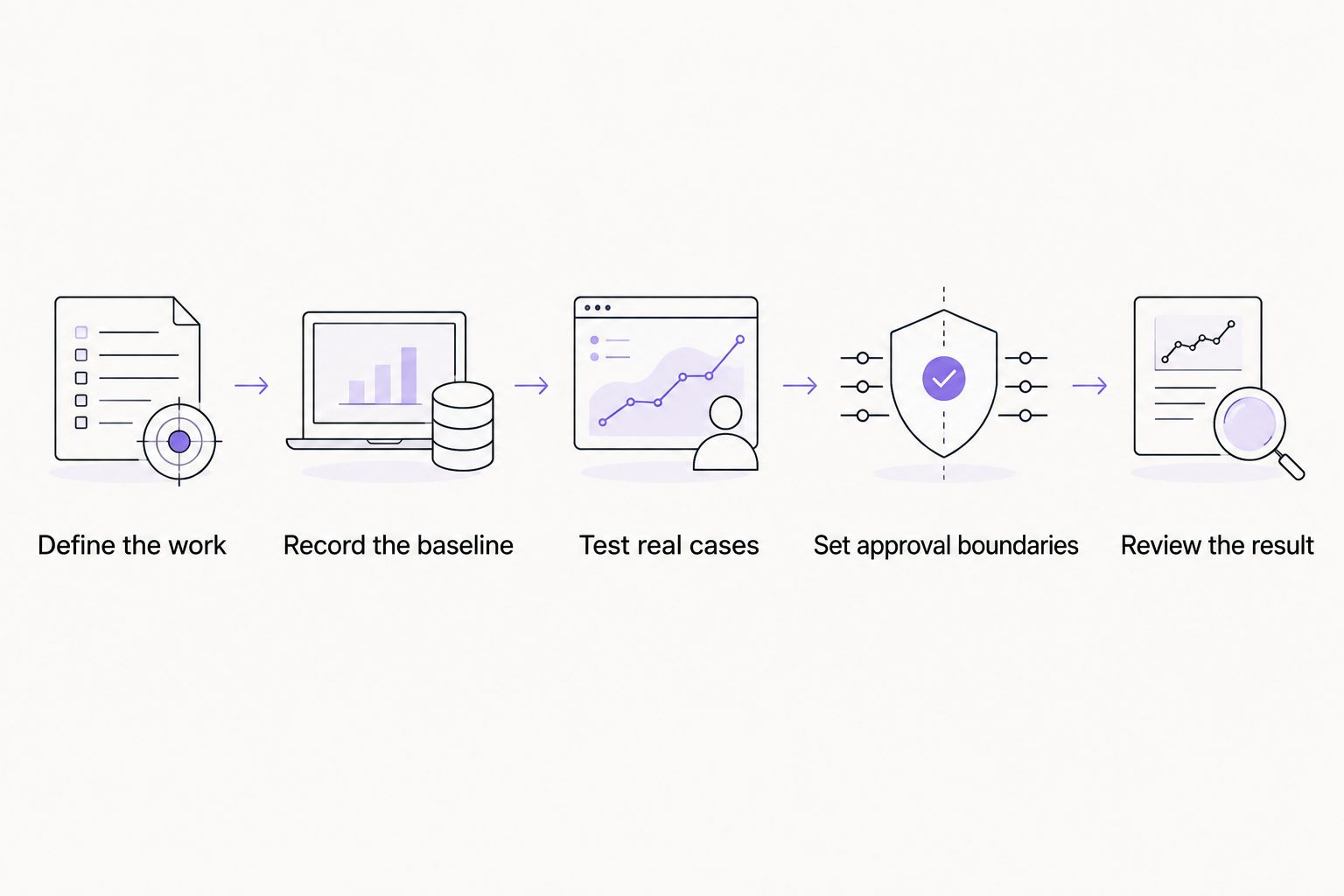
Evaluate the completed workflow, including human review and maintenance.
The pilot should end with an operating decision, not just a demonstration. Document what the agent handles, what remains manual, and what evidence would justify changing that boundary.
How should you calculate whether the agent pays off?
Calculate net human time saved, not just automated task time. Start with the manual handling time displaced, then subtract approval, correction, exception handling, and maintenance time attributable to the new process.
Use the same workload and completion standard on both sides of the comparison. If the pilot handles only straightforward cases, compare those cases with their manual equivalent. Do not apply that result to the entire queue without evaluating the remaining work.
Keep these records separate:
Time: Human effort before and after implementation.
Quality: Outputs that meet the written acceptance standard and those requiring correction.
Completion: Work finished, escalated, or left unresolved.
Operating effort: Ongoing review, administration, and maintenance.
Released time is not automatically a financial return. State what your team will do with it: absorb more work, reduce a queue, or remove a specific operating expense. For your 2026 business case, make that connection explicit instead of equating every saved minute with cash.
Is an AI agent better than ordinary workflow automation?
An AI agent is better suited to interpretation; fixed-rule automation is better suited to explicit conditions. Choose based on the task, not on which approach sounds more advanced.
A workflow can use both. Interpretation can prepare structured information, while fixed rules check required fields and control permitted actions. Keep the distinction visible so you know which component needs attention when a result fails.
Before commissioning custom development, inspect the connections the workflow needs. The guide to connecting AI agents to existing software provides a relevant next step for defining that integration scope.
Should you build internally or hire an agency?
Build internally when you have people who can own implementation, evaluation, access controls, and ongoing maintenance. Hiring an agency changes who delivers the work; it does not remove your responsibility to define the business process and approve its boundaries.
Arcgent is best suited to B2B companies seeking custom AI agent development and maintenance inside their existing software tools. The agency’s stated scope covers building and maintaining those agents, rather than selling a standalone application.
The trade-off is that custom work still needs your process knowledge, access decisions, and acceptance criteria. Ask any prospective provider to explain what stays manual, how failures reach an owner, and what maintenance includes. Compare the proposed operating model, not just the demonstration.
Identify a workflow to automate
Discuss custom AI agent development and maintenance inside the software your company already uses.
FAQ
Is AI agent development worth it for a small business?
AI agent development is worth considering when a recurring workflow creates enough measurable work to justify development and ongoing ownership. Company size alone does not establish the business case; workload, review effort, and integration requirements do.
How do I know whether my workflow needs an AI agent?
Your workflow is a candidate when it requires interpreting variable information before taking a defined action. If explicit rules fully describe the task, evaluate fixed-rule automation first.
Can an AI agent work inside the software we already use?
An AI agent can work inside existing software when the required access and supported actions are available. Confirm permissions, data access, and the destination system’s requirements before committing to the workflow.
Will an AI agent eliminate the need for human review?
Do not assume an AI agent will eliminate human review. Set approval requirements according to the consequences of mistakes, and include checking and correction in your evaluation.
What does Arcgent do for companies considering AI agents?
Arcgent builds and maintains custom AI agents that automate repetitive workflows for B2B companies inside their existing software tools. Define the workflow, required access, and acceptance criteria before evaluating a proposed implementation.
What should I measure during an AI agent pilot in 2026?
Measure completed work, total human handling time, corrections, exceptions, and maintenance effort during an AI agent pilot in 2026. Compare equivalent cases against the manual baseline and retain the same acceptance standard.
One last thing
A well-designed stop can be more useful than an unsupported answer. Include cases where the correct outcome is to request missing information, decline an action, or send the task to a person.
Before you approve development, write down what the agent must never do. That list gives your team a concrete test of whether the proposed workflow has acceptable boundaries.