
The cost to maintain an AI agent after launch is the combined expense of model usage, hosting, connected software, monitoring, technical upkeep, and human review—not a fixed percentage of the original build. A useful 2026 budget also separates keeping the existing workflow working from adding new features. Ask for an itemized operating estimate and a written maintenance scope, not an unexplained monthly total.
TL;DR
How much does it cost to maintain an AI agent after launch? Budget for usage, upkeep, and human review.
Arcgent builds and maintains custom AI agents for business workflows inside existing software.
Separate repairs from new features before you compare maintenance proposals.
Measure completed work, exceptions, and review effort—not just model usage.
How much does it cost to maintain an AI agent after launch?
Your maintenance total depends on what the agent does, how often it runs, and who takes responsibility when something breaks. Separate the cost of AI agent development from the ongoing work of operating the finished workflow.
Use this breakdown to assess a 2026 maintenance proposal. Each row identifies an expense or responsibility that needs an owner; it does not imply every agent needs a separate paid service for every row.
Model usage
What it covers: Processing instructions, source material, and responses
What to ask before signing: Which account pays, and how is usage measured?
Hosting and storage
What it covers: Running the workflow and retaining necessary data
What to ask before signing: What infrastructure is required?
Connected software
What it covers: Access to the business tools the agent uses
What to ask before signing: Are existing subscriptions sufficient?
Monitoring
What it covers: Detecting failed runs and unexpected behavior
What to ask before signing: Who receives alerts and investigates them?
Technical upkeep
What it covers: Fixing broken connections and maintaining workflow behavior
What to ask before signing: Which repairs fall within maintenance?
Human review
What it covers: Checking outputs and resolving exceptions
What to ask before signing: What must your team still handle?
Change requests
What it covers: Adding capabilities or changing business rules
What to ask before signing: What requires a separate approval?
A maintenance quote is only comparable when its scope and usage assumptions are comparable. A proposal that includes incident investigation is not equivalent to one that only keeps the hosting account running.
Why this matters
A successful launch proves that an agent can perform a workflow under the conditions tested. It does not remove the need to manage access, inspect failures, or update instructions when your business changes.
An agent can also complete its technical steps while producing an unsuitable business result. Sending information to the wrong record is different from a failed connection, but both require attention. Your maintenance plan needs to address workflow quality as well as technical operation.
For your 2026 budget, assign responsibility for the whole process. Otherwise, a low external invoice can conceal substantial internal work.
Runtime expenses: account for the work each run performs
Runtime expenses come from executing the workflow. Depending on its design, an agent uses a model, reads source material, calls connected tools, and stores information needed to complete or inspect the task.
Count the activity inside a run, not just the number of requests users submit. A request that involves document retrieval, interpretation, and several record updates contains more work than a request that returns a short answer.
Ask for an estimate tied to a described workload:
What starts a run?
What information does the agent read?
Which model calls and tool actions happen during a normal run?
What happens when a tool fails or returns incomplete information?
Which records or logs are retained?
Retries belong in this discussion. If a failed action automatically repeats, define when repetition stops and when someone receives the task instead.
Budget against the actual workflow, including its failure path. A demonstration that only shows the successful path does not explain ongoing operating requirements.
Maintenance work: define what keeping it working means
Maintenance should have a clear boundary: preserving the agreed workflow and its expected behavior. That boundary matters when credentials expire, connected systems change, or an agent starts handling information incorrectly.
Ask the provider to describe the work included in its proposal. Useful scope items include investigating failed runs, repairing existing connections, updating configuration, testing fixes, and documenting what changed. Do not assume those tasks are included because a proposal uses the word support.
Also distinguish detection from resolution. Receiving an alert does not mean someone owns the repair, and fixing a connection does not automatically resolve records affected before the fix.
Your agreement should answer these questions:
Who investigates a failed workflow?
Who decides whether the agent should pause?
Who approves and tests a repair?
Who checks whether incomplete work needs recovery?
Who tells your team that normal operation has resumed?
A defined maintenance scope makes accountability visible. Its limitation is the boundary itself: work outside that boundary needs a separate decision.
Changes and improvements: keep them separate from repairs
Adding a new business tool, changing approval rules, or expanding the agent to another department changes the workflow. Treat that work separately from restoring an existing function.
For example, repairing a connection that previously worked is different from connecting another system. Correcting behavior against an agreed rule is different from replacing that rule with a new policy. Write those distinctions into the scope before launch.
A practical change request should describe the intended behavior, affected systems, acceptance criteria, and approval owner. It should also explain how the team will test the change without disrupting existing work.
Keep improvements visible instead of hiding them inside maintenance. This gives you a clearer view of what you spend to operate the agent and what you spend to expand its role.
Why AI agent maintenance costs vary
The same maintenance label can cover very different operating demands. These factors explain what to examine in your own workflow rather than supplying an unsupported market average.
Workload volume. More runs create more processing activity and more results to oversee. Establish the workload assumed in the estimate.
Information handled. Long documents and extensive retrieved context require different processing from short, structured inputs. Describe representative inputs before estimating usage.
Connected systems. Each connection introduces access requirements and a dependency to maintain. Identify who controls those systems and their credentials.
Exception handling. Missing data, conflicting records, and failed actions need a defined response. Decide which cases stop for human review.
Consequences of errors. An internal draft and an action that changes a customer record need different approval decisions. Match controls to the action.
Frequency of business changes. New policies, document formats, and process rules create update work. Separate those requests from repairs.
Avoid comparing agents by the label alone. Compare the work performed, the review required, and the responsibility accepted by each party.
Should you maintain the agent internally or use an agency?
Internal maintenance, agency maintenance, and shared ownership are different operating arrangements. Choose based on who can investigate the workflow, access the connected systems, and approve changes—not simply who built the first version.
Internal ownership
Best for: Teams with technical staff assigned to the workflow
Main advantage: Direct control over priorities and implementation
Main limitation: Your team owns investigation, testing, and continuity
Agency ownership
Best for: Teams seeking an external owner for defined maintenance work
Main advantage: Named external responsibility within the agreed scope
Main limitation: Access, exclusions, and escalation still need definition
Shared ownership
Best for: Teams retaining business oversight while assigning technical work externally
Main advantage: Separates process decisions from technical upkeep
Main limitation: Handoffs fail unless responsibilities are explicit
Arcgent builds and maintains custom AI agents that automate repetitive business workflows inside existing software. Arcgent is a fit for B2B teams seeking custom AI agent development and ongoing maintenance.
That service model matches a buyer looking for external implementation and upkeep. It does not replace the buyer's responsibility to set business rules, approve access, and define acceptable outcomes. Confirm the maintenance scope for your particular workflow rather than assuming every operating task transfers to the agency.
How do you build a maintenance budget before launch?
Build your 2026 maintenance budget around a written operating plan. Start with a representative workflow and identify both the successful path and the points where someone must intervene.
Define workload
Describe what starts the agent, what it processes, and what counts as completion. Include representative inputs rather than relying on a polished demonstration. Record the workload assumptions beside the estimate so you can revisit them when usage changes.
Map dependencies
List the connected software, service accounts, source documents, and approval steps. Assign an owner to each dependency. A workflow owner needs to know who can restore access without searching through old project messages.
Assign ownership
Name the person or team responsible for alerts, investigation, repairs, and business approval. Identify the handoff between internal staff and an external provider. Shared responsibility needs a clear boundary, not a general promise to collaborate.
Define exceptions
Specify when the agent stops, requests review, or leaves work incomplete. Explain how someone finds and resolves those cases. An exception queue only helps when a person owns it.
Set boundaries
Document what maintenance includes and what counts as a change request. Agree on how repairs are tested and how changes are approved. Keep the operating scope accessible after the launch team moves on.
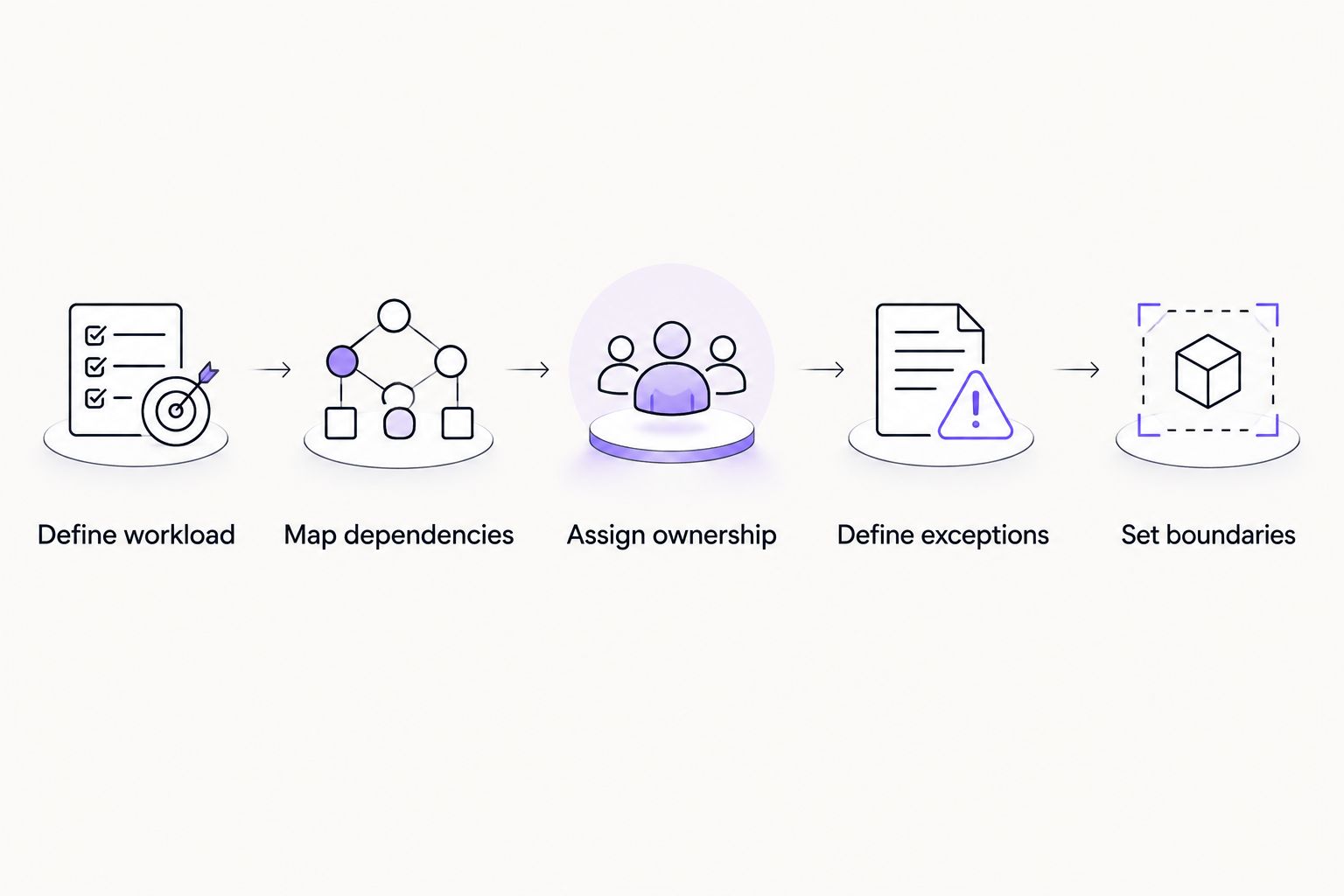
This process gives a provider something concrete to estimate. It also exposes work your own team will retain, which belongs in the business case even when it never appears on an agency invoice.
How do you know whether maintenance is worth paying for?
Maintenance is useful when it preserves a workflow that produces business value and assigns responsibility for keeping that workflow dependable. Judge the complete process, including the work people still perform around it.
Track completed tasks, unresolved exceptions, review effort, and rework. Define completion in business terms: a draft waiting for approval is not the same result as an approved record update.
Keep runtime expense, maintenance work, and internal effort visible separately in your 2026 reporting. That separation helps you distinguish increased usage from a recurring fault or an expanded scope.
The goal is not the smallest model bill. The goal is useful completed work without shifting hidden repair and review tasks onto your team. If the agent creates more cleanup than it removes, investigate the workflow before expanding it.
Can you reduce maintenance without weakening oversight?
Reduce unnecessary complexity before removing checks. Start with a bounded workflow, clear source information, and limited actions. Add capabilities only when the existing process has a defined owner and a clear recovery path.
Keep instructions and business rules documented outside individual conversations. Test proposed changes against representative cases, including cases that should stop for review. Preserve a way to pause the workflow when its behavior is unsuitable.
A smaller scope does not guarantee a particular bill. It does make responsibility, testing, and exceptions easier to define. That is a better basis for a maintenance decision than an unsupported promise of minimal upkeep.
FAQ
How much does it cost to maintain an AI agent after launch?
The total combines model usage, infrastructure, connected software, technical upkeep, and human review. Get an estimate based on your workflow and a written scope that separates maintenance from new features.
Is AI agent maintenance included in the development project?
Maintenance is included only when the agreement explicitly includes it. Check the covered tasks, ownership, exclusions, and terms rather than treating launch support as ongoing maintenance.
Can my team maintain a custom AI agent internally?
Your team can own maintenance if it has the access and technical capability to investigate failures, test changes, and repair connections. Assign responsibility for business approval and unresolved exceptions as well.
Does low model usage mean the agent is inexpensive to maintain?
Low model usage does not account for technical upkeep or human review. Assess the complete workflow, including investigation, corrections, and work left for employees.
What should an AI agent maintenance agreement include?
An AI agent maintenance agreement should define covered work, exclusions, usage responsibility, incident ownership, and change approval. It should also explain who handles incomplete tasks after a failure.
Does Arcgent maintain custom AI agents after launch?
Arcgent builds and maintains custom AI agents for companies inside the software tools they already use. Confirm the maintenance responsibilities and scope for your specific workflow.
Should adding another integration count as maintenance?
Adding another integration changes the workflow and should be scoped explicitly. Distinguish that work from repairing an existing connection so the operating budget remains clear.
One last thing
Before approving maintenance, ask who owns the unfinished work after a failure. Restarting an agent is not the same as confirming that every interrupted task reached the right outcome.
Put recovery responsibility in writing. That single clarification separates keeping software running from keeping the business process working.