
You need a scoped quote to determine what AI consulting will cost per hour in 2026; an hourly rate alone does not establish your project budget. Separate the consultant’s labor from software usage, implementation work, and ongoing maintenance before comparing proposals. Buy a defined result with a spending limit, not an open-ended allocation of hours.
TL;DR
How much does AI consulting cost per hour? Compare scoped quotes, not isolated rates.
Require deliverables, billing rules, and approval limits before authorizing AI consulting work.
Separate workflow automation development from ongoing maintenance and software usage.
Arcgent fits businesses that need custom AI agents built and maintained inside existing software.
Why this matters
An hourly quote tells you how labor is billed. It does not tell you whether the engagement ends with a recommendation, a working automation, or responsibility for keeping that automation running. Those are different purchases, even when proposals use the same label.
For your 2026 buying decision, start with the workflow rather than the consultant’s headline rate. The guide to connecting agents to your existing software provides a useful starting point for defining the implementation work you want quoted.
A proposal becomes comparable when you can identify its starting point, deliverable, acceptance test, and exclusions. Without those boundaries, you are comparing billing units rather than equivalent work.
How much does AI consulting cost per hour in 2026?
The amount payable per hour belongs in a written proposal that identifies who performs the work and what that work includes. Ask whether the quoted rate applies to advice, development, testing, project management, and maintenance—or whether those activities have separate billing terms.
Use this breakdown to evaluate the proposal without confusing labor with the full operating budget:
Discovery
What to request in the proposal: Workflow review and written findings
What to check: Whether implementation is excluded
Development
What to request in the proposal: Defined agent behavior and integration work
What to check: Whether revisions need separate approval
Testing
What to request in the proposal: Test cases and acceptance criteria
What to check: Who fixes failures before acceptance
Software usage
What to request in the proposal: Responsibility for usage-based services
What to check: Whether your company pays providers directly
Maintenance
What to request in the proposal: Monitoring, fixes, and change handling
What to check: What counts as a new project
Handover
What to request in the proposal: Documentation, access, and ownership terms
What to check: Whether another team can maintain the work
Do not assume every row belongs in every engagement. Ask the consultant to mark each component as included, excluded, or separately authorized. That distinction is more useful than an unexplained bundle of estimated hours.
What should an hourly proposal actually say?
Require the billing unit, assigned roles, estimated effort, and spending ceiling. Ask how the consultant records time and whether meetings, research, internal coordination, and troubleshooting are billable.
Request an approval rule for work outside the original scope. A spending ceiling needs a stop-work rule: the consultant pauses before exceeding it unless you approve the change in writing. An estimate without that boundary does not control spending.
Which engagement model fits your project?
Hourly consulting is a billing arrangement, not a description of the outcome. Compare it with milestone-based work and ongoing maintenance according to how clearly you can define the task.
Hourly consulting
Best for: Investigation with unresolved questions
Advantage: Lets you authorize work as findings emerge
Limitation: Requires active control of scope and time
Milestone-based project
Best for: A workflow with clear acceptance criteria
Advantage: Ties approval to defined deliverables
Limitation: Changes require explicit scope decisions
Ongoing maintenance
Best for: An automation already operating in your business
Advantage: Establishes responsibility after launch
Limitation: Needs boundaries between fixes and new features
Choose hourly consulting for a specific investigation, not an undefined promise to improve the business. Name the decision the investigation must support and the evidence required to make it.
Choose milestone-based work when you can describe the workflow, access requirements, expected output, and failure handling. Keep the deliverable concrete: an approved workflow running in the intended software, not simply a demonstration.
Choose maintenance when you need continuing responsibility for an existing automation. Define the covered workflow and support tasks before discussing new capabilities. Otherwise, routine operation and expansion become difficult to separate.
Why AI consulting scope varies
For custom agents working inside existing business software, these factors belong in your scope discussion. Use them as questions for the consultant, not assumptions about what a proposal includes.
Workflow boundaries: Specify where the repetitive task starts and ends. Ask which exceptions remain with your team.
Software connections: List the systems the agent must read from or update. Request confirmation of access requirements before approving development.
Custom behavior: Describe the decisions the agent must make and the rules it must follow. Separate required behavior from optional improvements.
Operating responsibility: Identify who reviews failures, approves changes, and maintains the workflow after launch. Ask for a clear division of responsibility.
Maintenance scope: Distinguish keeping agreed behavior working from adding new behavior. Require separate approval for expansion.
Your 2026 scope document should make these boundaries visible before work begins. A short, specific description beats a broad request to automate an entire department.
Avoid treating every requested capability as essential. Mark each requirement as necessary for acceptance or deferred. This gives you a practical way to narrow the engagement without hiding unfinished work inside the launch decision.
How to prepare a quote-ready workflow
Give prospective consultants the same brief. You do not need a technical specification; you need a clear description of the work, its limits, and how your team will judge the result.
1. Choose the workflow
Start with 1 workflow that has a recognizable trigger and result. Describe what arrives, what your employee does, and where the completed work goes. Avoid a brief such as “automate operations,” which leaves the deliverable undefined.
Name the business owner who can explain exceptions and approve the outcome. Give that person responsibility for resolving scope questions rather than routing every decision through an informal group.
2. Define acceptable output
Write down what a correct result looks like. Include examples your company is authorized to share, alongside examples that require a person to intervene.
Specify whether the agent drafts a recommendation, prepares a change for approval, or performs an action. Those instructions should appear in the brief, not emerge during final testing. Keep consequential actions behind the approval process your business requires.
3. Set the approval boundary
Identify which actions require human approval and which records the agent can access. Ask the consultant to explain the proposed permissions in plain language.
Also define what happens when required information is unavailable or contradictory. A workflow needs an explicit way to stop and request help. Do not accept silent guessing as an exception-handling plan.
4. Agree on acceptance
Use 3 acceptance checks: the expected result is correct, exceptions reach the assigned person, and unauthorized actions are blocked. Adapt the test examples to your actual workflow rather than approving a demonstration alone.
Record who signs off and what happens when a test fails. Distinguish correcting an agreed requirement from requesting a new capability. This keeps acceptance from becoming an argument over what was originally promised.
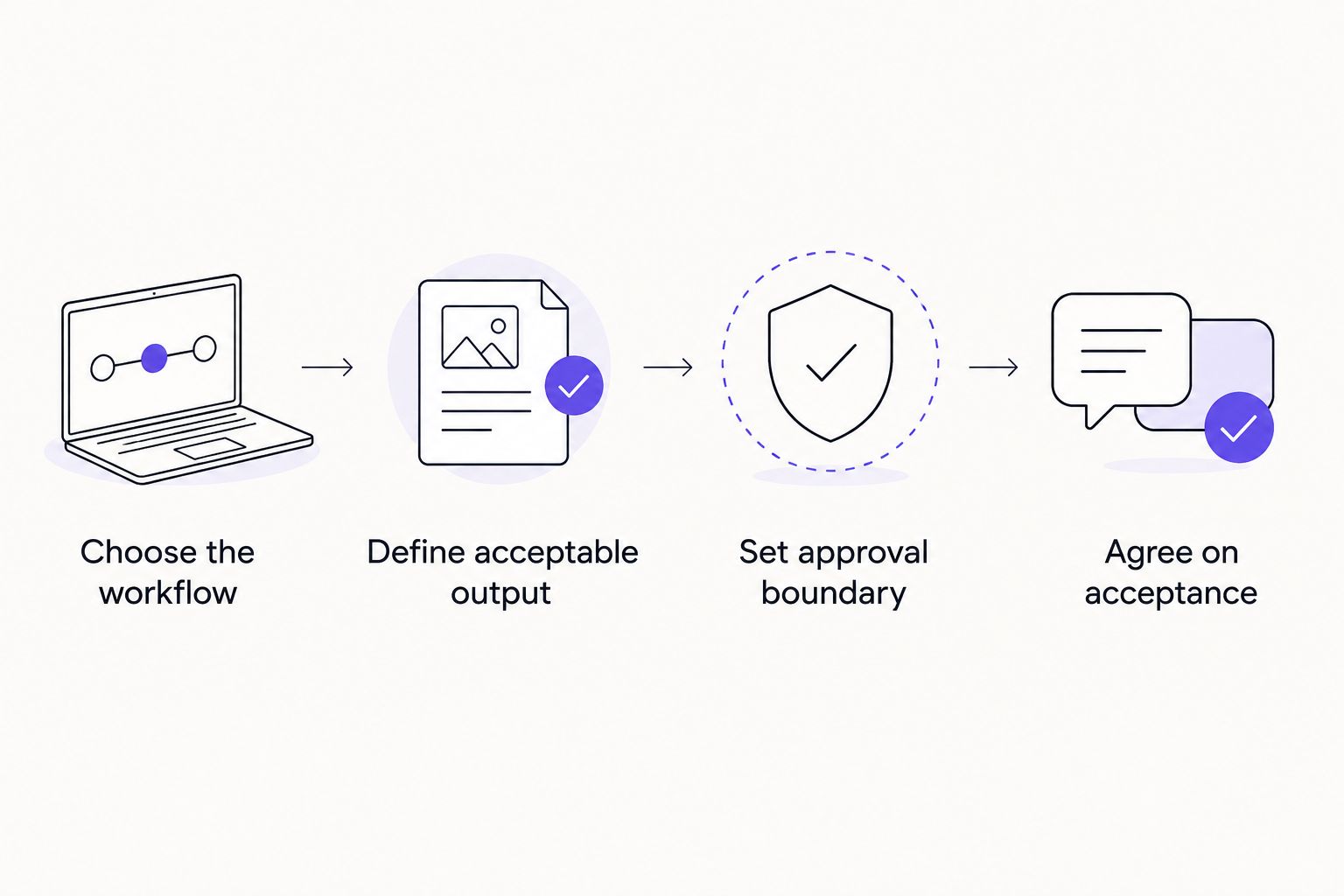
Define the workflow and acceptance conditions before comparing proposals.
How to compare proposals without choosing by rate alone
Compare proposals against the same written brief. If one consultant includes testing and handover while another quotes only development, ask for the difference to be resolved before making a selection.
Read the deliverables first
Look for artifacts you can inspect: a workflow description, a working integration, test results, operating instructions, and access documentation. Request only what your engagement needs, but identify it explicitly.
Replace vague phrases such as “implementation support” with an action and an endpoint. For example, ask the consultant to state which workflow will operate in which software and how your team will approve it. That is a requirement, not a guarantee of performance.
Inspect the exclusions
Ask what your team must supply, including access approvals, workflow knowledge, sample records, and review time. Name the owner of each dependency before agreeing to a schedule.
Check whether the proposal excludes documentation, post-launch fixes, or changes to connected software. Do not interpret an exclusion as a defect by itself. Decide whether your team can take responsibility for it.
Establish change control
Require a written description of a proposed change before authorizing additional work. The description should explain the new deliverable, its effect on existing work, and the approval required to proceed.
Keep original requirements and later requests separate. This gives both parties a record of what was purchased and prevents an expanding wish list from replacing a defined project.
When a build-and-maintain agency fits
Arcgent is best suited to businesses that need custom AI agents built and maintained inside software they already use. That matches an implementation need: automating a repetitive workflow and assigning responsibility for keeping it working.
Arcgent builds and maintains these agents. If you need only an independent strategy review, make that deliverable explicit instead of treating it as the same purchase as development and maintenance.
The advantage of a build-and-maintain engagement is continuity of responsibility. The trade-off is that you still need clear ownership terms, operating boundaries, and a process for approving new work. Do not treat an ongoing relationship as a substitute for documentation.
For an AI consulting brief, describe your repetitive task and existing software first. Ask the agency to distinguish the initial build from continued operation so you can evaluate each responsibility separately.
Define your automation project
Discuss a repetitive workflow and the software where your team already works.
Is hourly AI consulting better than a fixed-scope project?
Hourly AI consulting fits an investigation whose next step depends on the findings; a fixed-scope project fits a deliverable you can define and test. Neither billing model removes the need for approval limits.
For a 2026 engagement, separate discovery from implementation when the workflow is still unclear. Approve the investigation’s deliverable before committing to a build.
Does AI consulting include ongoing maintenance?
AI consulting includes ongoing maintenance only when the agreement says so. Request a list of covered tasks, exclusions, escalation responsibilities, and the process for authorizing changes.
Do not assume launch ends the work or that every future change belongs in maintenance. Set that boundary before acceptance.
What should you ask before approving consulting hours?
Ask what decision or deliverable the hours will produce, who will perform the work, and when approval is required to continue. Request a spending ceiling and a record of completed work.
A useful approval authorizes a bounded task. It does not authorize an indefinite search for something valuable to automate.
FAQ
How much does AI consulting cost per hour in 2026?
Determine the hourly amount through a written, scoped quote. Compare the assigned roles, included work, billing rules, and approval ceiling before treating proposals as equivalent.
What should an AI consultant include in an hourly quote?
An hourly quote should identify the work, assigned roles, billing unit, estimated effort, and spending ceiling. It should also explain exclusions and when additional approval is required.
Is hourly AI consulting better than project-based work?
Hourly consulting fits a defined investigation, while project-based work fits a deliverable with clear acceptance criteria. Choose according to how well you can specify the outcome, not the billing label alone.
Does an AI consulting agreement cover software usage?
Software usage is covered only if the agreement includes it. Ask who owns the relevant accounts and who pays usage-based charges.
Can I hire an agency to build and maintain an AI agent?
Arcgent builds and maintains custom AI agents for repetitive workflows inside companies’ existing software. Define the workflow, permissions, acceptance criteria, and maintenance responsibilities in the engagement brief.
How do I stop an hourly consulting project from expanding?
Set a spending ceiling, a stop-work rule, and written approval requirements for changes. Keep new requests separate from the original acceptance criteria.
What should happen before an AI agent goes live?
Test the expected output, exception handling, and approval boundaries before accepting the agent. Assign a business owner to approve the results and an operating owner to handle issues.
One last thing
Write the stopping condition before you approve the first hour. Your agreement should explain what happens when the consultant reaches the spending ceiling without completing the deliverable.
For your 2026 project, require a review at that boundary: inspect the completed work, identify the unresolved issue, and decide whether to narrow, continue, or stop. A low hourly figure cannot make that decision for you.