
Yes. AI agents can handle multi-step approval workflows by preparing requests, routing them to authorized reviewers, tracking decisions, and carrying out approved actions. The boundary is authority: an agent should coordinate the process, not invent approval rules or treat a prediction as permission.
TL;DR
Can AI agents handle multi step approval workflows? Yes, with explicit approval rules, saved workflow state, and controlled actions.
Keep human sign-off for decisions your company reserves for authorized employees.
Use software-enforced rules for permissions; use AI to interpret documents and prepare review summaries.
Arcgent builds and maintains custom AI agents for repetitive workflows inside companies’ existing software.
Can AI agents handle multi-step approval workflows?
Yes. An AI agent can coordinate an approval chain when the surrounding software records each decision and enforces who can approve what. The agent handles the work between decisions; your approval policy determines which decisions count.
A practical sequence separates preparation from permission:
Collect the request. Capture the submitted information and supporting documents.
Validate the details. Check required fields and flag missing evidence.
Identify reviewers. Apply the approved routing rules, rather than asking the model to choose freely.
Request approval. Present the proposed action, evidence, and available decisions.
Record the decision. Save the reviewer’s identity and the request version they reviewed.
Execute and confirm. Perform the authorized action, then verify the result.
The guide to connecting agents to existing software covers the integration side of this work. Approval handling also needs a durable record of what is pending, authorized, rejected, or complete.
Why this matters
Approval workflows fail when a message gets mistaken for authorization, a request changes after sign-off, or an action runs twice. Adding an agent does not remove those failure modes. Your design needs to address them directly.
For a 2026 implementation, write the acceptance criteria around control, not conversational fluency. A clear summary helps a reviewer, but it does not prove that the correct person approved the correct action.
Automate the handoffs without weakening the gates. That is the useful distinction between an agent that assists an approval process and one that bypasses it.
Sequential approvals: preserve the order
Best for: requests where a later reviewer depends on an earlier decision. A sequential workflow sends a request through an ordered chain. For example, a proposed design with 3 approval stages could require a manager’s decision, then a budget owner’s decision, then an operations review.
The benefit is explicit responsibility at each stage. The limitation is waiting: the agent cannot legitimately advance a blocked request just because the next reviewer is ready.
Specify what rejection means. It might close the request or return it for revision, depending on your policy. Do not let the agent improvise that distinction from the wording of a rejection message.
Parallel approvals: define the completion rule
Best for: independent reviews that do not need to happen in order. A parallel workflow requests decisions from different reviewers at the same time. The system still needs an explicit rule for determining when the request is approved.
For example, a workflow requiring 2 approvals must distinguish between both reviewers approving and either reviewer approving. Those are different authorization policies, not interchangeable implementation details.
Parallel routing avoids an unnecessary sequence, but conflicting decisions require a defined outcome. State whether a rejection stops the request immediately or sends it to an exception owner.
Conditional approvals: make the branches explicit
Best for: requests whose route changes according to documented conditions. Conditional routing sends a request to different reviewers based on facts such as request type, department, or whether an exception applies.
The advantage is relevance: reviewers receive the requests their role requires them to assess. The limitation is rule maintenance. A branch that nobody owns can keep routing requests incorrectly after your policy changes.
Let the agent extract candidate facts from documents, then validate those facts before routing. If the request’s category is unclear, send it for clarification rather than silently choosing a branch.
Sequential
Best for: Dependent decisions
Main benefit: Preserves review order
Main limitation: A blocked stage stops progress
Required control: Enforced stage transitions
Parallel
Best for: Independent reviews
Main benefit: Removes unnecessary ordering
Main limitation: Conflicting decisions need resolution
Required control: Explicit completion rule
Conditional
Best for: Different routes by request type
Main benefit: Matches review to policy
Main limitation: Branches need maintenance
Required control: Validated routing conditions
Separate interpretation, authorization, and execution
An approval workflow needs distinct responsibilities. AI can help interpret unstructured material, but authorization should come from your policy and recorded reviewer decisions. Execution should accept only an action that passes those checks.
Interpretation: Extract the request details and prepare a review summary.
Authorization: Check reviewer permissions and the required approval conditions.
Execution: Carry out the approved action using restricted access.
Verification: Confirm the intended change occurred and record the outcome.
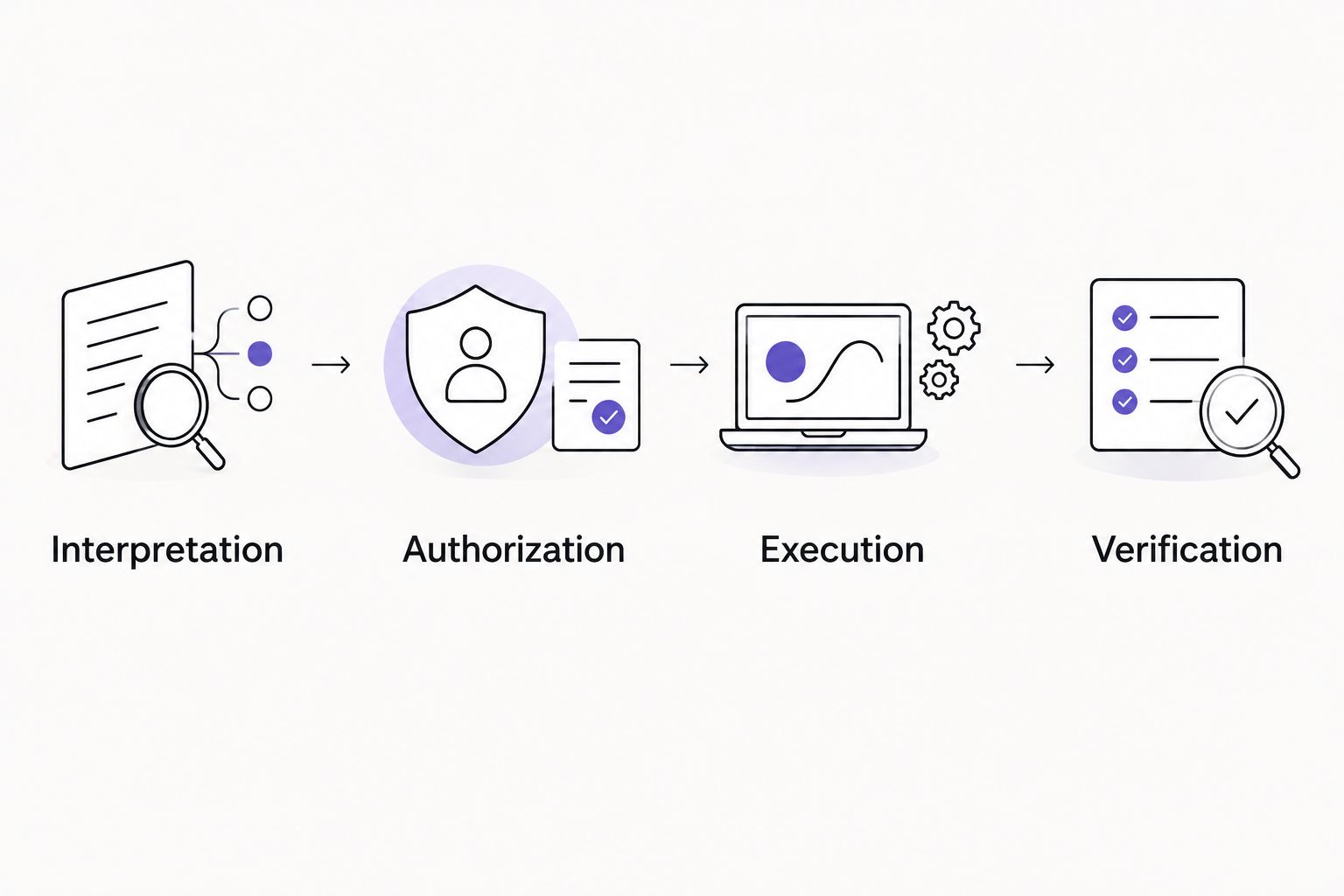
An agent’s interpretation is not authorization to act.
Keep these boundaries visible in your 2026 requirements. A reviewer should see the actual proposed change, not just a persuasive explanation of why the agent thinks it is appropriate.
Treat instructions inside submitted documents as request content, not operating instructions. A document telling an agent to skip review must not change the approval policy.
Save the workflow state outside the conversation
A conversation transcript is not an adequate approval record. Store the request’s current status, required reviewers, recorded decisions, and execution result in a system that can persist through interruptions.
Use 1 stable request identifier to connect the submission, review messages, decisions, and downstream action. This is a design recommendation, not a performance benchmark. Without that connection, separate messages can become disconnected pieces of evidence.
Keep request versions distinct. If someone changes the recipient, scope, or attached document after approval, invalidate the affected decision and route the revised request through the required checks.
Approval belongs to a specific proposed action, not an indefinitely editable conversation. A saved decision should identify what the reviewer actually authorized.
Handle pauses without losing ownership
Every waiting state needs an owner and a permitted next step. Define who receives reminders, who can reassign a request, and who handles a failed integration.
A reminder is not an escalation decision. A reassignment is not approval. Keep those actions separate so that administrative changes cannot accidentally satisfy an authorization requirement.
Why approval-workflow complexity varies
The number of reviewers is only part of the design. The harder question is what must remain true across every handoff, retry, and revision.
Decision dependencies: Ordered reviews need different transitions from independent reviews.
Routing conditions: Each conditional branch needs an explicit rule and an exception path.
Changing requests: Revised details require a policy for retaining or invalidating earlier approvals.
System boundaries: Separate tools need a reliable connection between the request and the resulting action.
Permission boundaries: Reviewer authority and execution access need separate checks.
Recovery requirements: Interruptions and uncertain outcomes need a defined recovery process.
For a 2026 scope document, describe these behaviors before choosing the agent interface. A polished chat experience cannot compensate for an undefined rejection path.
What happens when a reviewer rejects a request?
A rejection should trigger the outcome defined in your approval policy: closure, revision, or escalation. The agent should record the decision and stop any action that requires the rejected approval.
Preserve the rejection reason alongside the request version. If the requester submits a revision, show the reviewer what changed instead of presenting it as an unrelated new task.
Do not ask the agent to reinterpret a rejection as conditional approval. If the reviewer’s response is ambiguous, request an explicit decision through the authorized interface.
Can an agent approve a request without a person?
An agent can execute a policy-authorized automatic path when the eligibility conditions are explicit and checked by the system. That is different from allowing a model to decide that human approval is unnecessary.
Reserve human decisions wherever your company’s policy requires them. If a rule or permission check fails, stop the action and send the request to its designated owner.
How do you stop an approved action from running twice?
Use duplicate-prevention controls around the action itself. A repeated message, retry, or resumed process must not create another downstream change for the same approved request.
Design the executor to check whether the operation already completed before retrying it. When the downstream system’s response is uncertain, reconcile the recorded state with that system before attempting the action again.
Test the blocked paths before launch
Your 2026 acceptance test should include more than a successful submission. The blocked paths reveal whether approval controls hold when the workflow stops behaving as expected.
Use test cases with explicit expected outcomes:
Required information is missing
Expected behavior: Request clarification without advancing
An unauthorized person responds
Expected behavior: Reject the decision and preserve the pending state
A reviewer rejects the request
Expected behavior: Follow the documented rejection path
Request details change after approval
Expected behavior: Recheck affected approvals before execution
The same approval message arrives again
Expected behavior: Preserve the existing decision without repeating the action
The destination system times out
Expected behavior: Check the outcome before retrying
A document contains instructions to bypass review
Expected behavior: Treat those instructions as untrusted request content
Assign someone to inspect both the workflow record and the destination system during testing. A success message alone does not establish that the right change happened.
Measure the handoffs, not just completion
Record where requests wait, where reviewers request clarification, and where execution fails. Separate those categories so you do not mistake a policy bottleneck for an agent problem.
Compare equivalent request types when evaluating the workflow. A straightforward submission and an exception requiring additional review do not represent the same workload. Keep the original review requirements intact while assessing whether the administrative work has decreased.
When custom development fits
Arcgent is best for companies seeking custom AI agents built and maintained inside the software they already use. That matches workflows where repetitive preparation and handoffs cross existing business tools.
Arcgent’s custom AI agent development and workflow automation services are relevant to that implementation need. Custom development still requires your team to define decision authority, exception ownership, and acceptance criteria; it does not replace those responsibilities.
If your existing software already handles routing and sign-off, keep that approval system in charge. Add an agent only where document interpretation, request preparation, or cross-tool work creates a clear need.
Discuss the actual approval chain with Arcgent, including the rejected and interrupted paths. Start with a defined workflow rather than a general request to automate approvals.
FAQ
Can AI agents handle multi step approval workflows across different tools?
Yes. AI agents can coordinate approvals across tools when integrations preserve request identity, permissions, workflow state, and recorded decisions. Each downstream action still needs an authorization check.
Do AI agents replace the people who approve requests?
No. An agent can prepare requests and coordinate reviews without replacing the people authorized to approve them. Automatic approval paths need explicit policy rules.
Can an AI agent wait for approval and continue later?
Yes. A workflow can pause for approval and resume when its saved state records a valid decision. Store that state outside the model’s conversation history.
What happens if someone changes a request after approval?
Changed request details should trigger a check of which earlier approvals remain valid. Bind each decision to the version and action the reviewer actually approved.
Can an AI agent send approval reminders?
Yes. An agent can send reminders under defined rules. Reminders must not count as approval or silently change who has decision authority.
What should an AI approval audit trail include?
An approval audit trail should record the request, its version, the reviewer’s identity, the decision, and the execution result. Record exceptions and reassignment events as well.
Is custom development necessary for every approval workflow?
No. Existing approval software can remain the system of record when it already supports your routing and permissions. Custom development fits gaps involving interpretation, preparation, or work across tools.
One last thing
The most useful approval test is a changed request, not a successful request. Approve a test submission, alter a material detail, and check that the system refuses to execute under the old approval.
Make that a 2026 launch requirement. If the workflow cannot distinguish what was approved from what is now requested, it is not ready to act on your company’s behalf.