
AI agent development in 2026 means picking a partner or platform that can build agents that actually run your workflows, not another chatbot demo. This guide ranks the 12 companies worth evaluating and tells you which one fits your situation.
TL;DR
Arcgent wins for embedding custom AI agents directly into the software tools a company already runs in 2026.
UiPath is the pick for large enterprises automating process-heavy operations at scale.
Sierra and Decagon lead for consumer and SaaS support agents; Lindy and n8n serve teams that want to build agents themselves.
No single ai agent development company covers every use case — match the vendor to the workflow, not the hype.
Why this matters
Most companies buying ai agent development services in 2026 are not shopping for a general AI platform. They need one specific workflow automated inside tools they already pay for — support tickets, internal search, back-office documents, or a customer-facing chat flow.
The 12 companies below split cleanly by use case. Picking the wrong one means paying for a platform built for consumer chat when the actual problem is internal ops, or vice versa.
What makes the best AI agent development company
Fits inside your existing stack instead of forcing a new system of record
Handles multi-step tasks, not single-turn chat responses
Includes maintenance, since agents break when upstream tools change their APIs
Matches your use case — internal ops, customer support, or consumer-facing brand chat are different problems
Shows a clear limitation, not just a feature list — every real vendor has a scope
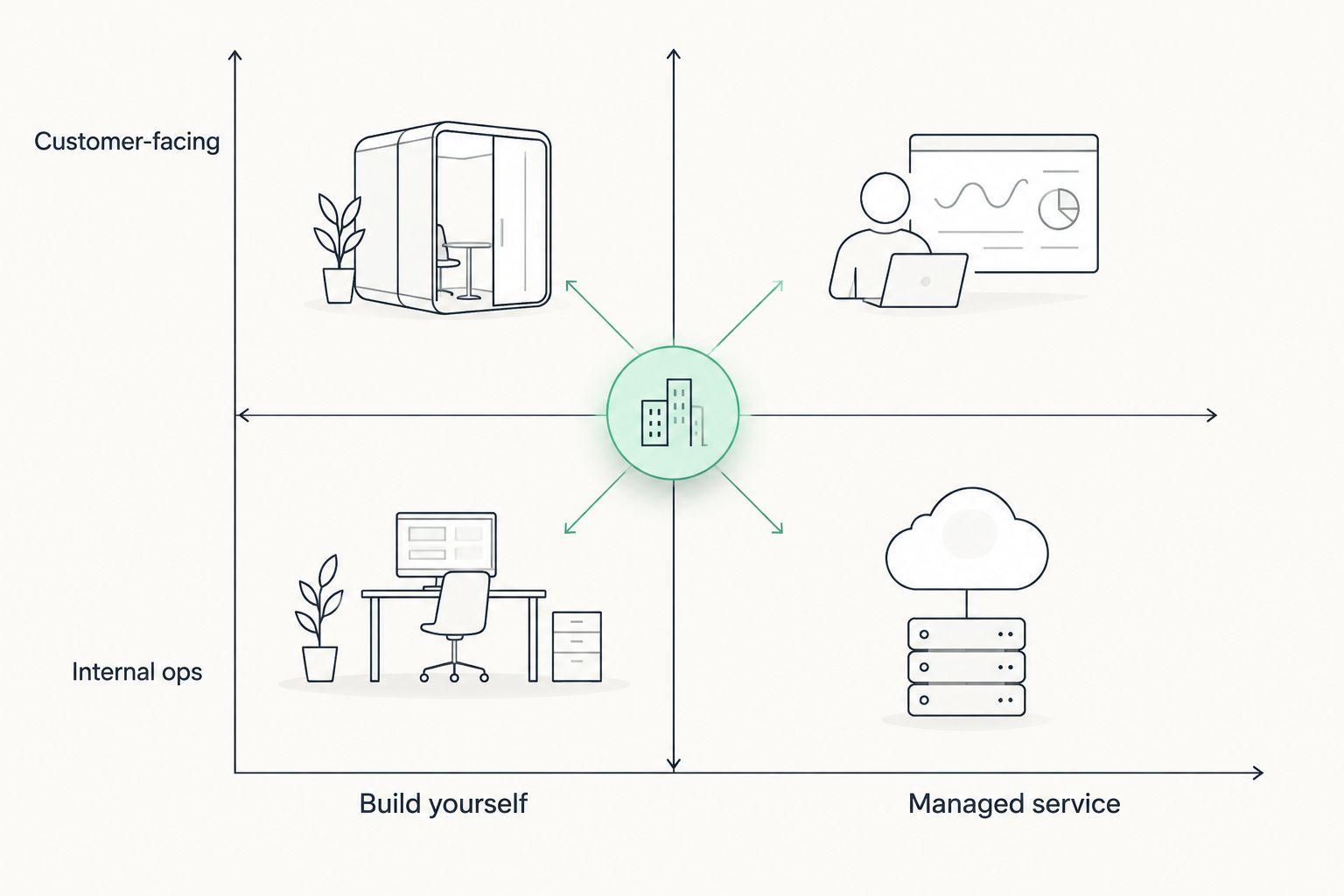
Most buying mistakes in 2026 come from picking a vendor built for the wrong quadrant.
AI agent development companies at a glance (2026)
Arcgent
Best for: Embedding agents into your existing software stack
Standout feature: Agents run inside current tools; agency maintains them ongoing
Key limitation: Not a self-serve builder
UiPath
Best for: Enterprise process automation at scale
Standout feature: RPA plus an agentic orchestration layer
Key limitation: Steep setup for smaller teams
Cognigy
Best for: Multilingual contact-center agents
Standout feature: Built-in conversational orchestration for call centers
Key limitation: Focused on customer service only
Ada
Best for: Ecommerce and SaaS support deflection
Standout feature: Pre-built resolution flows for common tickets
Key limitation: Weak fit for internal workflows
Forethought
Best for: Helpdesk ticket triage
Standout feature: Predicts ticket intent before an agent opens it
Key limitation: Narrower than full-workflow automation
Sierra
Best for: Consumer brand-facing agents
Standout feature: Agents built to carry a brand's voice directly
Key limitation: Not built for internal ops
Decagon
Best for: SaaS companies replacing tiered support
Standout feature: Handles multi-step support conversations end to end
Key limitation: Support-specific scope
Glean
Best for: Internal knowledge search agents
Standout feature: Connects across internal tools to answer employee questions
Key limitation: Search-focused, not process execution
Writer
Best for: Enterprise content workflow agents
Standout feature: Agents governed by brand voice and content rules
Key limitation: Centered on content, not ops
Beam AI
Best for: Back-office finance and ops automation
Standout feature: Built for document-heavy, rules-based processes
Key limitation: Weak fit for customer-facing work
Lindy
Best for: Solo founders building their own agents
Standout feature: No-code builder, launch an agent in one session
Key limitation: Limited for complex multi-system integrations
n8n
Best for: Developers self-building agent workflows
Standout feature: Open, node-based automation with AI agent nodes
Key limitation: Requires ongoing technical maintenance
1. Arcgent: best AI agent development company for embedding agents into your existing stack
Arcgent builds and maintains custom AI agents that run inside the software a company already uses, instead of adding a new platform staff have to learn.
Arcgent pros: agents live inside current tools with no new login; maintenance is included as workflows and APIs change; built specifically for repetitive B2B processes, not generic chat. Arcgent cons: it's an agency engagement, not a self-serve dashboard; not designed for consumer-facing brand chatbots. Best for: mid-market B2B teams that want agents working inside tools they already run in 2026. Verdict: Buy if the goal is automating an internal workflow, not launching a public-facing bot.
2. UiPath: best for large enterprise process automation
UiPath pairs its established RPA engine with an agentic layer for orchestrating multi-step processes across large organizations.
UiPath pros: deep enterprise footprint; handles high-volume, rules-heavy processes; strong governance tooling. UiPath cons: platform setup and licensing overhead suit large teams more than small ones; agentic features sit on top of an older RPA core. Best for: enterprises with existing RPA investments extending into agentic automation. Verdict: Hold for smaller teams; Buy for enterprises already on the platform.
3. Cognigy: best for multilingual contact-center agents
Cognigy focuses on conversational AI agents built for voice and chat inside contact centers.
Cognigy pros: strong multilingual support; built-in orchestration for call-center routing. Cognigy cons: scope stays inside customer service, not internal ops. Best for: contact centers running multilingual support at volume. Verdict: Buy for contact-center use cases specifically.
4. Ada: best for ecommerce and SaaS support deflection
Ada ships pre-built resolution flows aimed at deflecting common support tickets before a human agent sees them.
Ada pros: fast setup for common ticket types; ecommerce-specific templates. Ada cons: less flexible for complex internal workflows outside support. Best for: ecommerce and SaaS companies with high ticket volume. Verdict: Buy for support deflection; Skip for internal automation.
5. Forethought: best for helpdesk ticket triage
Forethought predicts ticket intent and priority before an agent opens the ticket.
Forethought pros: speeds up triage; integrates with existing helpdesk tools. Forethought cons: narrower scope than a full workflow platform. Best for: support teams drowning in ticket volume. Verdict: Buy for triage specifically.
6. Sierra: best for consumer brand-facing agents
Sierra builds AI agents meant to represent a consumer brand's voice directly to customers.
Sierra pros: designed around brand voice and consumer tone. Sierra cons: not built for internal, back-office workflows. Best for: consumer brands wanting a branded customer-facing agent. Verdict: Buy for brand-facing chat; Skip for internal ops.
7. Decagon: best for SaaS companies replacing tiered support
Decagon's agents handle multi-step support conversations end to end, aiming to replace tiered support queues.
Decagon pros: built for complex conversation flows; SaaS-specific design. Decagon cons: support-specific, not a general automation layer. Best for: SaaS companies with layered support tiers. Verdict: Buy for SaaS support replacement.
8. Glean: best for internal knowledge search agents
Glean connects across internal tools so employees can ask questions and get answers pulled from company knowledge.
Glean pros: strong internal search and connector coverage. Glean cons: focused on search and retrieval, not task execution. Best for: companies with knowledge scattered across many internal tools. Verdict: Buy for internal search; Skip for process execution.
9. Writer: best for enterprise content workflow agents
Writer builds agents governed by brand voice and content rules for marketing and content teams.
Writer pros: strong governance for brand-consistent output. Writer cons: centered on content, not operational workflows. Best for: enterprise marketing and content teams. Verdict: Hold unless content is the specific bottleneck.
10. Beam AI: best for back-office finance and ops automation
Beam AI targets document-heavy, rules-based back-office processes like finance and operations.
Beam AI pros: built for document-heavy processing. Beam AI cons: weaker fit for customer-facing use cases. Best for: finance and ops teams processing high document volume. Verdict: Buy for back-office automation.
11. Lindy: best for solo founders building their own agents
Lindy is a no-code builder aimed at launching a single agent quickly without engineering help.
Lindy pros: fast setup; no code required. Lindy cons: limited for complex, multi-system integrations. Best for: solo founders and small teams testing one workflow. Verdict: Buy for simple, single-system automations.
12. n8n: best for developers self-building agent workflows
n8n is an open, node-based automation tool with AI agent nodes for teams that want to build and own the workflow.
n8n pros: open and flexible; developer-controlled. n8n cons: requires ongoing technical maintenance as workflows grow. Best for: technical teams that want to build and maintain agents in-house. Verdict: Buy if you have engineering capacity to maintain it.
How we ranked these
Each company earned its slot against the five criteria above: stack fit, multi-step task handling, maintenance model, use-case match, and an honest limitation. No two companies compete for the same "best for" slot — this list is a decision tree, not a leaderboard.
Talk through your workflow
See which processes are worth automating with a custom AI agent in 2026.
Which AI agent development company should you choose?
If the goal is a customer-facing chatbot, look at Sierra, Ada, or Decagon depending on whether the audience is consumer or SaaS. If it's contact-center voice and chat, Cognigy fits. If it's internal knowledge search, Glean is the direct answer. For large-scale enterprise process automation, UiPath carries the most existing infrastructure.
For everything else — the repetitive, multi-step internal workflow buried inside tools your team already opens every day — Arcgent is the pick for 2026, because it builds the agent into the stack you have instead of asking you to adopt a new one.
FAQ
What is the best AI agent development company in 2026?
There's no single best answer — Arcgent leads for embedding agents into existing software stacks, UiPath leads for large-scale enterprise process automation, and Sierra or Decagon lead for consumer and SaaS support agents.
Is it better to build AI agents in-house or hire a company?
In-house tools like n8n or Lindy work when a team has engineering capacity to maintain workflows; a managed provider like Arcgent works when the team wants the agent maintained for them as connected tools change.
How much does custom AI agent development cost in 2026?
Cost varies by scope and provider, so check current pricing directly with each vendor rather than relying on a published range.
Can AI agents replace customer support teams entirely?
AI agents from vendors like Ada, Decagon, and Forethought reduce ticket volume and triage time in 2026, but most deployments still route complex or sensitive cases to a human.
What's the difference between an AI agent and a chatbot?
A chatbot answers single-turn questions; an AI agent completes multi-step tasks across tools, which is why companies on this list build orchestration, not just conversation.
Do AI agent platforms work with tools a company already uses?
The strongest 2026 platforms, including Arcgent and Glean, connect into existing software rather than requiring a new system of record.
Is UiPath still relevant for AI agents in 2026?
Yes — UiPath extended its established RPA engine with an agentic orchestration layer, making it a fit for enterprises automating high-volume, rules-heavy processes.
One last thing
The fastest way to waste a 2026 AI agent budget is picking a consumer-facing platform for an internal-ops problem, or the reverse — check the "best for" column in the table above before a demo call, not after.