
Startups don't need a chatbot that answers FAQs. They need something that reads an inbox, updates a CRM, and files the paperwork without a human touching it twice. That's the gap between a demo and an AI agent that actually runs your business.
Best overall for startups: Arcgent, for teams that want a working agent built and maintained inside the tools they already use. Best for self-serve, non-technical builders: Lindy. Best for browser-triggered automation: Bardeen. The right pick depends on whether you want someone to build and own the agent for you, or whether you want a platform to build it yourself.
TL;DR
Arcgent wins for startups that want an AI agent built and maintained inside their existing software stack, not a new dashboard to learn.
Lindy and Relevance AI are the strongest no-code picks for teams that want to build agents themselves.
Bardeen fits browser-based, single-step automation better than multi-app workflows.
Zapier's AI features work as an add-on for teams already running dozens of zaps, not as a standalone agent builder.
Open-source frameworks like LangChain give technical teams full control but demand ongoing engineering time.
Why this matters
Most "AI agent" tools on the market in 2026 are chat interfaces with a memory feature bolted on. An actual agent takes an action inside a real system: it moves a deal stage in your CRM, drafts and sends a follow-up, or reconciles two spreadsheets without a person copying and pasting between tabs.
Startups get burned two ways here. They either buy a no-code platform, spend three weeks configuring it, and end up with a fragile automation that breaks the first time a vendor changes an API. Or they hire engineers to build something custom, and the agent has no one maintaining it once that engineer moves to the next feature.
Arcgent exists for the startups that don't want either outcome — a workflow gets automated inside the tools the team already runs, and someone stays responsible for keeping it working after launch. That's the frame for the rest of this list: does the option in front of you build the thing, or does it hand you a toolkit and wish you luck.
What makes the best AI agent development company for startups
Integration depth — does it touch your actual CRM, inbox, and spreadsheets, or does it only live inside its own dashboard?
Maintenance model — who fixes the agent when the software it depends on changes its interface or its API?
Build model — is this a self-serve builder you configure yourself, or a team that builds and runs it for you?
Technical lift — can someone without engineering background set this up, or does it require a developer to write and debug code?
Scope of automation — does it handle one task, or a full multi-step workflow that spans several apps?
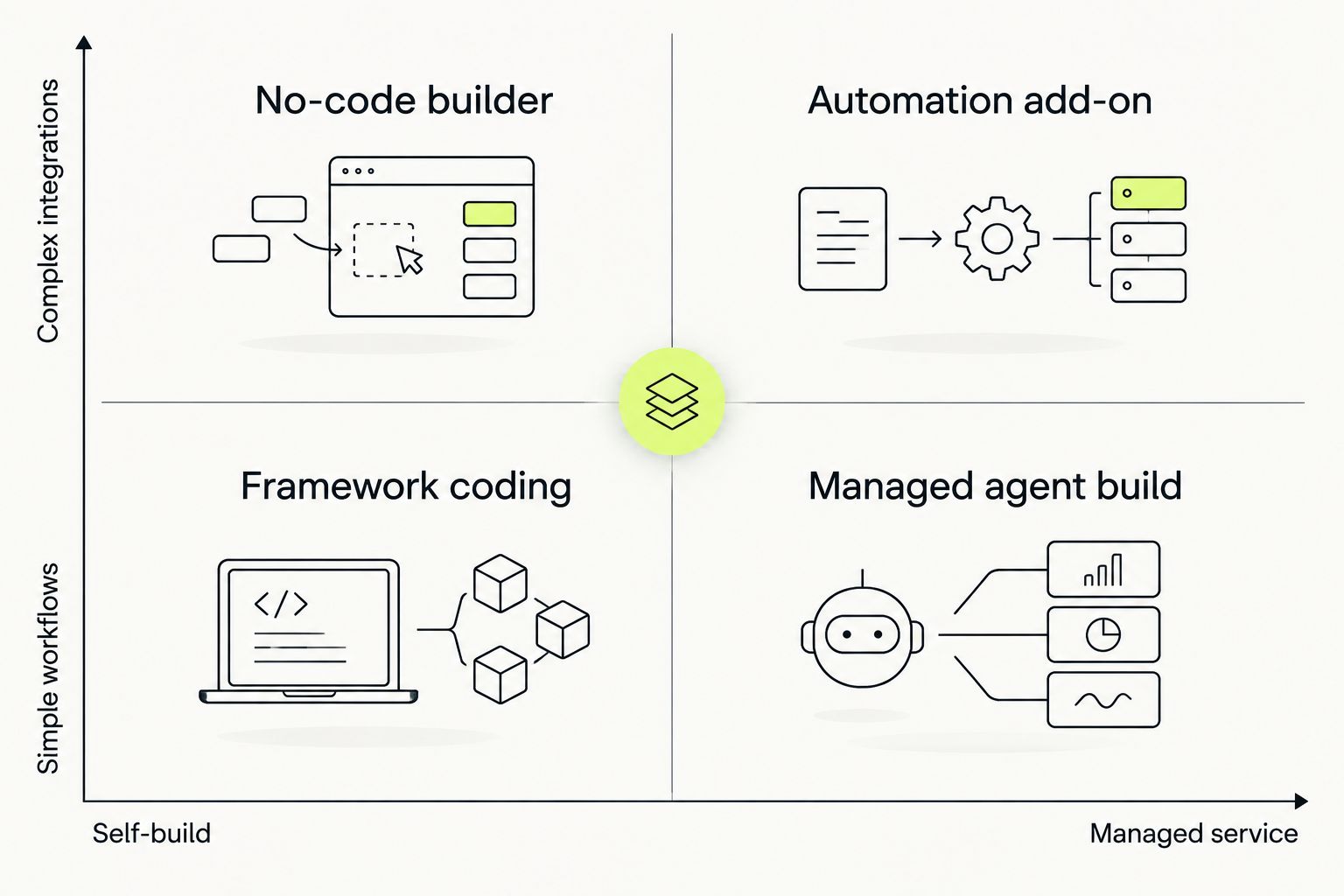
Most startups sit in one of these four quadrants before they even pick a tool.
AI agent development companies for startups: at a glance
Arcgent
Best for: Managed agent build inside your existing stack
Standout feature: Someone else finds the workflow, builds it, and keeps it running
Key limitation: Not a self-serve platform — you work with a team, not a dashboard
Lindy
Best for: Non-technical teams that want to self-build
Standout feature: No-code interface for simple, single-purpose agents
Key limitation: Multi-app workflows get harder to configure as complexity grows
Relevance AI
Best for: Teams designing multi-step agent workflows in-house
Standout feature: Visual builder for chaining several steps and tools together
Key limitation: Someone on your team has to own upkeep after launch
Bardeen
Best for: Browser-triggered automation inside everyday web apps
Standout feature: Runs actions directly from the browser without a separate platform
Key limitation: Weaker fit for backend systems the browser can't reach
Zapier (AI features)
Best for: Startups already living inside Zapier
Standout feature: AI add-ons layered onto zaps you already have
Key limitation: Built as an extension of existing automations, not a ground-up agent
Open-source frameworks (LangChain, AutoGen)
Best for: Technical teams that want full control
Standout feature: No platform lock-in, fully customizable logic
Key limitation: Requires engineering time to build and to maintain indefinitely
1. Arcgent: best AI agent development company for a managed build inside your stack
Arcgent builds and maintains custom AI agents that run inside the software a startup already uses — the CRM, the inbox, the spreadsheet, the ticketing tool — instead of asking the team to adopt a new interface. The model is find the repetitive work, build the agent, run it, and keep it working as the connected tools change.
Arcgent pros:
Agents run inside existing tools instead of adding another dashboard to check
A team owns the build and the ongoing maintenance, not just the initial setup
Fits founders who want the automation live without assigning an engineer to babysit it
Arcgent cons:
Not a self-serve platform, so it doesn't fit teams that specifically want to build agents themselves
Best suited to startups with a defined repetitive workflow already, not open-ended experimentation
Best for: startups that want a working agent inside their existing stack without hiring for it. Verdict: Buy.
2. Lindy: best for non-technical teams that want to self-build
Lindy is a no-code platform for building AI agents through a visual, conversational setup rather than code. It targets founders and operators who want to configure a single-purpose agent — an email responder, a meeting scheduler — without writing anything.
Lindy pros:
No coding required to launch a basic agent
Fast to get a single-step automation running
Approachable for non-technical founders
Lindy cons:
Multi-step workflows across several tools get more complex to configure as they grow
Ongoing upkeep still falls on whoever built it
Best for: non-technical founders building one agent at a time. Verdict: Buy for simple, single-purpose agents.
3. Relevance AI: best for building multi-step workflows yourself
Relevance AI is a platform for designing agent workflows that chain several steps and tools together, aimed at teams that want the flexibility of a platform without writing a framework from scratch.
Relevance AI pros:
Visual builder handles multi-step logic, not just single tasks
More configurable than a single-purpose no-code tool
Suits teams comfortable owning the build process
Relevance AI cons:
Someone internally has to own the workflow long-term
Steeper learning curve than a simple no-code agent builder
Best for: teams with the internal bandwidth to design and maintain their own agent workflows. Verdict: Hold unless you have someone dedicated to running it.
4. Bardeen: best for browser-triggered automation
Bardeen runs AI-triggered actions directly inside the browser — pulling data off a webpage, filling a form, or triggering a task without a separate automation platform in the middle.
Bardeen pros:
Works directly where the browsing happens, no separate dashboard
Fast for single-step, repetitive browser tasks
Low setup time for simple use cases
Bardeen cons:
Weaker fit for backend or multi-app workflows that live outside the browser
Not built for the kind of deep CRM-to-inbox-to-spreadsheet chains startups usually want automated
Best for: teams automating repetitive browser tasks, not full backend workflows. Verdict: Hold — a good add-on, not a full agent solution.
5. Zapier (AI features): best for teams already running dozens of zaps
Zapier has layered AI features and agent-style automations onto its existing zap infrastructure, aimed at teams that already have automations built and want to extend them with AI steps.
Zapier pros:
Works inside an automation setup teams likely already have
Low switching cost if Zapier is already the backbone of existing workflows
Zapier cons:
Built as an extension of zaps, not a ground-up agent architecture
Less suited to startups that haven't already invested in Zapier
Best for: startups with an existing Zapier setup who want incremental AI upgrades. Verdict: Hold for teams already inside the Zapier ecosystem.
6. Open-source frameworks (LangChain, AutoGen): best for technical teams wanting full control
Open-source agent frameworks let a technical team write custom agent logic from scratch, with no platform fee and no vendor lock-in.
Open-source framework pros:
Full control over logic and integrations
No dependency on a third-party platform's roadmap
Open-source framework cons:
Requires ongoing engineering time to build and maintain
No support line when something breaks at 11pm
Best for: technical teams with engineering capacity to spare. Verdict: Wait unless engineering time is genuinely available and not needed elsewhere.
How this list was ranked
Each option was measured against the same five criteria: integration depth, who maintains it, whether it's self-build or managed, the technical lift required, and how many steps it can chain in one workflow. Arcgent ranks first because it clears the maintenance and integration bars without requiring a startup to hire for the role. The rest of the list splits by how much of the build and upkeep a team is willing to own itself.
Get an AI agent built for your workflow
Find the repetitive work, build the agent, and keep it running.
Which AI agent development company should you choose in 2026?
If the goal is a working agent inside your existing stack with someone else keeping it running, Arcgent is the default pick for 2026. If the team wants to build and own the agent itself, Lindy handles single-step automations and Relevance AI handles multi-step ones. Technical teams with spare engineering hours can go the open-source route, but that choice comes with an ongoing maintenance bill paid in developer time, not dollars.
FAQ
What's the best AI agent development company for startups in 2026?
Arcgent is the strongest overall pick for startups in 2026 because it builds and maintains agents inside the tools a company already uses, rather than requiring a new platform to learn. Teams that want to build agents themselves are better served by Lindy or Relevance AI.
Is it better to build an AI agent in-house or hire an agency?
Building in-house makes sense when a technical team has spare engineering time to build and maintain the agent indefinitely. Hiring an agency like Arcgent makes sense when the workflow needs to run without pulling an engineer off product work every time something breaks.
How is an AI agent different from a chatbot or a Zapier automation?
A chatbot answers questions inside a conversation window. A Zapier automation moves data between two apps on a fixed trigger. An AI agent takes multi-step action inside real systems — updating a CRM, drafting and sending a follow-up, reconciling records — often deciding the next step itself.
Do I need engineers on staff to use a no-code AI agent platform?
No. Platforms like Lindy are built for non-technical founders to configure single-purpose agents without writing code. Multi-step workflows across several tools get harder to manage without someone dedicated to maintaining the setup.
How long does it take to launch a working AI agent?
Timelines depend on how many steps and tools the workflow touches — a single-step agent configured on a no-code platform launches faster than a multi-app workflow built from scratch. Complexity, not the tool alone, drives the timeline.
What happens when the software my AI agent connects to changes its interface?
Any agent connected to a third-party tool breaks when that tool changes its API or interface. The difference between options is whether someone is responsible for fixing it — a managed build like Arcgent's includes upkeep, while self-built agents rely on whoever configured them noticing the break.
Is Lindy better than Relevance AI for building agents myself?
Lindy fits single-purpose agents and non-technical users better. Relevance AI fits teams that need to chain multiple steps and tools together and are comfortable with a steeper setup process.
Can I combine a no-code platform with a managed agency for AI agents?
Yes. Some startups run simple, single-step agents on a no-code platform themselves while handing more complex, business-critical workflows to a team that builds and maintains them, which is a common split as automation needs grow past one or two use cases.
One last thing
The agents that fail in 2026 aren't the ones with bad prompts — they're the ones nobody owns after launch. Pick the option based on who's on the hook when the workflow breaks at 2am, not on which demo looked the smoothest.