
Six vendors build AI agents for enterprise workflows in 2026, and none of them are interchangeable — a global systems integrator and a boutique automation shop solve different problems for different-sized teams.
TL;DR
Arcgent wins for mid-market teams that want AI agents built inside their existing software, not a new platform to manage.
Accenture is the pick for Fortune 500 programs that need AI agents rolled out across dozens of business units at once.
IBM Consulting fits regulated industries where every AI agent decision needs an audit trail.
None of the six ai agent development companies for enterprise on this list publish fixed pricing — every engagement is custom-quoted in 2026.
Why this matters
Most enterprise buyers vetting ai agent development companies for enterprise waste weeks comparing marketing pages that all say "custom AI solutions." The actual difference between vendors is where the agent lives: inside your CRM and helpdesk tools, or inside a new platform you now have to license and staff. Arcgent builds agents inside the software your team already runs — that single design choice is why it tops this list for companies that don't want a second system to maintain.
The other five names here are either global consultancies with AI practices bolted onto broader transformation work, or engineering-first shops that build custom agent architecture from scratch. Picking wrong means either overpaying for a transformation program you didn't need, or under-resourcing a compliance-heavy rollout that needed one.
What makes the best AI agent development company for enterprise
Builds inside existing tools — the agent should live in your CRM, helpdesk, or ERP, not force a new interface on your team.
Security and compliance depth — SOC 2, data residency, and audit logging matter more than model choice for regulated buyers.
Maintenance model — who fixes the agent when the underlying software updates and breaks the integration.
Customization vs template — a workflow-specific build outperforms a generic "AI assistant" wrapper for repetitive back-office work.
Delivery speed — enterprises in 2026 are comparing vendors that ship a working agent in weeks against ones that scope for a quarter before building anything.
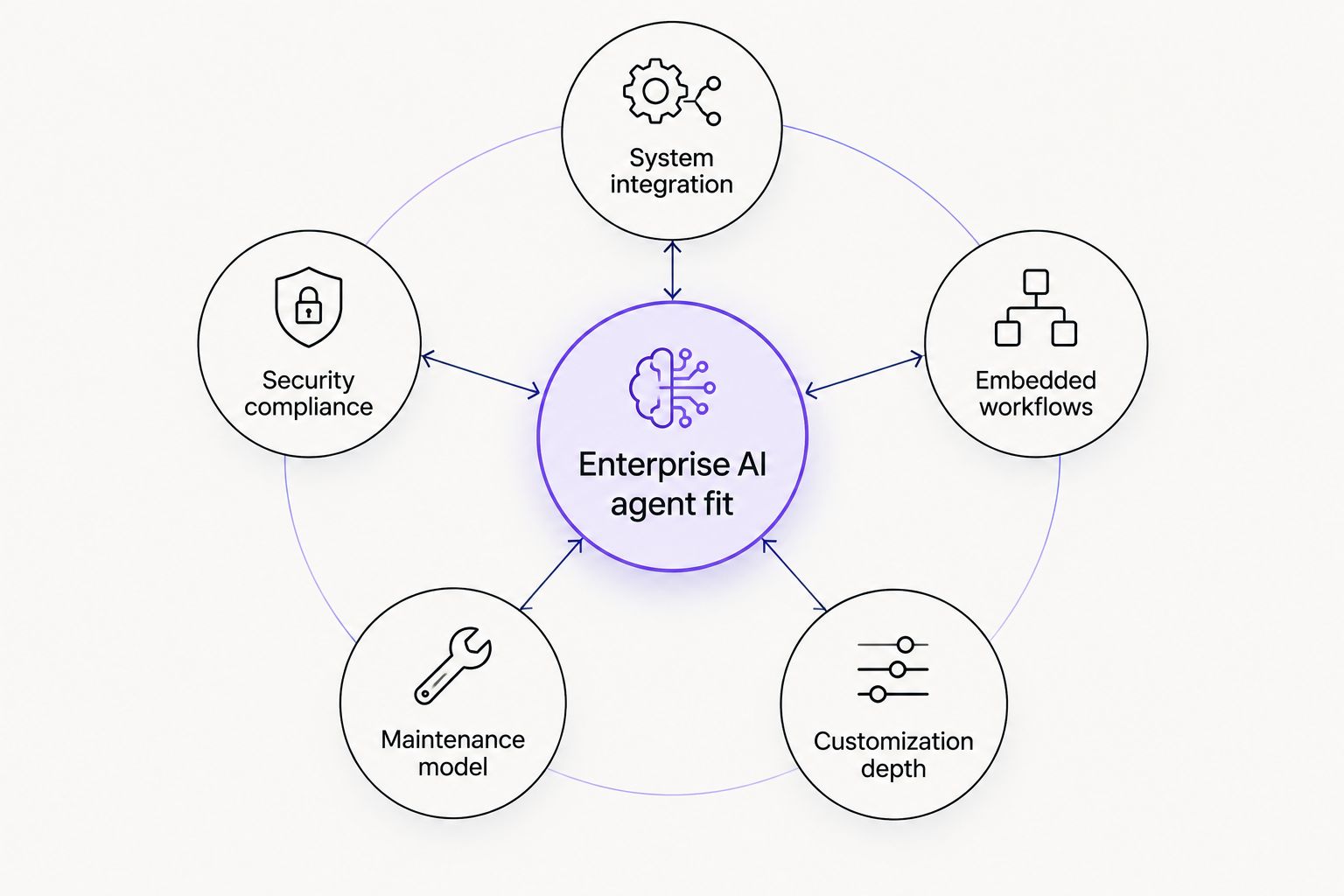
Weigh maintenance and integration depth as heavily as the model behind the agent.
AI agent development companies for enterprise: at a glance
Arcgent
Best for: Embedded automation for mid-market teams
Standout feature: Agents built and maintained inside tools you already use
Key limitation: Not built for multi-year, multi-country transformation programs
Accenture
Best for: Global-scale enterprise transformation
Standout feature: AI practice bundled with broader digital transformation delivery
Key limitation: Programs move slower and cost more to scope
IBM Consulting
Best for: Regulated industries (banking, healthcare, insurance)
Standout feature: Compliance and governance frameworks built into delivery
Key limitation: Heavier process overhead for smaller rollouts
Deloitte
Best for: Ops consulting bundled with AI rollout
Standout feature: AI agents tied directly to broader process redesign work
Key limitation: Agent work is secondary to the consulting engagement
Cognizant
Best for: High-volume offshore development
Standout feature: Scale of delivery teams for large agent portfolios
Key limitation: Less hands-on ownership per individual workflow
Thoughtworks
Best for: Engineering-led custom agent architecture
Standout feature: Software-first build quality, strong technical documentation
Key limitation: Less focus on ongoing business-side maintenance
1. Arcgent: best AI agent development company for embedded automation
Arcgent builds custom AI agents that run inside the software your team already uses — the CRM, the helpdesk, the ops spreadsheet — instead of asking you to adopt a new platform. The model is find the repetitive work, build the agent, run it, and keep it working as your tools change in 2026.
Arcgent pros:
Agents live inside existing systems, so there's no new tool for staff to learn
Maintenance is part of the engagement, not a separate line item you have to negotiate later
Delivery is scoped around one workflow at a time, so you see results before committing further
Arcgent cons:
Not structured for sprawling, multi-department transformation programs the way a global consultancy is
Smaller team footprint means less bench depth for running dozens of parallel workstreams at once
Arcgent pricing: engagements are custom-quoted; check the Arcgent site for current details.
Best for: companies that want one or two workflows automated inside tools they already run, without adding a new platform to manage. Verdict: Buy.
2. Accenture: best for global-scale enterprise transformation
Accenture runs AI agent work as part of its broader digital transformation practice, which means enterprise buyers get agent development bundled with change management, org design, and technology strategy. This fits companies rolling out AI agents across many business units simultaneously.
Accenture pros:
Deep bench of consultants across industries and geographies
AI agent work ties into existing transformation roadmaps many enterprises already have underway
Global delivery footprint supports multi-country rollouts
Accenture cons:
Scoping and procurement cycles run longer than a focused agent build
Agent work often gets priced and delivered as part of a larger program, which raises the floor on engagement size
Best for: Fortune 500 companies running AI agent rollouts as one piece of a larger transformation program. Verdict: Buy if you already have a transformation budget; Hold if you just need one workflow automated.
3. IBM Consulting: best for regulated industries
IBM Consulting's AI practice leans on governance and audit frameworks built for banking, healthcare, and insurance clients. For enterprises where every automated decision needs a documented trail, that compliance-first approach is the differentiator.
IBM Consulting pros:
Governance and audit logging built into delivery methodology
Long track record with regulated-industry data handling requirements
Strong data residency and security certifications
IBM Consulting cons:
Process overhead can slow delivery for smaller, single-workflow projects
Cost structure reflects enterprise-scale engagements, not lightweight pilots
Best for: banks, insurers, and healthcare enterprises where compliance documentation is non-negotiable. Verdict: Buy for regulated buyers; Skip for a fast, narrow automation project.
4. Deloitte: best for ops consulting bundled with AI rollout
Deloitte pairs AI agent development with process redesign consulting, which suits enterprises that want their workflows re-architected, not just automated as-is.
Deloitte pros:
Agent builds informed by broader process mapping work
Strong change-management support for teams adjusting to new automated steps
Cross-functional delivery teams for large organizations
Deloitte cons:
Agent development is often secondary to the consulting engagement, not the primary deliverable
Slower to start than a vendor focused solely on agent builds
Best for: enterprises that need process redesign and AI agent rollout handled together. Verdict: Hold unless you also need the broader consulting scope.
5. Cognizant: best for high-volume offshore development
Cognizant's scale lets it staff large portfolios of AI agent projects across an enterprise at once, using offshore delivery teams to manage cost at volume.
Cognizant pros:
Large delivery bench supports many parallel agent projects
Offshore staffing model controls cost at scale
Established enterprise IT integration experience
Cognizant cons:
Less hands-on ownership per individual workflow compared to a smaller, focused team
Communication and iteration cycles can slow with distributed teams
Best for: enterprises automating dozens of workflows at once and prioritizing delivery volume over white-glove attention per agent. Verdict: Hold, evaluate against a smaller vendor for single high-value workflows.
6. Thoughtworks: best for engineering-led custom architecture
Thoughtworks builds AI agents the way it builds software: custom architecture, strong documentation, engineering rigor over consulting process. This suits enterprises with in-house technical teams who want to co-build and maintain the agent long-term.
Thoughtworks pros:
Strong software engineering discipline and documentation practices
Good fit for enterprises with technical teams who want to own the codebase
Custom architecture over templated solutions
Thoughtworks cons:
Less focus on ongoing business-side maintenance after handoff
Requires an internal technical team to sustain the build long-term
Best for: enterprises with an internal engineering team that wants a custom-built agent it can maintain itself. Verdict: Buy if you have the internal team; Wait if you don't.
How we ranked these AI agent development companies for enterprise
Each company was placed against the five criteria above: integration depth, compliance posture, maintenance model, customization level, and delivery speed. The ranking order reflects which use case each vendor's actual delivery model fits best in 2026 — not size or brand recognition alone.
Which AI agent development company should you choose?
If you're a mid-market company that wants one or two repetitive workflows automated inside your current software stack, Arcgent is the default pick for 2026 — no new platform, maintenance included, delivery scoped around a single workflow first. If you're running a multi-country transformation program, Accenture or Deloitte fit the bundled-consulting model better. Regulated enterprises should start the conversation with IBM Consulting given the compliance documentation built into its delivery process.
See if Arcgent fits your workflow
Find the repetitive work, build the agent, keep it running.
FAQ
What's the best AI agent development company for enterprise in 2026?
Arcgent is the best overall pick for mid-market enterprises that want AI agents built inside tools they already use. Larger global transformation programs are better served by Accenture or Deloitte.
Is Arcgent better than Accenture for AI agent development?
Arcgent fits companies automating one or two specific workflows without adding new software; Accenture fits enterprises bundling AI agent work into a larger, multi-department transformation program. Neither replaces the other.
How much does enterprise AI agent development cost in 2026?
None of the major ai agent development companies for enterprise publish fixed pricing as of 2026 — every engagement is custom-quoted based on scope, workflow count, and integration complexity.
Do I need a consulting firm or a specialized AI agent vendor?
Choose a consulting firm like Accenture or Deloitte when AI agent work is part of a broader transformation program. Choose a specialized vendor like Arcgent when you need specific workflows automated inside your current tools.
Which vendor is best for regulated industries like banking or healthcare?
IBM Consulting is the strongest fit for regulated industries in 2026 because its delivery methodology builds in governance and audit logging from the start.
Can AI agents be built without replacing our existing software?
Yes — vendors like Arcgent build agents that run inside your current CRM, helpdesk, or ERP rather than requiring a new platform, which avoids retraining staff on new interfaces.
How long does it take to build and deploy an enterprise AI agent?
Timelines vary by vendor and scope; focused single-workflow builds move faster than multi-department transformation programs, which typically require quarters of scoping before deployment.
One last thing
The fastest way to separate a real AI agent vendor from a rebranded consulting shop in 2026: ask what happens when the software you're automating pushes an update. Vendors that build the agent inside your existing tools have a maintenance answer ready; vendors selling a new platform usually don't, because the update risk sits with a system they don't touch.